About
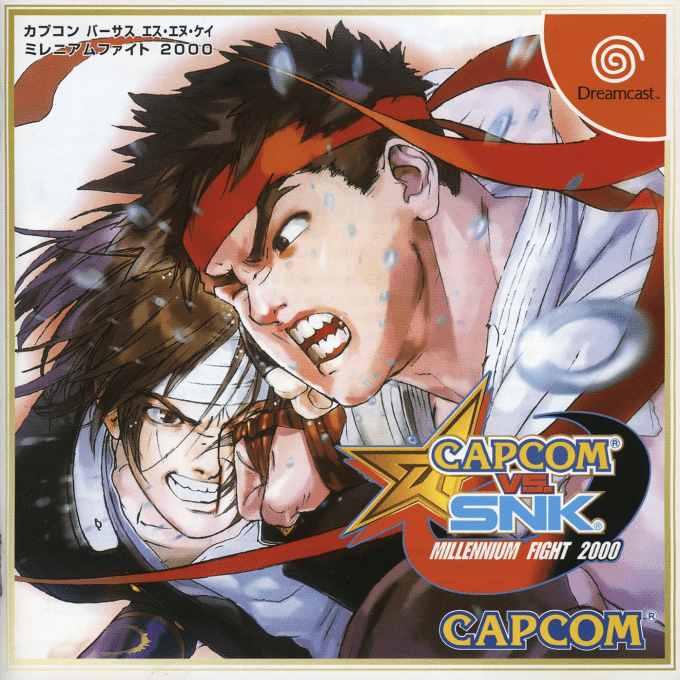
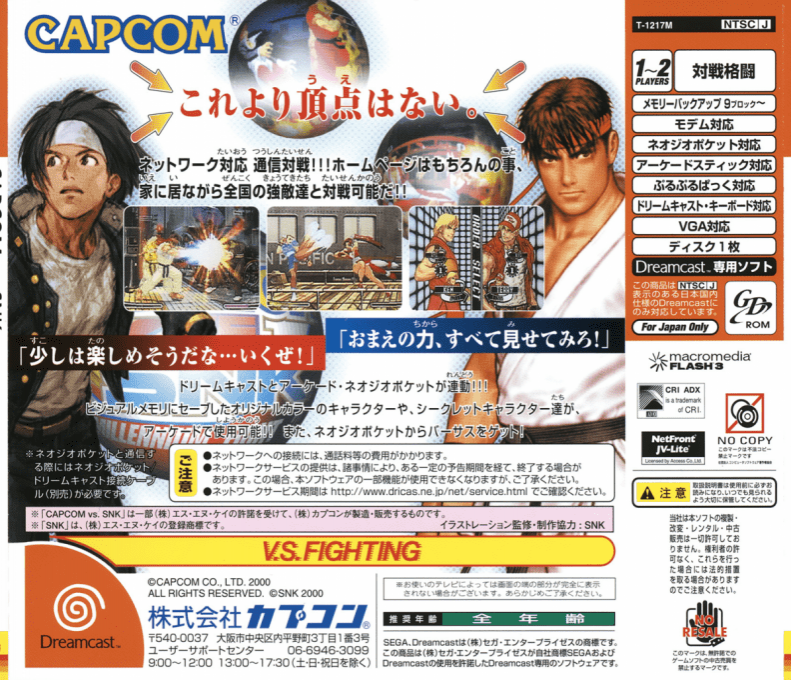
Capcom vs. SNK: Millennium Fight 2000 for Dreamcast is a 2D crossover fighting game developed and published by Capcom. First released in Japanese arcades on Sega NAOMI hardware and brought to Sega's console in 2000, it unites fighters associated with Capcom and SNK in a tournament staged at the turn of the millennium. The Dreamcast release arrived in Japan in September 2000, with North American and European editions following later that year; outside Japan it is commonly titled simply Capcom vs. SNK. This is the original Millennium Fight 2000, rather than the later expanded Capcom vs. SNK Pro revision.
The contest is framed around Millennium Fight 2000, an event arranged by the Garcia Financial Clique and the Masters Foundation in the hope that public competition can settle tension between the organizations. That setup brings together familiar faces from Street Fighter, The King of Fighters, Fatal Fury, Samurai Shodown, Darkstalkers, and other fighting-game series. Ryu, Chun-Li, Guile, M. Bison, Terry Bogard, Kyo Kusanagi, Mai Shiranui, Iori Yagami, Geese Howard, and Nakoruru are among the crossover's combatants, giving the game a deliberately broad meeting point for the two companies' characters and fighting traditions.
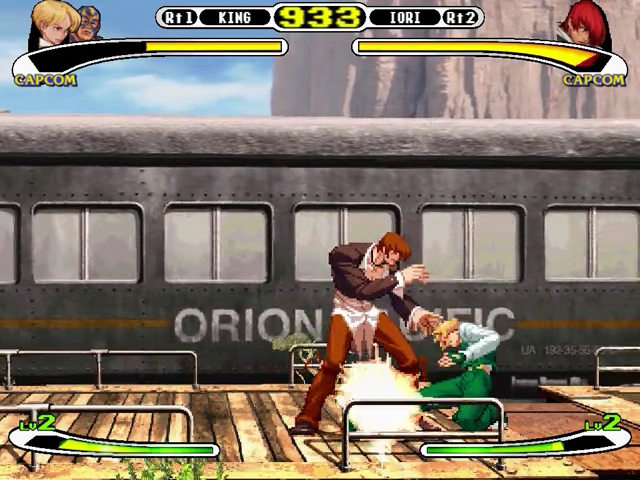
Matches use the original game's SNK-style four-button layout, with light and heavy punches alongside light and heavy kicks. The central team-building rule is the Ratio system. Every fighter is assigned a value from one to four, and a player may field one strong character or assemble a team of up to four so long as the total stays within a ratio of four. A higher-ratio selection carries more strength, while several lower-ratio fighters create a longer team lineup. This simple restriction makes roster choice part of each match before the opening round begins.
Before fighting, each player also chooses either Capcom Groove or SNK Groove. The choice changes the super meter and associated systems, drawing respectively on the Street Fighter Alpha approach and the Extra mode used in The King of Fighters '94 through '98. As a result, the same character can be played under a different resource system depending on the selected groove. The game asks players to manage regular attacks, special moves, guarding, jumps, and meter-building while adapting to the order and remaining strength of the opposing team.
The Dreamcast version carries the arcade game home while adding options suited to solo practice and local competition. Arcade battles pit a selected team against a sequence of CPU opponents, while versus play lets two players test different team and groove combinations. Training provides a place to work through moves and matchups. Progress also earns versus points that can be used to open extra material, including secret fighters, music, stages, modes, and options. The hidden roster includes characters such as Akuma, Evil Ryu, Morrigan, Orochi Iori, and Nakoruru.
Capcom vs. SNK: Millennium Fight 2000 belongs to the early phase of the wider SNK vs. Capcom crossover line, following SNK's Neo Geo Pocket Color title SNK vs. Capcom: Match of the Millennium while marking Capcom's first arcade entry in the partnership. Its NAOMI origins made it a natural fit for Dreamcast hardware, and the console edition became one of the system's notable head-to-head fighters. The presentation combines hand-drawn character sprites with arcade-style stages and uses the contrast between the companies' rosters as a core part of its identity.
The later Capcom vs. SNK Pro should not be confused with this Dreamcast game. Pro added Joe Higashi and Dan Hibiki, revised moves for existing fighters, and further play options; its Dreamcast release was limited to Japan. Capcom vs. SNK 2: Mark of the Millennium 2001 followed with a larger follow-up. Millennium Fight 2000 remains the foundational Capcom-produced crossover: a focused four-button fighter in which team ratios and the two groove systems shape how Capcom and SNK characters meet on Dreamcast.
Gallery
Details
- Developer
- Capcom
- Publisher
- Virgin
- Genre
- Fighting
- Players
- 1-2
- Release Date
- September 6, 2000
- System
- Dreamcast