About
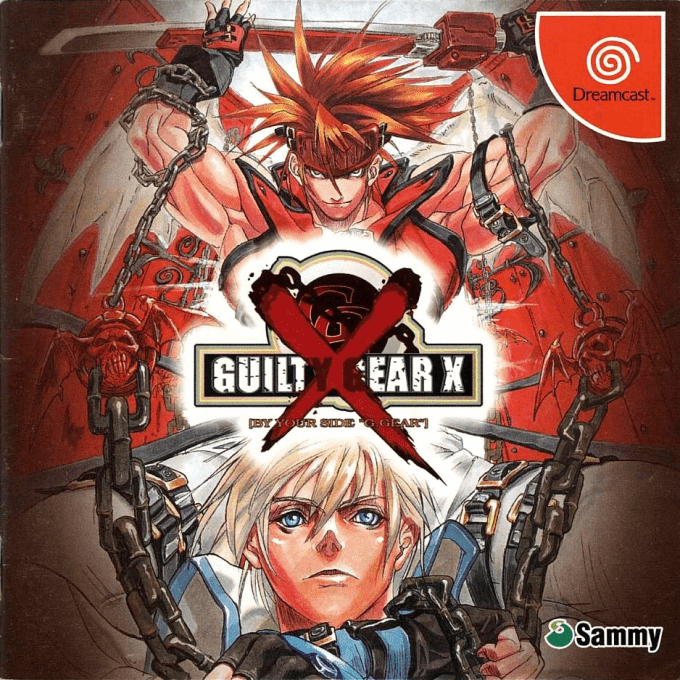
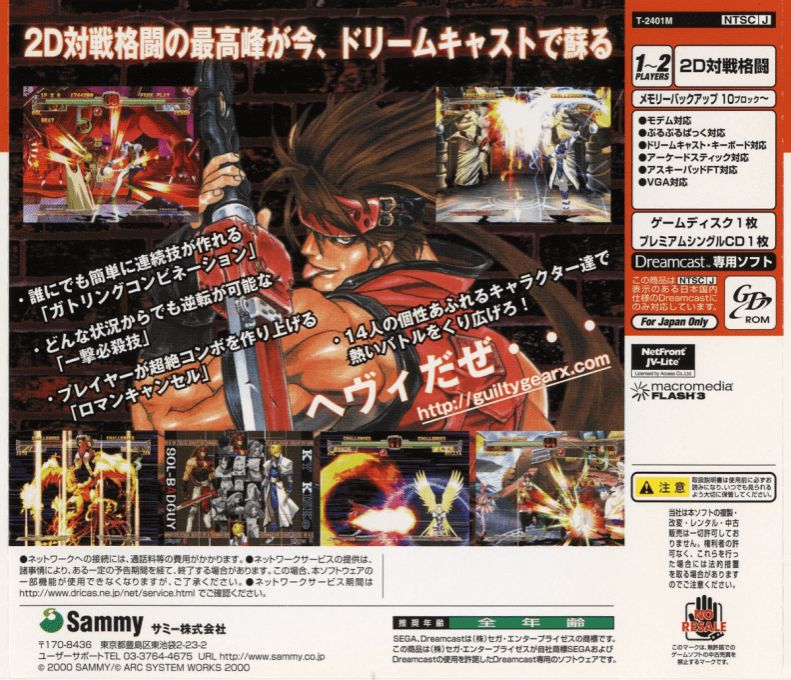
Guilty Gear X for Dreamcast brings Arc System Works’ fast, anime-styled 2D fighting series to Sega’s console in its Japanese release of December 2000. Published by Sammy Corporation, it follows the original Guilty Gear after an arcade debut earlier that year and builds on its one-on-one combat with a larger cast, richly animated character art and a heavy rock soundtrack. The Dreamcast edition is the home version of the arcade game rather than the later Japanese PlayStation 2 revision, Guilty Gear X Plus, so its feature set reflects this earlier release.
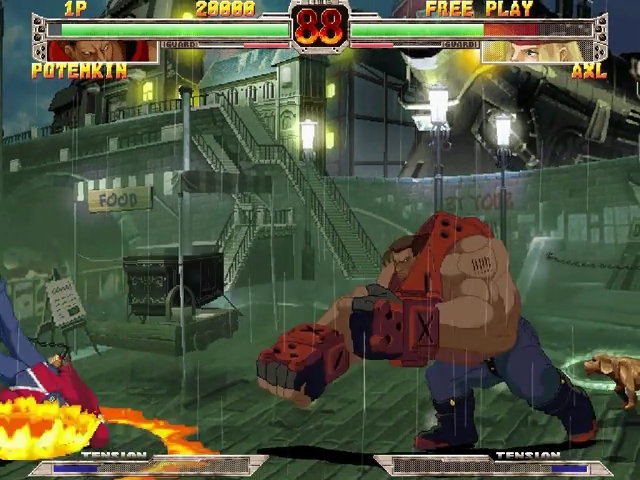
Matches use four principal attack buttons—Punch, Kick, Slash and Heavy Slash—with each fighter built around a very different set of normal attacks, special moves and movement options. The aim is familiar to fighting-game players: take rounds by emptying the opponent’s life bar before the timer expires. However, Guilty Gear X encourages active pressure through its Tension Gauge. Advancing and attacking build Tension, while overly passive retreating can reduce it, making momentum and meter management central to every round.
At sufficient Tension, players can spend meter on powerful Overdrive attacks, defensive options and Roman Cancels. A Roman Cancel can remove the recovery from a connecting or blocked move, opening routes into extended combinations or helping a fighter stay safe after committing to an attack. A full gauge also permits an Instant Kill attempt: an especially risky command that can end a round immediately if it connects, but leaves the player without Tension for the rest of that round if it fails. Those systems give straightforward exchanges an added tactical layer without changing the game’s direct four-button foundation.
The roster includes returning faces such as Sol Badguy, Ky Kiske, May, Baiken, Faust, Potemkin, Chipp Zanuff, Millia Rage, Zato-1, Axl Low and Testament, alongside newcomers including Jam Kuradoberi, Johnny, Anji Mito, Venom and Dizzy. Fourteen combatants are immediately selectable, while Testament and Dizzy are unlockable. Each character brings a distinctive visual identity and fighting style, from Sol’s aggressive sword-and-fire offense to Potemkin’s grappling power and Zato-1’s attacks coordinated with his shadow companion. This variety makes learning matchups as important as mastering a favorite character’s command list.
Set in the series’ futuristic world after the long conflict between humanity and the biological weapons known as Gears, Guilty Gear X centers on reports of a newly discovered commanding Gear. A bounty has drawn fighters to a new Holy Knights Tournament, while Dizzy becomes the target at the heart of the incident. The arcade mode supplies the main narrative path through individual encounters, connecting the fighters’ motives to that premise. It continues the story established by the 1998 PlayStation original while introducing people and conflicts that became important to later Guilty Gear games.
Beyond Arcade mode, the Dreamcast release offers Versus play for local two-player matches, Training for practicing commands with an in-game move list, and Survival, where a chosen fighter battles an ongoing sequence of opponents. Its arcade roots show in the brisk presentation and emphasis on replaying fights to improve execution, explore character-specific tools and challenge another player. Guilty Gear X is consequently an important early Dreamcast fighting game and a key step in the Guilty Gear series’ development: it established mechanics and a character lineup that helped define the franchise’s competitive identity.
Gallery
Details
- Developer
- Arc System Works
- Publisher
- Sammy Corporation
- Genre
- Fighting
- Players
- 1-2
- Release Date
- December 14, 2000
- System
- Dreamcast