About
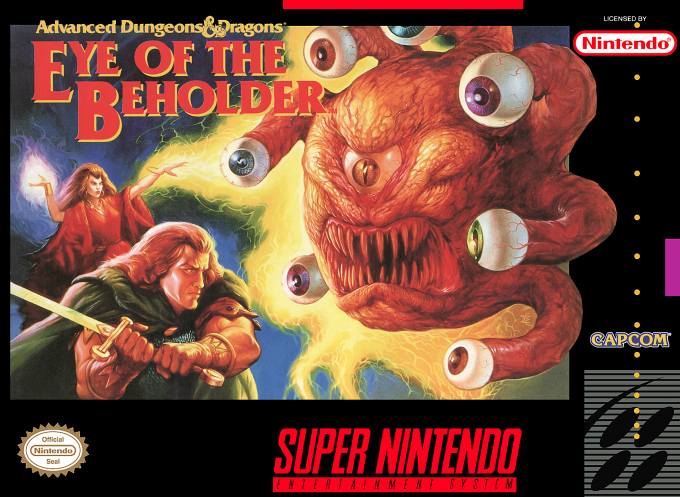
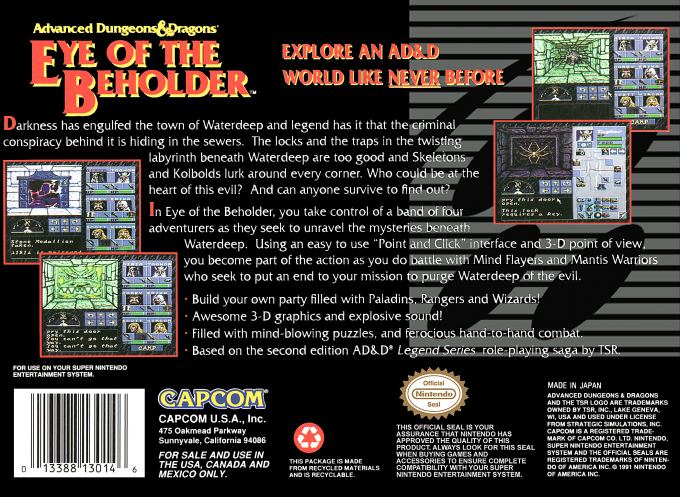
Eye of the Beholder for Super NES brings the Advanced Dungeons & Dragons dungeon-crawling adventure to Nintendo's 16-bit console. Published by Capcom in 1994, this single-player first-person role-playing game adapts the original Forgotten Realms quest set beneath Waterdeep. The Lords of the city send a party below ground to investigate a spreading threat, only for a collapse to seal the way back. With escape dependent on continuing downward, the expedition must trace a route through a dangerous underground maze toward the force responsible.
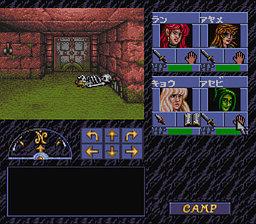
The view looks forward from the party's position as the group moves one square at a time through corridors, chambers, doors, and secret-filled walls. Progress depends on more than winning fights: players inspect their surroundings, operate wall switches and levers, use keys, manage equipment, and work through traps and environmental puzzles. The dungeon is a place to map mentally as well as explore, since passages can loop back, routes can be blocked, and a useful item may be needed well beyond the room where it was found.
Players assemble and manage an adventuring party drawn from the character types available in the AD&D rules, arranging members in front and back ranks. Position matters during encounters. Front-line characters can strike with close-range weapons, while those behind them need ranged options such as bows, darts, or thrown weapons to contribute directly. Attacks occur in real time, so the player must select weapons or actions while enemies advance. Equipment is handled through the on-screen interface, allowing weapons, ammunition, food, keys, scrolls, and other discoveries to be moved between characters or used in the dungeon.
Magic follows the game's tabletop-inspired spell structure rather than a single universal mana meter. Clerics and magic-users prepare their available spells while resting in camp, assigning their spell uses by level before returning to exploration. Rest can restore hit points and refresh prepared magic, but hungry characters need food before they can benefit fully. Scrolls offer another tactical resource: they can be used directly, and a magic-user can copy an unfamiliar spell into a spellbook when the appropriate conditions are met. Paladins and clerics also bring specialized abilities, including healing and efforts to turn visible undead.
The Super NES version translates the series' cursor-driven dungeon interface to a controller. Players can examine dungeon features, manipulate doors and locks, throw an item or place it down, shift party order, and switch between characters while arranging inventories. A thief can attempt to open locked doors with tools and may try to deal with traps, while opening mechanisms and keys create a steady rhythm of observation and experimentation. Battery-backed saving supports a longer expedition through the game’s connected levels.
Although the original Eye of the Beholder began as a 1991 computer game developed by Westwood Associates and published by Strategic Simulations, Inc., this 1994 Capcom release is its own Super NES presentation of the same Waterdeep adventure. It belongs to the Eye of the Beholder series and sits within the wider Forgotten Realms setting of Advanced Dungeons & Dragons. For players looking for a console dungeon RPG built around party formation, resource management, real-time combat, and methodical exploration, Eye of the Beholder offers a distinctively first-person take on the genre.
Gallery
Details
- Developer
- Capcom
- Publisher
- Capcom
- Genre
- Action RPG
- Players
- 1
- Release Date
- April 2, 1994
- System
- SNES







/Shin_Nekketsu_Kouha_Kunio-tachi_no_Banka.png)