About
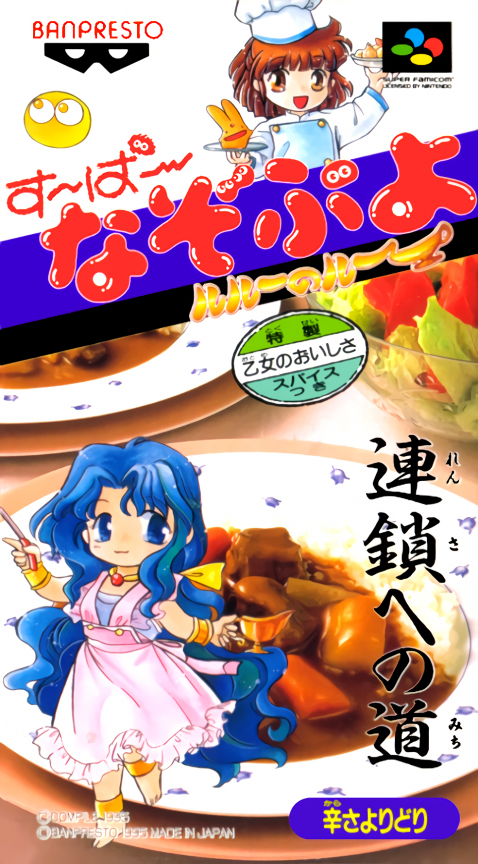
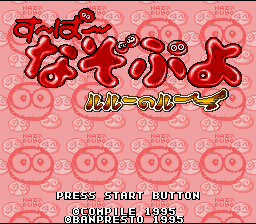
Super Nazo Puyo: Rulue no Roux is a Japanese Super Famicom puzzle game released by Banpresto on May 26, 1995 and developed by Compile. The game belongs to Compile’s Puyo Puyo family, whose characters originated in the Madou Monogatari role-playing games, but it takes a different route from the usual head-to-head falling-piece contest. Its Japanese title, す~ぱ~なぞぷよ ルルーのルー, identifies it as a Nazo Puyo entry: a collection of puzzle challenges built around specific conditions rather than simply outlasting an opponent.
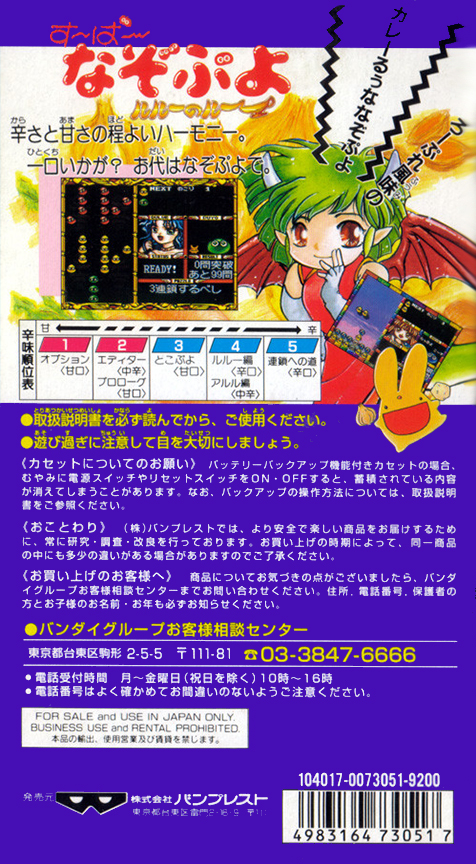
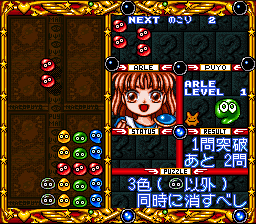
The basic language of Puyo Puyo remains central. Colored Puyo fall into a playfield, can be moved and rotated before settling, and disappear when groups of four or more matching Puyo connect horizontally or vertically. Clearing one group can cause the Puyo above it to drop, setting up another clear and producing the chain reactions that give the series much of its strategy. Super Nazo Puyo: Rulue no Roux asks players to use those familiar rules with careful planning instead of relying on speed or direct competitive pressure.
Each puzzle begins from a prepared arrangement and supplies a prescribed sequence or limited selection of Puyo. The objective may call for a particular color to be cleared, a required number of Puyo to vanish together, or a specified chain to be created. Because every challenge is a fixed situation with a stated goal, success depends on reading the board, anticipating gravity, and deciding where each incoming piece belongs. A placement that looks productive immediately can ruin the arrangement needed for the final chain, so the game rewards deliberate trial, observation, and an understanding of how one pop changes the rest of the field.
The Super Famicom game frames many of those tests with an adventure-style presentation. Arle Nadja and Rulue, recognizable members of the Madou Monogatari and Puyo Puyo cast, are selectable protagonists for the story-oriented mode. They travel through towns and dungeon-like locations, meet characters who present Nazo Puyo challenges, and advance by solving them. This structure gives a sequence of single-player logic puzzles a sense of movement through the series’ fantasy world while keeping the board-clearing rules at the center of play.
Outside the quest format, Super Nazo Puyo: Rulue no Roux also offers ways to concentrate on its puzzle mechanics. Its puzzle material emphasizes the series’ chain-building vocabulary, while a practice-oriented route lets players work through that logic step by step. An editor is included for creating original Nazo Puyo problems, extending the game beyond the built-in scenarios and inviting players to devise their own starting boards, piece setups, and objectives. That emphasis on authored problems distinguishes it from the standard versus-focused Puyo Puyo formula.
The game followed Nazo Puyo: Arle no Roux on Game Gear and preceded Super Nazo Puyo 2: Rulue no Tetsuwan Hanjouki on Super Famicom. It was released in Japan for Nintendo’s Super Famicom hardware rather than as a North American or European SNES title, which is why its romanized name appears in several forms, including Rulue no Roux, Ruruu no Ruu, and Lulu no Luu. Regardless of the spelling, it is a mid-1990s Compile puzzle spin-off that turns chain reactions into structured riddles and combines them with a character-driven single-player journey.
For players interested in the broader Puyo Puyo series, Super Nazo Puyo: Rulue no Roux captures a different side of its design. Competitive games in the series often turn chains into attacks against another board, whereas this entry makes the chain itself the answer to a question. The result is a Super Famicom puzzle game focused on preset positions, limited resources, and the satisfaction of discovering the one sequence that fulfills a challenge’s conditions.
Gallery
Details
- Developer
- Compile
- Publisher
- Banpresto
- Genre
- Tile-Matching Puzzle, Other RPG
- Players
- 1
- Release Date
- May 26, 1995
- System
- SNES