About
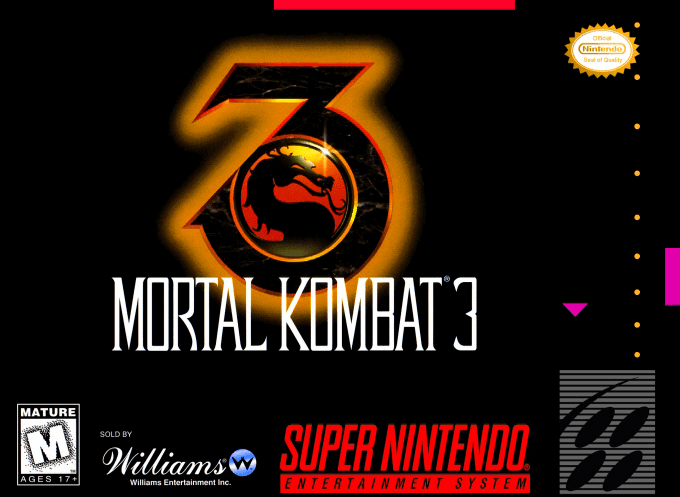
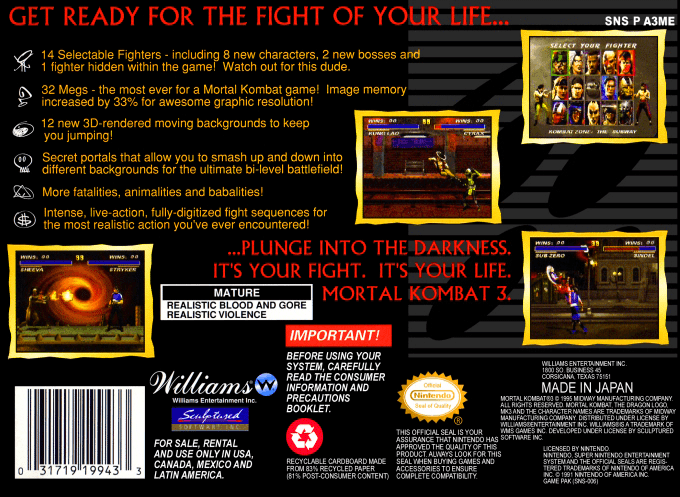
Mortal Kombat 3 began in arcades in 1995 as Midway's third main Mortal Kombat, then arrived on Super NES on October 13, 1995. Sculptured Software developed the SNES conversion; Williams Entertainment published it in North America, while Acclaim Entertainment handled the European release. The story moves the conflict to an invaded Earthrealm: Shao Kahn resurrects Queen Sindel on Earth, uses that link to merge realms, and sends extermination squads after the survivors protected by Raiden.
The regular roster has fourteen fighters. Returning combatants Liu Kang, Kung Lao, Sonya Blade, Jax, Kano, Sub-Zero and Shang Tsung stand beside newcomers Cyrax, Sektor, Kabal, Nightwolf, Sindel, Sheeva and Stryker. The cyborg Smoke is a hidden playable combatant, while the centaur Motaro and Shao Kahn serve as the single-player ladder's sub-boss and final opponent. This original version is also notable for leaving out several earlier favorites, including Scorpion, a decision later addressed by Ultimate Mortal Kombat 3.
Matches use the series' high and low punches and kicks, blocking, throws, sweeps, uppercuts and character-specific special moves, but Mortal Kombat 3 changes the pace substantially. A dedicated Run button spends a meter to close distance quickly, discouraging the defensive play that could dominate the earlier games. Its other major addition is the dial-a-combo: entering a prescribed sequence produces a chain of hits, often ending in a launcher or knockdown and creating opportunities for a follow-up juggle.
Solo play sends a chosen fighter through an opponent ladder and its Choose Your Destiny screen lets players select a difficulty route. Local two-player battles provide the direct competitive mode, with pre-match Kombat Kodes able to alter selected match conditions or reveal secrets. The game retains the series' elaborate post-round rewards: Fatalities, Babalities and Friendships return, while Animalities are new transformations that require a Mercy—briefly restoring a defeated rival's health—before the final victory. The Subway, Bell Tower and Pit 3 also support stage-specific finishers.
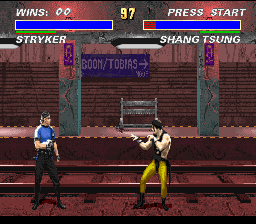
Its arenas emphasize a contemporary, invaded-city look rather than the earlier games' predominantly mystical tournament settings. Fights take place around locations such as streets, rooftops, a bank, a subway and Shao Kahn's stronghold. Some arenas are vertically linked, so an uppercut or Kung Lao's Whirl Wind Spin can send both fighters through a ceiling into the next backdrop, changing the normal stage progression during a match.
The Super NES edition preserves the full 16-bit fighter roster, blood, core special moves, run system, dial-a-combos, finishers and two-player play, making it a comparatively complete home version for its era. It nevertheless compresses the arcade presentation: animation and sound are reduced, the game can slow down under pressure, and the Graveyard arena is absent. Contemporary coverage nevertheless regarded it as the strongest 16-bit conversion, praising its graphics, options and demanding opponent AI while noting its audio and performance compromises.
Gallery
Details
- Developer
- Sculptured Software
- Publisher
- Acclaim Entertainment
- Genre
- Fighting
- Players
- 1-2
- Release Date
- October 1, 1995
- System
- SNES
/Panic_in_Nakayoshi_World.png)
/Shin_Nekketsu_Kouha_Kunio-tachi_no_Banka.png)