About
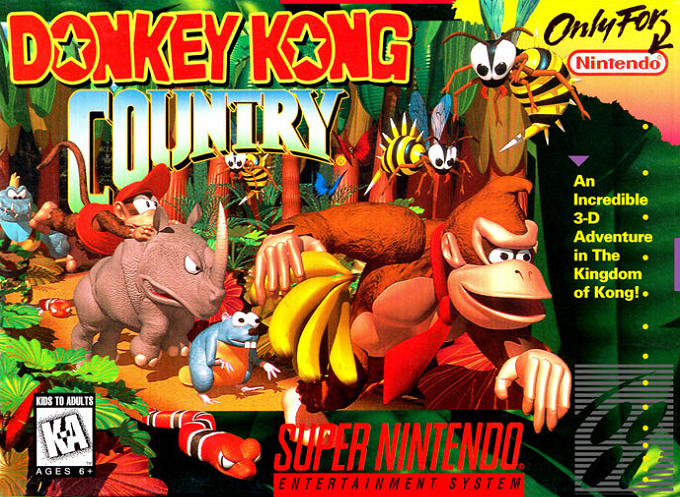
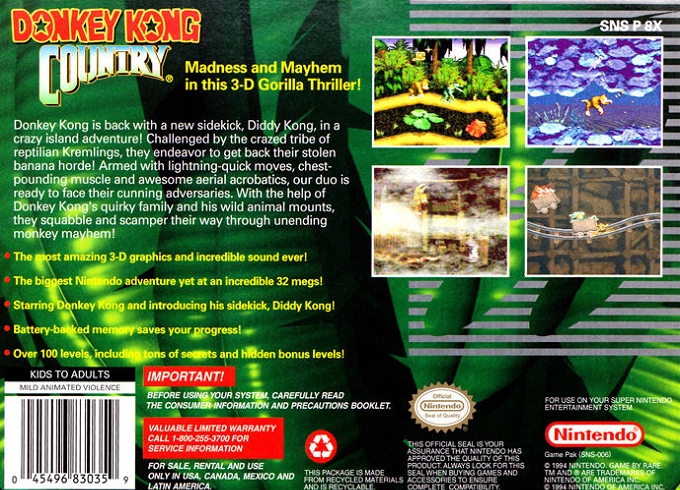
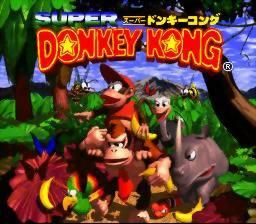
Donkey Kong Country is Rare's side-scrolling platform adventure for the Super Nintendo Entertainment System, published by Nintendo in 1994. It arrived in North America in November 1994, followed by the Japanese release as Super Donkey Kong on November 26; European territories received it later that same month. Built late in the 16-bit generation, the game revived Donkey Kong as a starring hero and became the opening chapter of Rare's SNES Country trilogy.
King K. Rool and his Kremling army have raided Donkey Kong Island and stolen the Kongs' banana hoard. Donkey Kong and the nimble Diddy Kong set out across the island to retrieve it, visiting their relatives between stages and confronting the Kremlings' leaders at each area's end. Cranky Kong supplies sarcastic advice, Candy Kong provides save services, and Funky Kong's transport lets players revisit reached worlds.
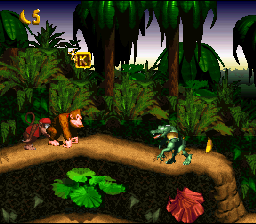
The two heroes share the same course but play differently. Donkey Kong is the stronger character: his hand slap can uncover items or deal with threats that resist ordinary attacks. Diddy is quicker and more agile, making him especially useful through rapid platforming sequences. Players switch between the active Kong, and taking a hit sends the current character away; the remaining partner continues until the other is recovered from a DK barrel.
Running, jumping, rolling, and carrying barrels form the core of the action. A well-timed roll dispatches many enemies and keeps momentum through a stage, while ordinary barrels can be thrown, carried, or used to break open otherwise hidden routes. The game turns the series' famous barrel imagery into practical stage design as well: barrel cannons launch the Kongs across gaps, and specialized barrels provide checkpoints, extra lives, or access to a partner.
Its 40 levels move through jungle ruins, caves, coral reefs, snowy mountains, mines, and industrial areas, with each setting introducing a different rhythm. Mine-cart rides demand quick reactions, rope sections reward steady timing, underwater courses change movement and attack options, and factory hazards force careful navigation. Animal friends broaden those possibilities: Rambi can charge through enemies and walls, Expresso glides over dangers, Winky reaches high platforms, Enguarde swims and attacks underwater, and Squawks lights dark passages.
Completing the path is only part of Donkey Kong Country. Bananas, balloons, K-O-N-G letters, and animal tokens add lives, while concealed entrances lead to bonus rooms with their own challenges. Searching for those rooms increases the completion percentage beyond a simple end-to-end finish, giving repeat runs a clear purpose. The world map records progress and makes it easy to return for missed secrets.
The SNES version also includes two multiplayer options. Contest has players alternate turns and compare their progress through the adventure, while Team mode splits Donkey Kong and Diddy between two players who trade control as one Kong is lost or found. Both modes build on the single-player tag system rather than changing the campaign into a separate set of levels.
Rare created the game's distinctive look by rendering 3D models on Silicon Graphics workstations and converting the resulting images into detailed SNES sprites through its Advanced Computer Modelling process. The pre-rendered characters, layered scenery, lighting effects, and animation gave a 16-bit cartridge an unusually elaborate visual presentation. Alongside David Wise's atmospheric score and the varied platforming, that technique made Donkey Kong Country a defining late-era SNES release.
Gallery
Details
- Developer
- Rareware
- Publisher
- Nintendo
- Genre
- Platformer
- Players
- 1-2
- Release Date
- November 25, 1994
- System
- SNES