About
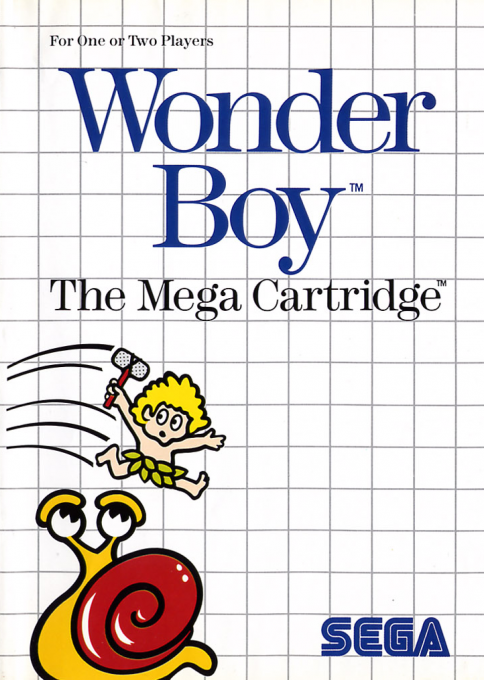
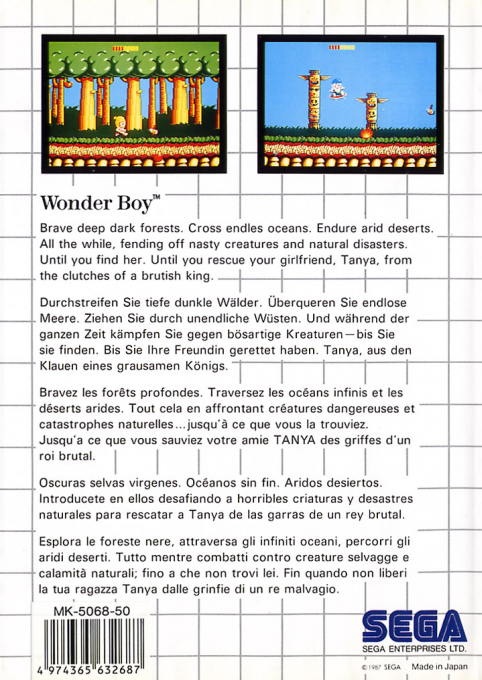
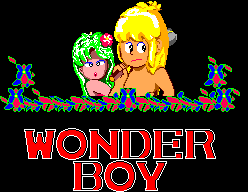
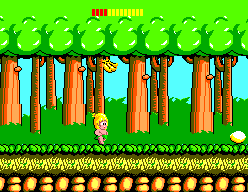
Wonder Boy Master System is Sega's 1987 home-console version of the run-and-jump action game created by Escape, later known as Westone. Released in Japan for the Sega Mark III as Super Wonder Boy and published overseas simply as Wonder Boy, it follows the island adventure of Boy, or Tom-Tom in some English materials. His girlfriend Tina has been taken by the King, sending him across an increasingly hazardous chain of outdoor courses. The Master System adaptation preserves the brisk, arcade-rooted style of the 1986 original while giving Sega's console release a larger journey of its own.
Each side-scrolling round is a race against a constantly declining vitality meter. Boy runs, jumps and attacks with a hatchet, and the player must keep moving while gathering fruit and other food to replenish vitality. The simple two-button controls make the essentials immediate, but the terrain and enemies demand careful timing: hazards and opponents approach from the ground and air, while gaps, slopes and changing elevations require well-judged jumps. Losing a life returns the player to the alternating two-player game when that mode is selected, making the adventure suitable for taking turns as well as solo play.
Eggs scattered through the stages are central to both survival and scoring. Breaking one can provide a throwable axe, a skateboard for fast travel, milk that restores vitality, or an angel that temporarily lets Boy defeat enemies by contact. The skateboard changes the feel of a round by increasing speed and preserving momentum, but a collision ends the ride. Not every egg is helpful: a speckled egg can release a Grim Reaper-like pursuer that accelerates vitality loss, and mushrooms carry a trade-off between a reduced meter and higher-scoring food. These shifting rewards make it worthwhile to recognize an egg's contents while maintaining the pace of the course.
The rescue route crosses settings such as grassy ground, sea passages, caves, deserts and volcanic territory. Rounds culminate in confrontations with the King, whose attacks must be avoided while Boy finds openings to throw his weapon. Sega's Master System version expands upon the arcade game's route, presenting ten areas and forty rounds when its full content is reached. Dolls hidden through the normal courses are more than collectibles: completing the collection opens the extra final area. Special warp sequences can also carry Boy into the clouds for a heart-collecting bonus challenge before returning him to the main route.
This release should not be confused with Sega's earlier SG-1000 interpretation, which was rebuilt around that machine's different hardware and omitted elements such as the skateboard, nor with Hudson Soft's Adventure Island, the separately named Nintendo adaptation of the arcade design. The Master System version's extra stages and its Japanese Super Wonder Boy title mark it as a specific branch of the first Wonder Boy adventure. It also established the foundation for Sega and Westone's long-running Wonder Boy and Monster World lineage, where later games moved in new directions while retaining the series' recognizable combination of colorful action, platforming and forward momentum.
Gallery
Details
- Developer
- Escape
- Publisher
- SEGA
- Genre
- Platformer
- Players
- 1-2
- Release Date
- January 1, 1987
- System
- Master System