About
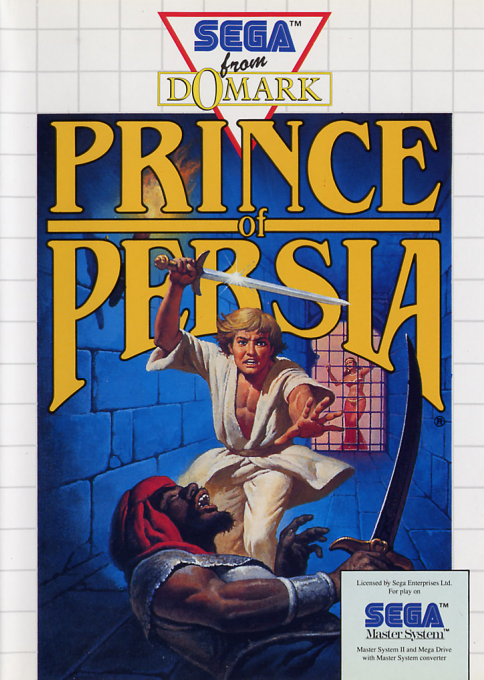
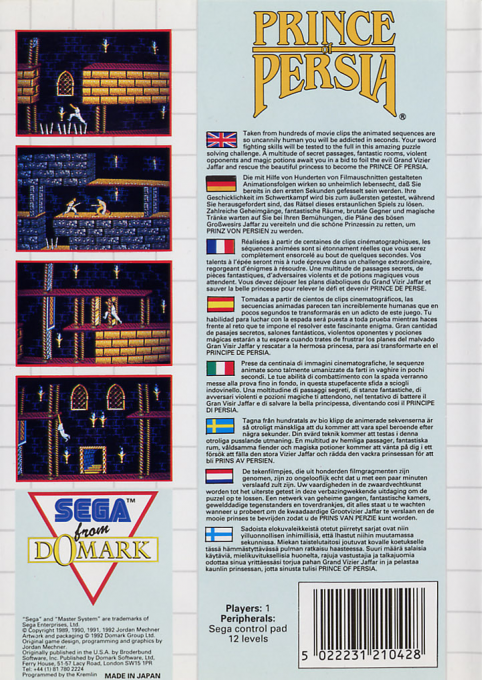
Prince of Persia on Sega Master System brings Jordan Mechner’s 1989 Apple II adventure to Sega’s 8-bit console. It is a single-player, screen-by-screen cinematic platform game set in medieval Persia, where the Sultan is away at war and the Grand Vizier Jaffar has seized the chance to take power. Jaffar has imprisoned the Sultan’s daughter and given her an ultimatum: accept marriage or die when the hour expires. The unnamed Prince begins below the palace in a dungeon, with one urgent task—reach the tower, overcome Jaffar, and rescue the Princess before the clock runs out.
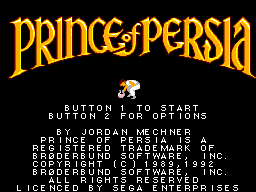
The Master System release arrived in 1992 as a Domark cartridge, published in this edition by Domark Software. Its credits identify James Tripp for code, Matthew Hicks and Saurav Sarkar for graphics, and Matt Furniss for music, alongside Jordan Mechner’s original creation. That makes it a console conversion of the Apple II game, not a newly designed sequel or the later reimagined Prince of Persia games. The basic quest, fixed-room progression, dangerous palace architecture, and countdown that define the original all remain central here.
Each chamber presents a small but demanding problem in movement and timing. The Prince runs, walks, crouches, makes standing and running jumps, catches ledges, and carefully lowers himself from drops. Momentum and position matter: a mistimed leap can send him into a pit, while an unhurried approach may be necessary to line up a safe landing. The deliberately animated movement gives these actions weight, so crossing even a familiar room can become a tense calculation between speed and control.
The palace is built to punish careless progress. Floor plates raise gates elsewhere in a room or corridor, forcing the player to activate them and move through before they close. Retracting spikes, chopping blades, crumbling floors, falling hazards, and deep drops turn routes into traps. Some obstacles are immediate threats, while others work as spatial puzzles, asking the player to understand which switch affects which door and when it is safe to proceed. Death returns the Prince to the beginning of the current level, but it does not restore the time already spent.
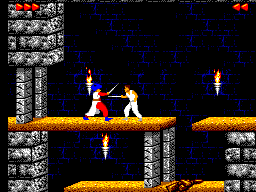
Swordplay changes the pace whenever a guard blocks the way. After obtaining a sword early in the escape, the Prince can advance, retreat, strike, and parry against opponents carrying their own blades. Fights reward distance, timing, and reading an enemy’s response rather than simply rushing forward. Guards are not the only strange presence in the fortress: the adventure also includes a skeletal swordsman and the Prince’s supernatural double, a figure tied to the game’s magic-mirror sequence and its larger story.
Health is represented by a row of red life indicators. Hits from swords and certain falls reduce it, while potions found in the palace can restore health, harm the Prince, or increase his maximum vitality. This makes exploration a balance between haste and survival. A useful potion may be beyond a risky jump, and a shortcut can still cost more time than a longer path if traps or guards force repeated attempts. The one-hour limit remains the governing pressure throughout the journey, turning each delay into part of the challenge.
Prince of Persia is often remembered for the remarkably lifelike animation that came from Mechner’s rotoscoped approach on the Apple II original. That history belongs to the original production: Mechner designed and implemented the 1989 Apple II game, using filmed movement as reference. The Master System version preserves the series’ distinctive sense of animated, physical platforming through its own conversion team’s work. Its 1992 release should not be confused with the Super NES version, which expanded the adventure with additional levels and a longer time allowance, or with the later Genesis version and its separate presentation changes.
For Master System players, the appeal is the concentrated structure of an escape story where movement, traps, sword duels, and route knowledge all feed the same deadline. The game asks for patience at first, then rewards confidence as rooms, hazards, and enemy patterns become familiar. It is a landmark-style platform adventure on Sega hardware: not about collecting endless upgrades, but about mastering a confined palace quickly enough to turn a prison break into a rescue.
Gallery
Details
- Developer
- Domark
- Publisher
- SEGA
- Genre
- Platformer
- Players
- 1
- Release Date
- October 1, 1992
- System
- Master System