About
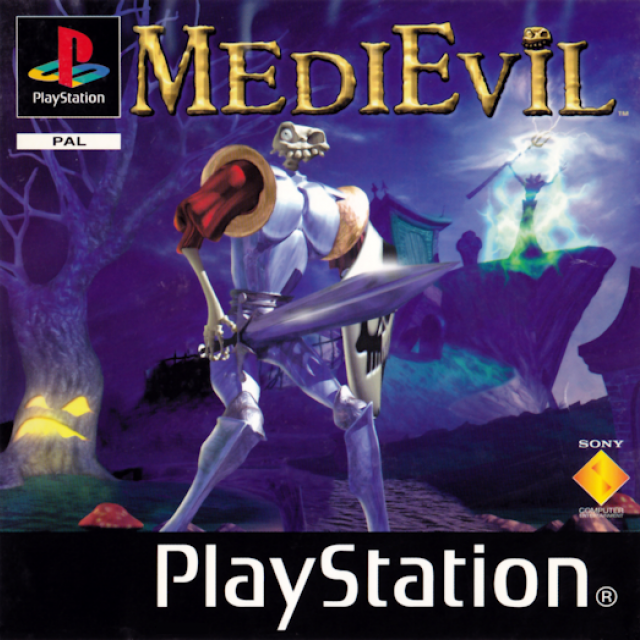
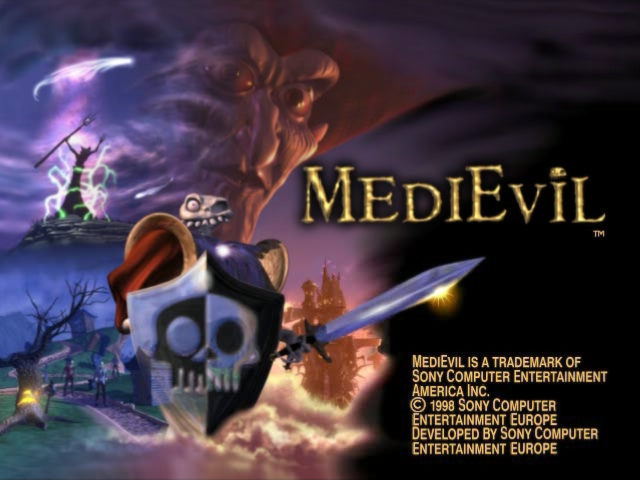
MediEvil for the original PlayStation is a single-player action-adventure released in 1998 by Sony Computer Entertainment. Developed by SCE Studio Cambridge, it casts players as Sir Daniel Fortesque, a skeletal knight unexpectedly returned to life in the fantasy kingdom of Gallowmere. A century after his supposed heroic victory over the sorcerer Zarok, Dan awakens to discover that the old legend concealed an embarrassing truth: he fell almost immediately in the battle. Zarok’s renewed assault gives the reluctant undead knight a chance to protect Gallowmere and earn the heroic reputation he never truly deserved.
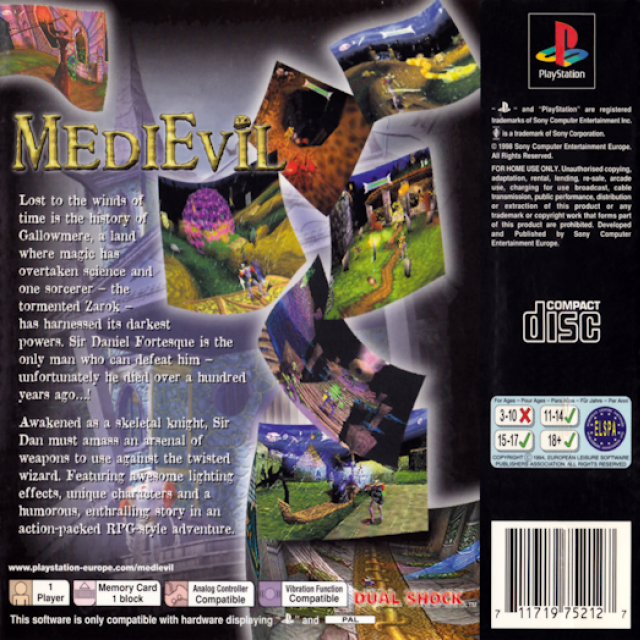
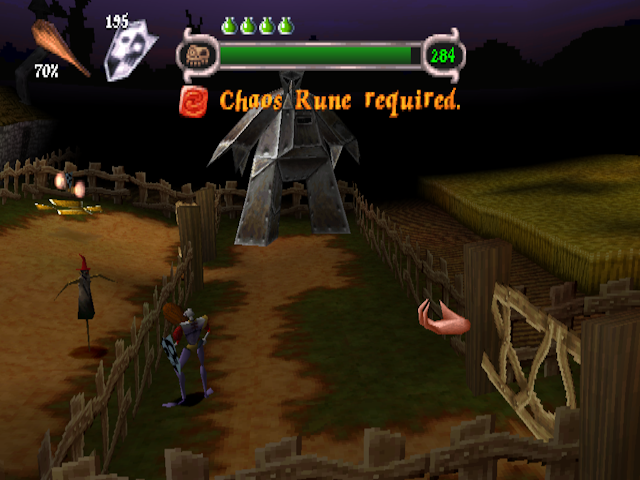
The PlayStation game unfolds across a sequence of self-contained 3D stages rather than one continuous world. Dan explores graveyards, villages, ruins, caves and other darkly comic locations while opening routes, locating keys and confronting Zarok’s forces. Progress often depends on reading the environment as well as fighting; paths may be blocked by gates, hazards, objects that need to be activated, or areas that become useful only after a new tool has been acquired. The result is an adventure built around returning to the road ahead with a better understanding of each level’s layout and purpose.
Combat gives Sir Dan an expanding selection of close- and long-range equipment. Swords, clubs and other melee tools sit alongside weapons such as crossbows, while shields absorb damage until their strength is exhausted. Several attacks can be charged, and particular weapons have practical uses outside of straightforward combat, helping the player reach or interact with parts of a stage. If stripped of equipment, Dan can even detach and use his own arm as an improvised attack. This mixture of weapon switching, defensive timing and environmental problem-solving gives MediEvil PS1 a distinct identity among late-1990s PlayStation action games.
Dan’s health is represented by a life bar, with Life Vials and Life Fountains offering recovery during the journey. Life Bottles can extend his reserves and automatically restore him after his health is depleted, provided one is filled. Treasure found during exploration also has a purpose: blue gargoyle merchants can exchange it for ammunition and services, while green gargoyles offer guidance. Those systems encourage players to inspect levels carefully, conserve finite resources and decide how best to prepare for later encounters.
A key collectible is the Chalice of Souls hidden in most stages. Defeating enough eligible enemies fills the Chalice, allowing Dan to claim it and visit the Hall of Heroes after clearing the level. There he meets the spirits of celebrated warriors and receives rewards, including additional weaponry. Chalices therefore tie completion goals directly to the game’s progression, and collecting the full set changes the conclusion of Dan’s quest. The premise is consistently playful: the hero’s missing jaw, awkward speech and attempt to live up to a fabricated legend bring comedy to a world filled with undead armies and gothic danger.
MediEvil debuted in Europe and North America during October 1998; Japan received it in 1999 as MediEvil: Yomigaetta Garomea no Yuusha. It began a series that continued with MediEvil 2 on PlayStation in 2000. Later revisits include the PSP reimagining MediEvil: Resurrection and a PlayStation 4 remake, but the 1998 PS1 original remains the introduction to Sir Daniel Fortesque’s misadventure: a stylized mix of action, exploration, collectibles and macabre fairy-tale humor centered on restoring peace to Gallowmere.
Gallery
Details
- Developer
- SCE Studio Cambridge
- Publisher
- Sony Computer Entertainment
- Genre
- Other Adventure
- Players
- 1
- Release Date
- October 9, 1998
- System
- PS1