About
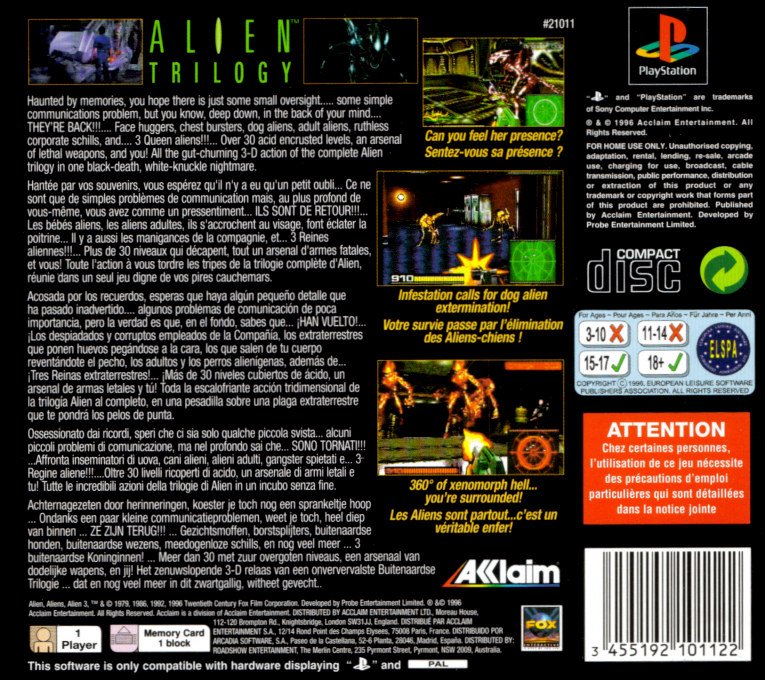
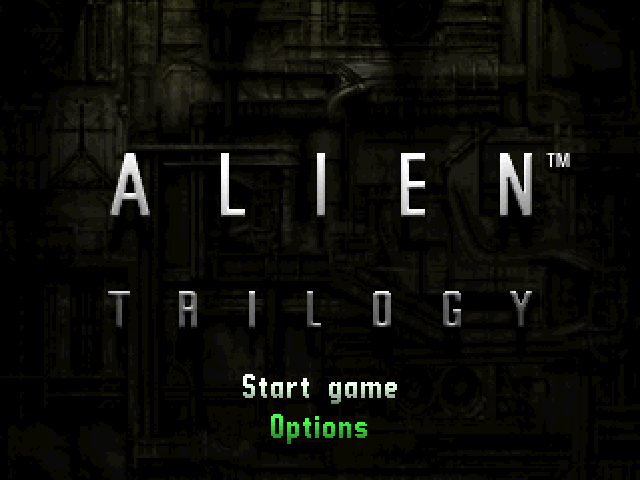
Alien Trilogy for PlayStation is a 1996 first-person shooter developed by Probe Entertainment and published by Acclaim Entertainment. Built from the settings, creatures, and imagery of the first three Alien films, it casts the player as Lieutenant Ellen Ripley in a new, action-led mission across locations associated with Alien, Aliens, and Alien 3. Rather than reenacting each film scene by scene, the game uses their worlds as the framework for a long single-player campaign of exploration, firefights, and survival.
The PlayStation version is divided into three connected chapters containing a total of 30 missions. Ripley first heads to the lost colony on LV-426, then fights through the prison complex from Alien 3, before reaching the derelict vessel tied to the original Alien. Text briefings introduce missions and set clear objectives, so advancing is about more than simply reaching an exit. A stage may require the player to eliminate a specified threat, find a vital item, operate switches, rescue someone, or locate the route onward while the facility fills with danger.
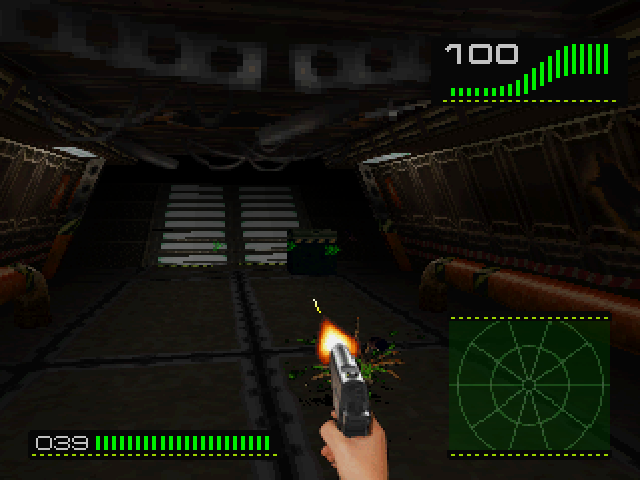
Viewed from Ripley's perspective, Alien Trilogy combines fast shooting with cautious navigation. Its PlayStation controls put a familiar set of weapons at hand: a pistol, shotgun, pulse rifle, flamethrower, smart gun, grenades, and seismic charges. Ammunition, health supplies, armor, and key items must be collected in the field, making the order in which rooms are searched important. Explosives can uncover hidden spaces and destroy hazards, while an automap helps the player keep track of the maze-like installations. The game continually asks players to balance their ammunition against enemies and unexplored territory.
The enemies draw on the Alien life cycle and on the three films that inspired the campaign. Facehuggers rush at ground level, chestbursters create sudden close-range threats, and full-grown xenomorphs can attack from corridors, ceilings, and darker corners of a level. Dog aliens reflect the Alien 3 material, and alien queens serve as major end-of-chapter confrontations. Ripley also encounters hostile Company personnel and infected humans. A motion tracker offers a warning when a moving target is nearby, but it cannot reveal everything a player needs to know, while lamps and night-vision equipment help when the environment turns nearly black.
This PlayStation release is a solo experience, designed around its campaign rather than the network deathmatch feature later associated with the DOS version. Probe used digitized and motion-capture-oriented techniques for its creature presentation, and the game leans heavily on sounds and visual cues associated with the films. The result is a shooter that uses film license details as playable tools: the pulse rifle, motion tracker, claustrophobic metal corridors, alarmed colonists, and the uncertainty of an enemy that may be above or behind the player all serve the mission design rather than appearing only as decoration.
Alien Trilogy arrived during the early years of the PlayStation, alongside Sega Saturn and PC editions, and became one of the better-known Alien games of its era. Its structure links three film worlds in a single original campaign, giving the PlayStation library a substantial licensed shooter with objectives, maps, equipment, and bosses spread across its lengthy run. For players exploring 1990s science-fiction action games, Alien Trilogy remains a snapshot of how a major film series was adapted to the first-person shooter format on Sony's first console.
Gallery

Details
- Developer
- Probe Entertainment
- Publisher
- Acclaim Entertainment
- Genre
- First-Person Shooter
- Players
- 1
- Release Date
- March 1, 1996
- System
- PS1