About
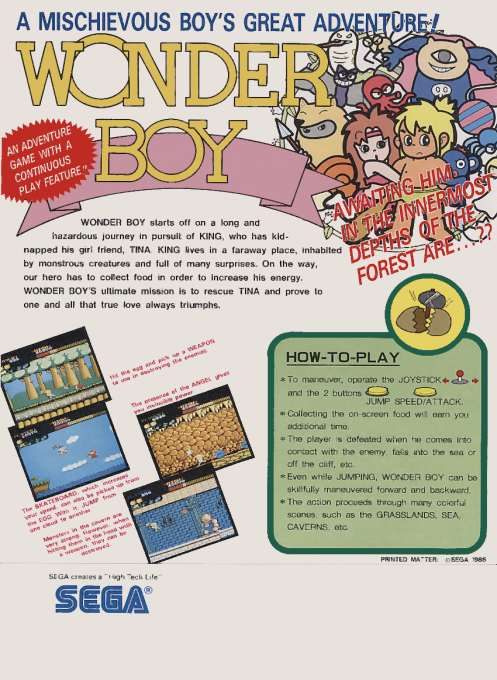
Wonder Boy arcade is a side-scrolling action platform game developed by Escape and released by Sega in 1986. This record represents a preserved arcade variation labelled “prototype?” in MAME, but its game design is the original Wonder Boy adventure: a boy sets out across a hostile island after the Evil King takes his girlfriend Tina. Built for Sega’s System 1 arcade hardware, the game helped establish the series’ bright, fast-moving style well before its later Monster World-era changes. Its appeal comes from a direct premise and a demanding route through compact obstacle courses where momentum, timing, and a constantly shrinking vitality supply all matter.
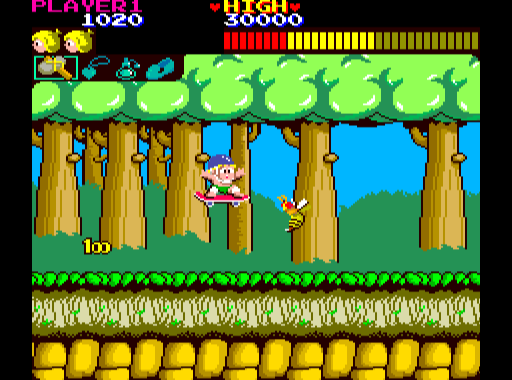
Each area is divided into four rounds, with forests, shorelines, caves, and other changing backdrops giving the journey a traveling, storybook quality. The player moves right through levels filled with enemies and hazards, leaping over gaps, uneven terrain, falling threats, and environmental traps while searching for safe lines forward. A horizontal joystick controls movement, while the action buttons cover jumping and the attacks that keep nearby enemies at bay. The arcade layout is easy to understand on sight, yet the fixed scrolling routes quickly ask for practiced responses rather than cautious wandering.
Wonder Boy’s central resource is vitality. The meter drains steadily during a round, so collecting the food placed along the route is as important as avoiding enemies. Fruit and other pickups keep the run alive, while score items reward careful play. Eggs placed in the stages can open into useful equipment or less welcome surprises. A stone hatchet gives the hero a ranged attack, allowing threats to be cleared before they crowd his path. Other eggs can provide a skateboard, which sends him racing ahead with less opportunity to stop, turning familiar stretches of a level into a different test of balance and anticipation.
The game layers those changing tools over a simple rescue quest. In addition to ordinary opponents, the player faces a boss at the end of an area, making each four-round sequence feel like a short expedition rather than a single uninterrupted course. Hidden dolls offer an extra challenge for players trying to master every route; collecting them is connected to reaching the later bonus content. The cabinet also supports alternating two-player play, so a second challenger can take over after a life is lost. That format keeps the focus on individual runs while making score chasing and route knowledge easy to share.
Sega’s own history describes Wonder Boy as a side-view jump action game in which the boy throws axes, rides a skateboard, and confronts enemies such as spiders, bees, and fish while negotiating obstacles. The original arcade release arrived in April 1986, and its distinct combination of a running timer, food collection, thrown weapons, and changing movement states gives it a rhythm unlike a purely precision-jump platformer. Standing still may feel safe for a moment, but the vitality countdown insists on progress. Riding the skateboard makes stopping impossible, so the player must read the terrain and enemy placement well ahead of time.
Wonder Boy became the starting point for a long-running Sega-associated series, although later entries explored substantially different action and role-playing ideas. Its underlying design also travelled in another direction through Hudson Soft’s Adventure Island adaptation, which created a separate character and franchise from the same basic arcade template. This 1986 arcade version remains the clearest place to see the formula in its original form: a colorful, relentlessly forward-moving rescue game where every piece of food, every egg, and every well-timed jump can decide whether the journey continues.
Gallery


Details
- Developer
- Escape
- Publisher
- SEGA
- Genre
- Run and Gun
- Players
- 1-2
- Release Date
- January 1, 1986
- System
- Arcade