About
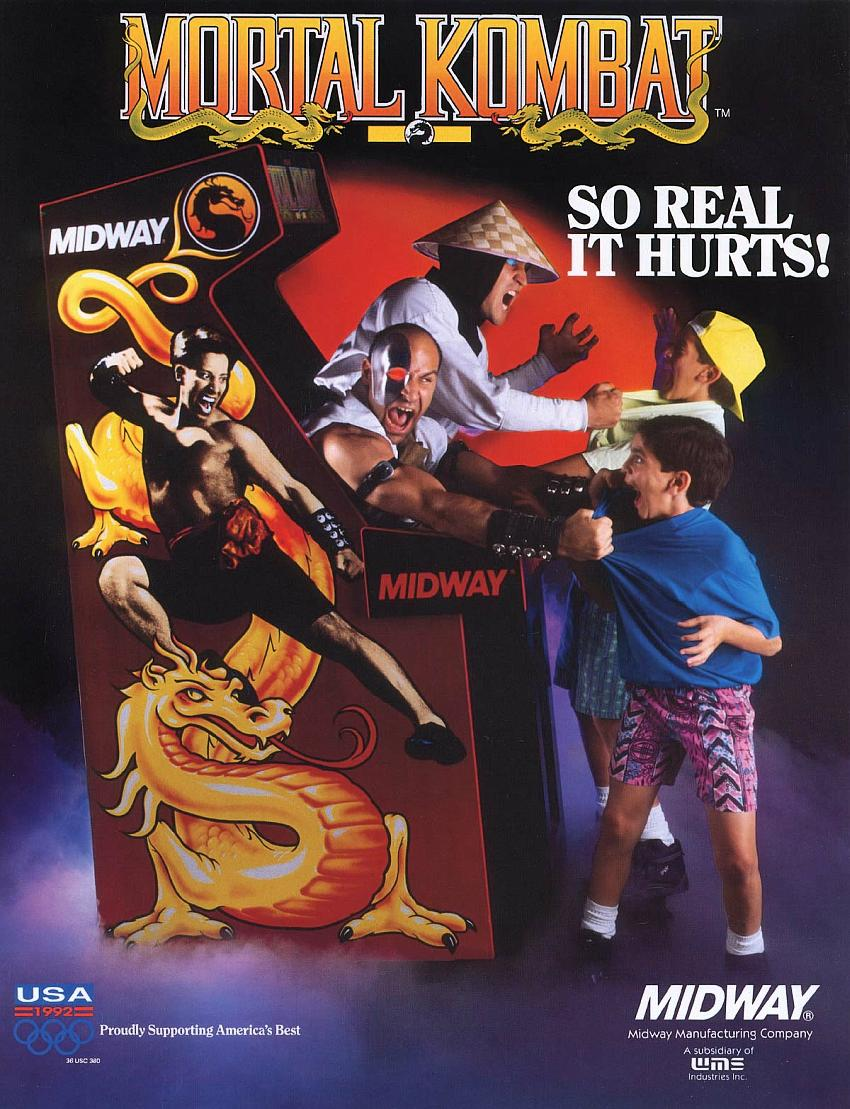
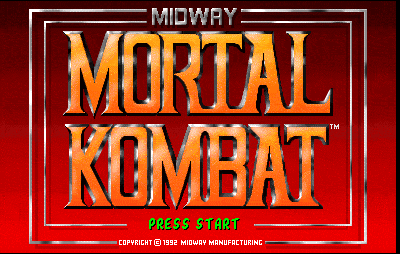
Mortal Kombat (rev 5.0 T-Unit 03/19/93) is the March 19, 1993 bug-fix revision of Midway's original 1992 arcade fighting game, not a separate sequel or home-console port. The T-Unit label identifies the hardware version of this arcade release. Its foundation is the tournament on Shang Tsung's island, where Earthrealm's fighters face a threat that reaches beyond the arena: Goro has carried Outworld to nine straight tournament victories, and a tenth would put Earthrealm in jeopardy.
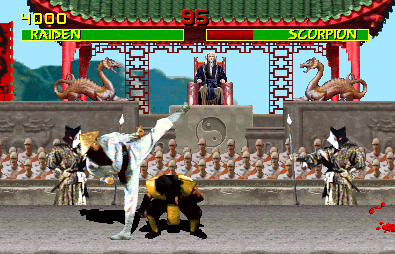
At the cabinet, two players square off with an eight-way joystick and five dedicated actions: high and low punches, high and low kicks, and block. A match is won by taking two rounds, with the timer and remaining health deciding an unfinished round. The layout is direct, but distance, timing, jumping attacks, sweeps, throws, and special-move inputs give every exchange its own rhythm. The separate block button is a defining part of the contest, letting a fighter defend without simply backing away.
The selectable roster consists of Johnny Cage, Kano, Raiden, Liu Kang, Scorpion, Sub-Zero, and Sonya Blade. Each competitor brings a distinct screen presence and special attacks to the tournament, from Scorpion's spear and Sub-Zero's freezing power to Liu Kang's fireball and flying kick. Digitized actors give the human fighters an unusually tangible look for a 1992 arcade game, while palette changes create the visual contrast between the yellow-clad Scorpion and blue-clad Sub-Zero. Goro and the shape-shifting Shang Tsung stand beyond the regular character select as the game's major computer-controlled challenges.
The climb through the single-player ladder is more demanding than a simple sequence of ordinary bouts. After facing the playable warriors and a mirror match, the player enters endurance fights: the next opponent arrives after the first falls, the timer resets, but the player's health does not. That structure makes resource management as important as winning a round cleanly. Defeating Goro opens the path to Shang Tsung, whose ability to assume other fighters' forms turns the finale into a test of recognition as well as execution.
Mortal Kombat's most famous punctuation mark comes after victory. When an opponent is defeated, the brief Finish Him or Her moment invites the winner to enter a character-specific finishing move before the opportunity disappears. These Fatalities helped give the arcade game its identity, but they are only one piece of a design built around striking animations, forceful sound, and a deliberately theatrical martial-arts atmosphere. Between fights, Test Your Might changes the pace by asking players to fill a power meter and smash progressively tougher materials for points.
The original arcade game also rewards curiosity. On the Pit stage, unusual conditions can lead to a battle with the hidden Reptile, a computer-controlled green ninja who combines moves associated with Scorpion and Sub-Zero. This revision belongs to the later arcade lineage in which Reptile was already part of Mortal Kombat, but the essential experience remains the original game's seven-player roster, island tournament, endurance ladder, Goro, and Shang Tsung. It should not be confused with Mortal Kombat II, the later 1993 arcade sequel that expanded the series with a different roster and new locations.
Mortal Kombat arrived in arcades as a product of Midway's digitized-video approach to fighting games. Its visual style, ominous announcer, and fantastical cast made a sharp contrast with hand-drawn rivals, while its combination of accessible attacks and memorized special inputs encouraged repeat play. Johnny Cage's movie-star swagger, Sonya's Special Forces mission, Kano's criminal ambition, Raiden's role as Earthrealm's thunder god, and the ninja rivalry between Scorpion and Sub-Zero give the tournament more personality than a purely abstract contest.
For players seeking the arcade original, this Revision 5.0 T-Unit set is a way to encounter the first Mortal Kombat in its coin-operated context. It preserves the early series' compact pace: pick a fighter, learn the spacing, survive the ladder, and see whether a hard-won finish can become something memorable. The later Genesis, Super NES, Game Boy, Game Gear, and other releases are adaptations of this arcade game, with their own technical and content differences; this entry is for Midway's original arcade Mortal Kombat revision.
Gallery

Details
- Developer
- Midway
- Publisher
- Midway
- Genre
- Fighting
- Players
- 1-2
- Release Date
- October 8, 1992
- System
- Arcade