About
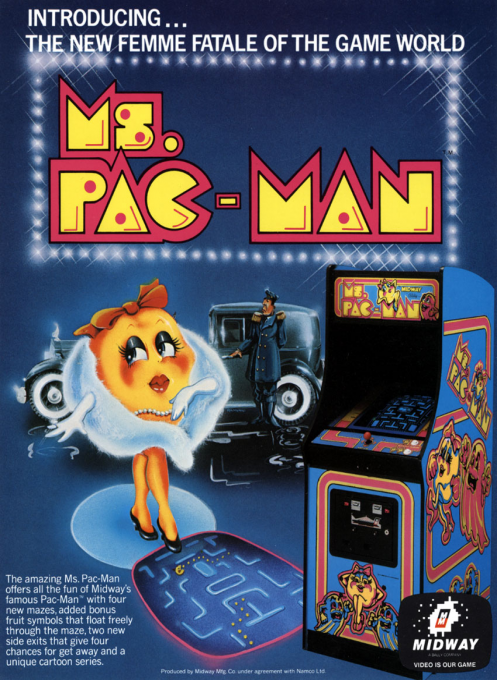
Ms. Pac-Man is a 1982 arcade maze game developed by General Computer Corporation and published in North America by Midway Manufacturing. It followed the enormous success of Namco's 1980 Pac-Man, but its path to the arcade was unusual: GCC had begun work on a Pac-Man enhancement kit called Crazy Otto before Midway acquired the project and shaped it into an official sequel. The result became one of the defining coin-operated games of its era and a lasting branch of the Pac-Man series.
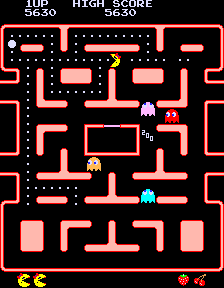
Using a four-way joystick, players guide Ms. Pac-Man through a maze filled with small dots. Clearing every dot completes the round, while contact with a dangerous ghost costs a life. The simple objective demands constant route planning: narrow corridors can become traps, intersections offer quick turns, and the side tunnels provide a vital way to escape a pursuit. Cabinet settings supported one or two players, with two-player games taking turns rather than playing on the maze together.
Four ghosts patrol the maze: Blinky, Pinky, Inky, and Sue. Their differing movement behavior and the game's less predictable chases make it harder to rely on one memorized route. Four power pellets, positioned near the maze's corners, temporarily turn the ghosts blue and vulnerable. Eating them in succession scores 200, 400, 800, and 1,600 points, rewarding players who can turn a close chase into a carefully timed counterattack before the effect ends.
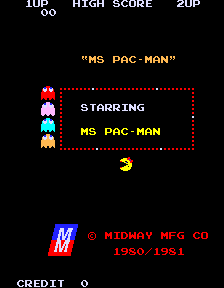
Ms. Pac-Man expands the original formula with four distinct maze layouts, changing colors and tunnel arrangements as play advances. The first two boards use the opening maze, then later rounds introduce the others before the game cycles between its advanced layouts. These changes alter the safest paths and escape options, so learning the board is as important as reacting to the ghosts. Short cartoon intermissions also tell a playful story of Ms. Pac-Man and Pac-Man meeting, courting, marrying, and welcoming Pac-Baby.
Bonus items bring another moving target to each round. Instead of appearing stationary in the center as in Pac-Man, fruit and other treats enter the maze and travel along set paths before leaving again. They appear twice per board and rise in value as the rounds progress, from early cherries and strawberries to items such as pretzels, apples, pears, and bananas. A player can ignore them to finish a maze safely, but collecting them adds both points and a risky decision to every chase.
The scoring system makes each route meaningful. Ordinary dots are worth 10 points and power pellets 50, while bonus items and ghost chains offer much larger rewards. A default game begins with three lives, and reaching 10,000 points awards an extra life under the standard settings. As the rounds advance, Ms. Pac-Man and the ghosts move faster, and the time that ghosts remain edible grows shorter, steadily turning a familiar maze into a tougher test of timing.
Although it preserves Pac-Man's instantly recognizable chase-and-clear structure, Ms. Pac-Man is more than a character swap. Its changing mazes, moving bonuses, additional ghost Sue, and variable pursuit patterns give each game a livelier rhythm than the fixed-board original. The game became a major arcade success in its own right, introduced a female lead to one of gaming's most visible franchises, and remains a classic example of how a well-judged sequel can deepen a simple competitive design.
Gallery

Details
- Developer
- Coleco Industries
- Publisher
- Coleco Industries
- Genre
- Maze
- Players
- 1-2
- Release Date
- January 1, 1981
- System
- Arcade