About
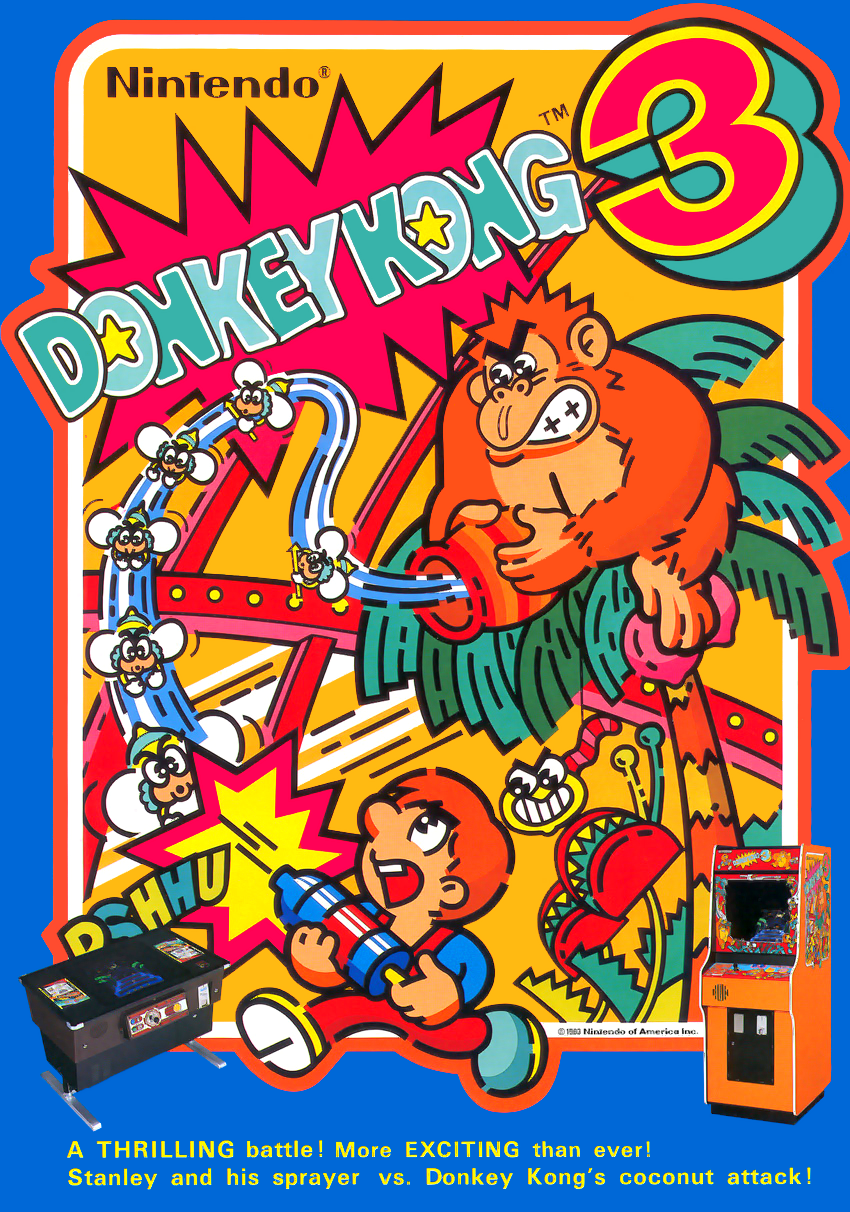
Donkey Kong 3 is Nintendo’s 1983 arcade game, released in the United States as the third early entry in the Donkey Kong series. Unlike the construction-site climbing of the original Donkey Kong or the chase between Mario and Donkey Kong Jr., this arcade installment takes place in a botanical garden. Players control Stanley, an exterminator protecting his greenhouse after Donkey Kong and a swarm of insects invade it. The result is a fixed-screen action game that combines platform movement with a vertical shooting contest.
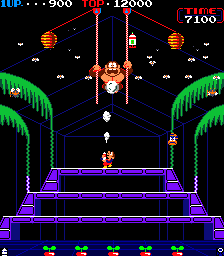
Each round places Stanley on tiers of platforms beneath Donkey Kong, who clings to vines above the garden. Stanley runs along the platforms, climbs where the layout permits, and jumps gaps while aiming his sprayer upward. Spraying Donkey Kong repeatedly forces him higher through the vines; driving him to the top completes a round. The same sprayer is also Stanley’s defense against the insects that fill the screen, so success depends on balancing pressure on Donkey Kong with immediate threats near the flowers.
The flowers at the bottom of the screen give the action a second objective. Flying pests can carry them away, reducing the bonus available at the end of a stage. Other insect types create different hazards, including enemies that split into moving pieces when hit. Players can clear a screen either by pushing Donkey Kong away or by eliminating the insects, which makes route choice and target priority part of every attempt. A limited-duration Super Sprayer can appear during a life and moves Donkey Kong more quickly when used effectively.
Donkey Kong 3 arcade gameplay cycles through three screen designs rather than presenting a long sequence of separate worlds. As the game advances, enemy activity and the demand for careful movement make the compact layouts increasingly demanding. The cabinet’s controls keep the premise direct: move Stanley around the platforms and use the sprayer to defend the greenhouse. Extra lives and score bonuses reward extended play, while the repeated layouts invite players to refine timing, learn enemy behavior, and preserve as many flowers as possible.
The game’s change of focus is central to its identity. Donkey Kong remains the prominent opponent, but Stanley replaces Mario as the playable character and the game abandons the series’ earlier rescue-and-climb structure for an insect-filled garden battle. Stanley had appeared previously in Nintendo’s Green House Game & Watch, and Donkey Kong 3 develops the character and greenhouse idea into a full arcade setting. It is therefore both a continuation of the Donkey Kong name and a notably different kind of Nintendo arcade game.
Nintendo later brought Donkey Kong 3 to the Family Computer in Japan and to the Nintendo Entertainment System in North America, with the home version adapting the arcade premise for console play. The original arcade game was also preserved in Hamster’s Arcade Archives series, allowing the 1983 release to be experienced with options associated with modern reissues. For players exploring early Nintendo arcade history, Donkey Kong 3 stands out for its unusual protagonist, botanical-garden setting, and mix of platform navigation, pest control, and score-focused action.
Gallery

Details
- Developer
- Nintendo
- Publisher
- Nintendo
- Genre
- Platformer
- Players
- 1-2
- Release Date
- January 1, 1983
- System
- Arcade