About
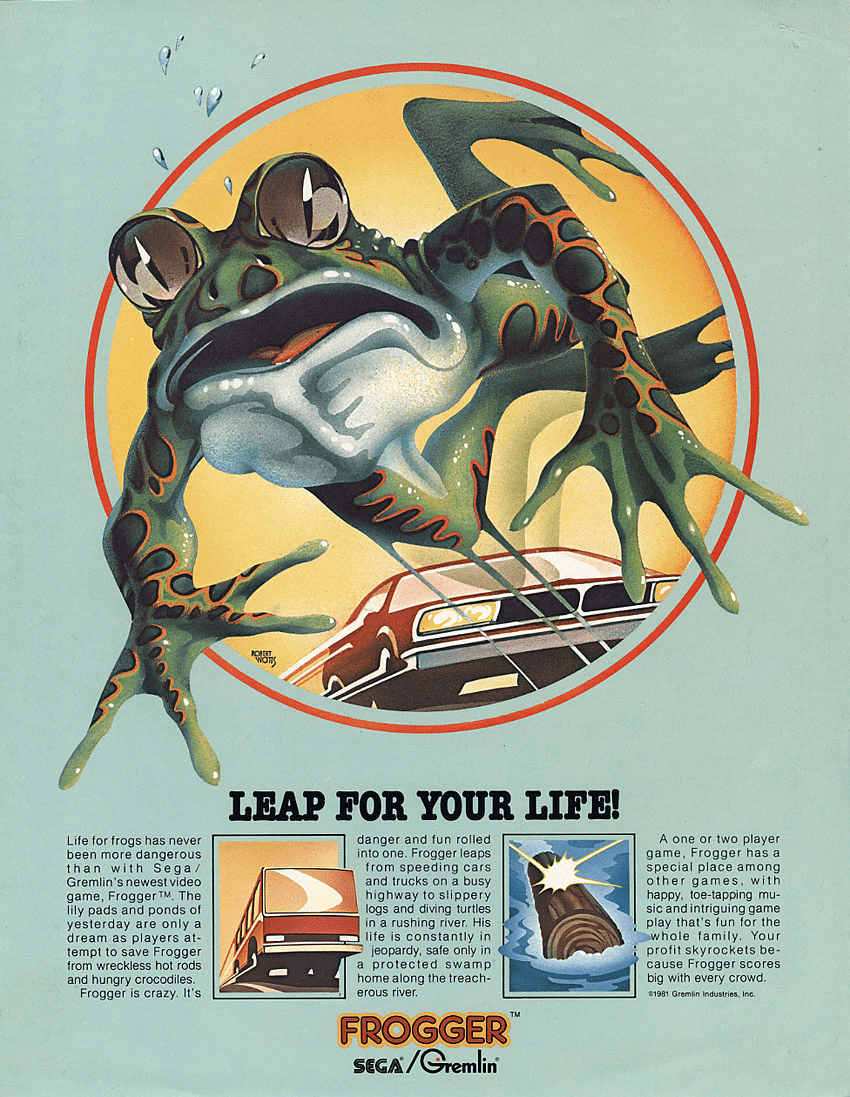
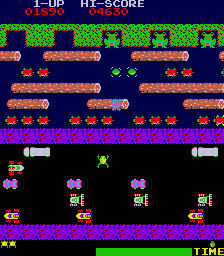
Frogger is the 1981 arcade classic developed by Konami, released by Sega in Japan and Europe and by Sega/Gremlin in the United States. Its premise is instantly legible and remains brilliantly tense: guide a lone frog from the pavement at the bottom of the screen to one of five home bays at the top. There is no attack button and no enemy to defeat. A four-way joystick makes the frog hop one space at a time, turning every move into a small commitment as a busy roadway and a dangerous river stand between the start and safety.
The first crossing is a compact traffic puzzle. Cars, trucks and other vehicles stream through five lanes in opposing directions and at different speeds, so a safe opening can vanish between hops. The frog can move up, down, left or right, but progress depends on reading the rhythm of the road, pausing where there is room, then advancing without drifting into a vehicle. Reaching the median is only halfway home: it is a short reprieve before the game replaces asphalt with moving water.
The river is Frogger’s defining challenge. The frog cannot swim, so it must ride logs, turtle groups and alligator backs while they carry it sideways across the current. A platform that seems useful can become a trap if it carries the frog off-screen, and diving turtles demand quick decisions before they disappear beneath the surface. Alligators are not uniformly safe either: their backs and tails offer passage, while their open jaws do not. In later play, snakes and otters add further hazards to the riverbank and floating routes.
The five home bays turn a successful crossing into a sequence of increasingly exact landings. Only an open bay is safe; an occupied bay, an alligator in a bay or a jump into the bordering greenery costs a frog. Flies that appear in a home bay and the lady frog that sometimes rides a log offer tempting bonuses, but chasing them means taking on more risk while the clock runs. Once all five homes have been filled, the round is complete and the game moves on with tougher traffic and more demanding river patterns.
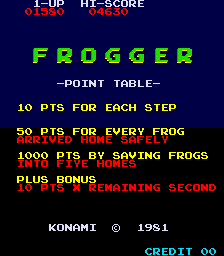
Frogger rewards urgency as well as survival. Each forward hop earns 10 points, bringing a frog home earns 50, and unused time is converted into bonus points. Bringing the lady frog home or eating a fly is worth 200 points, while filling all five homes earns a 1,000-point round-completion bonus. Original arcade scoring also grants an extra frog at 20,000 points, and the displayed score rolls over after 99,990. Those rules give the simple route across the screen a real score-chasing edge: the fastest safe line is not always the safest line.
The arcade cabinet supports one player or two players taking alternating turns, not simultaneous play. In a two-player game, one player continues until losing a frog, then control passes to the other player; each player is trying to make the best use of the same unforgiving road, river and timer. The original hardware presents the action on a vertical color raster display with mono sound, and its clarity is a large part of the game’s appeal: every lane, gap and moving platform can be understood at a glance, even when the decision is difficult.
That elegant structure is why the arcade original endures. Frogger asks for timing, positioning and composure rather than complicated rules, then finds new pressure in the interaction of motion, limited time and a shrinking set of open homes. It is a true coin-op endurance game with no conventional final stage, only escalating attempts to keep the frog moving and the score climbing. The later home ports, remakes and sequels spread the name widely, but this entry is the 1981 arcade game: the focused road-and-river challenge that established Frogger’s lasting identity.
Gallery

Details
- Developer
- Konami
- Publisher
- Konami
- Genre
- Platformer
- Players
- 1-2
- Release Date
- January 1, 1981
- System
- Arcade