About
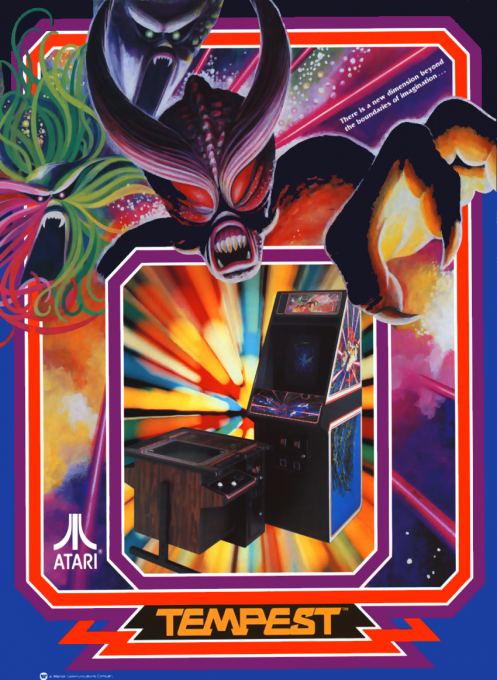
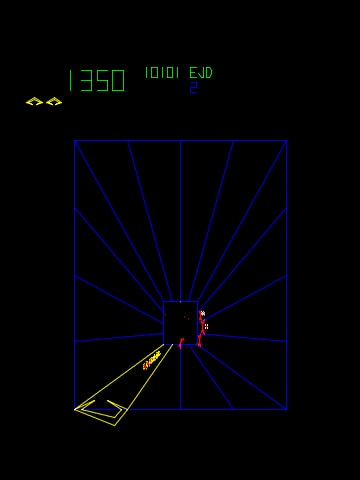
Tempest (rev 3, Revised Hardware) is an Atari arcade version of the 1981 vector shooter Tempest, designed and programmed by Dave Theurer. This revision belongs to the original coin-operated release rather than to a later sequel, home conversion, or modern remake. Atari presents the action as an abstract battle played across vividly drawn geometric surfaces: the player looks down a field divided into lanes and guards the near rim against shapes advancing from the distance. The “revised hardware” label identifies this particular arcade revision; its essential play is the original Tempest experience.
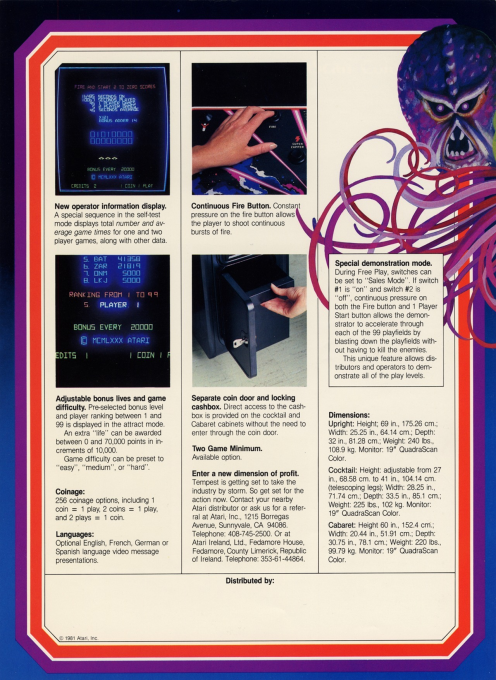
A rotary controller moves the claw-like blaster around the lip of the playfield, snapping it from lane to lane, while a fire button sends rapid shots straight down the selected route. The immediate task is to eliminate the enemies on a field before they reach, trap, or otherwise destroy the blaster. The dial is central to Tempest’s feel: it lets a player sweep quickly around a circle, reverse direction at once, and make small positional corrections on the more angular layouts. A second control activates the Superzapper, a powerful emergency weapon normally able to clear the current field once per level; an additional use in the same round has a much smaller, unpredictable effect.
Each cleared field leads into a warp sequence and then another stage. Tempest’s stages are not simply one arena repeated at higher speed. Its geometric layouts change from level to level, including enclosed tubes that wrap around and open shapes with separate ends, so the safe routes and the importance of positioning shift with the design. Atari’s SkillStep option lets an experienced player begin at a higher difficulty setting, while continued play steadily increases the pressure. After the main sequence of field shapes, the game cycles through altered colors and tougher patterns, making score survival depend on reading both the arena and the enemy mix.
The threats have distinct movement rules. Flippers can seize the player’s position and pull it down the field, while Pulsars make a lane dangerous in bursts and Fuseballs move erratically along the edges. Spikers leave obstacles behind them, and Tankers advance before splitting into additional enemies. Shots and enemy projectiles share the same lane-based space, so Tempest rewards quick target selection as much as fast reflexes. Destroying every threat is not quite the end of the danger: the warp itself can require the player to avoid or shoot through spikes. Lost blasters cost lives, and score thresholds can award extras, keeping a high-scoring run alive.
Tempest stands apart from many early arcade shooters through its color vector display and its view down a changing, three-dimensional-looking play surface. Atari released it in upright, cabaret, and cocktail cabinet formats, with the cocktail machine alternating play between participants; the core game is a one-player-at-a-time score contest rather than a simultaneous two-player battle. The arcade original later appeared in several compilations and inspired official follow-ups such as Tempest 2000, but this revised-hardware arcade entry points back to the concise 1981 design: a spinner, a firing button, a panic weapon, and a field of moving geometry that becomes more demanding as the levels advance.
Gallery
Details
- Developer
- Atari
- Publisher
- Atari
- Genre
- Shoot 'em Up
- Players
- 1-2
- Release Date
- October 1, 1981
- System
- Arcade