About
Q*bert Arcade is Gottlieb’s 1982 coin-operated action-puzzle game, built around an instantly recognizable pyramid of cubes and its orange, long-nosed hero. Designed and programmed by Warren Davis, with graphics by Jeff Lee and sound by David Thiel, it turns a simple four-way joystick into a demanding diagonal-navigation challenge. Rather than moving across a flat screen, Q*bert hops from the top of a stacked cube pyramid toward either lower diagonal, creating a striking pseudo-3D arcade playfield that became a hallmark of the early-1980s arcade era.
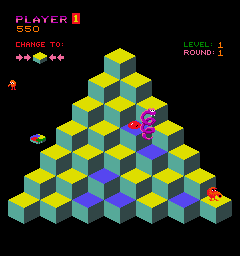
The basic objective is to make every cube on the pyramid reach its required color. Q*bert begins near the summit, and each landing changes the cube beneath him. Early rounds ask the player to visit all 28 cubes once, but later rounds require repeat visits, alter cubes back and forth between colors, or combine those rules. Finishing the pattern clears the stage and introduces a tougher board. The rhythm of reading the cube colors, choosing a safe route, and avoiding a dead-end jump gives the game both a puzzle-game focus and the immediate pressure expected from a coin-op action game.
The upright arcade cabinet uses a four-way joystick mounted on the diagonal so its directions correspond to Q*bert’s angled leaps. That layout is central to the original Q*bert experience: a wrong input can send the character off the pyramid, costing a life, while quick, accurate changes of direction keep him moving across the board. The action is single-player, with points awarded for changing cubes, surviving hazards, completing stages, and making use of opportunities that appear during play. Operators could set score thresholds for extra lives, adding another layer to the game’s high-score competition.
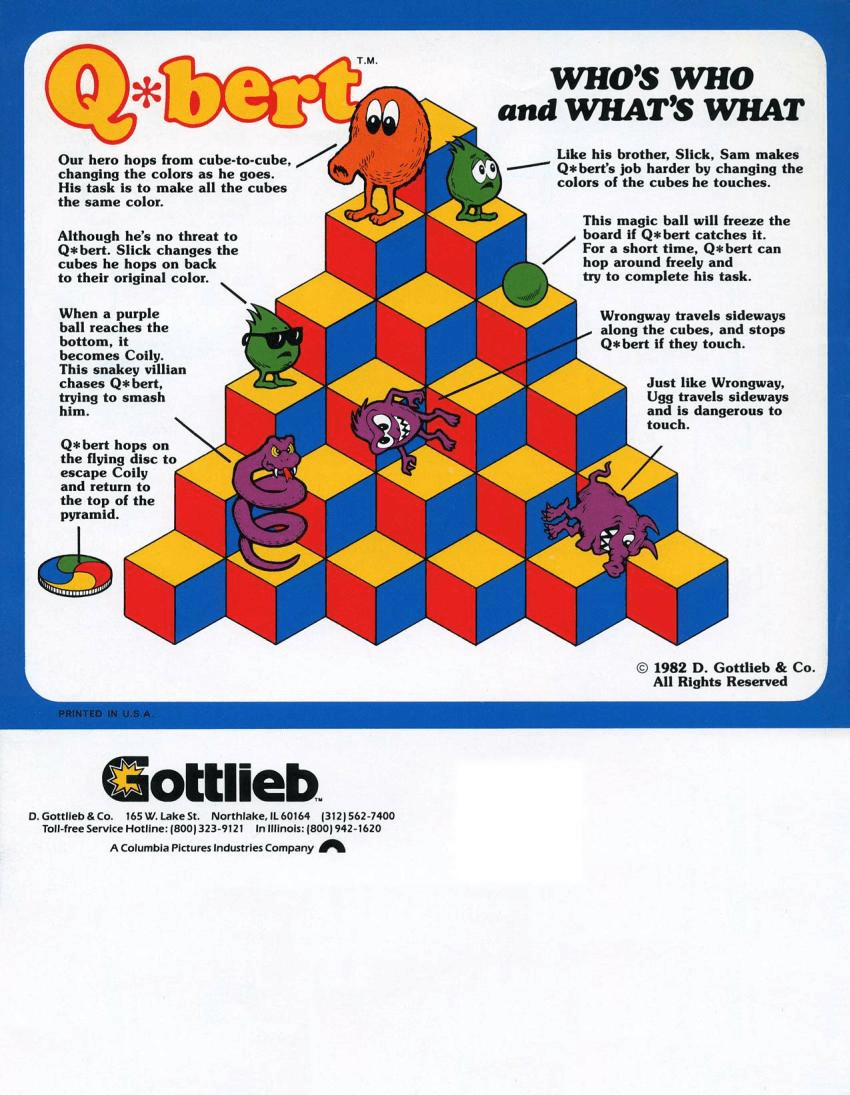
The pyramid becomes more hazardous as enemies arrive. Coily begins as a bouncing purple egg and changes into a pursuing snake after reaching the board. Ugg and Wrongway travel along the sides of the cubes, while Slick and Sam descend through the layout and undo Q*bert’s progress by changing cubes back. Red balls are dangerous, but green balls can temporarily freeze the threats. Floating discs beside the pyramid offer a valuable escape route: Q*bert can ride one back to the top, and a closely following Coily may leap after him and fall away. Learning when to preserve a disc and when to use it is one of the game’s most important tactical decisions.
Sound and character animation give the abstract board a personality. Q*bert reacts to collisions with a comic speech balloon full of symbols, while his unintelligible electronic exclamations became part of the game’s identity. The cabinet also uses a distinctive mechanical impact sound when he falls. These touches make the otherwise wordless challenge feel like a chase starring a mischievous cartoon character, and they help explain why the game stood apart from other score-driven arcade releases of its period.
Gottlieb released Q*bert during its brief but notable move from pinball into video games. The arcade original later led to licensed home conversions for systems including the Atari 2600, ColecoVision, Intellivision, Atari 8-bit computers, Commodore 64, and others, with their fidelity varying by hardware and controls. It also inspired sequels and follow-ups such as Q*bert’s Qubes, while the character appeared in a 1980s animated television segment and assorted licensed merchandise. This entry specifically represents the US set 1 arcade program, rather than a home conversion, remake, or later sequel.
Q*bert remains a defining example of how a compact arcade premise can grow through level rules, enemy behavior, and precise controls. Its cube-changing goal is easy to understand at a glance, but the diagonal geometry makes each advancing round a careful test of planning and reflexes. For players exploring classic arcade games, Q*bert Arcade offers a focused single-screen challenge whose colorful isometric design and unusual hero still distinguish it from the maze games and shooters that dominated the same era.
Gallery

Details
- Developer
- D. Gottlieb & Co.
- Publisher
- D. Gottlieb & Co.
- Genre
- Platformer, Logic Puzzle
- Players
- 1-2
- Release Date
- January 1, 1982
- System
- Arcade