About
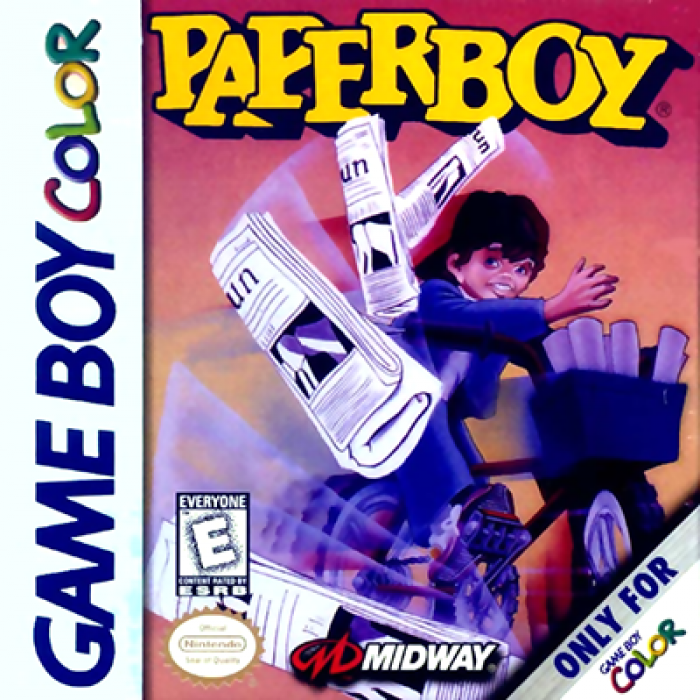
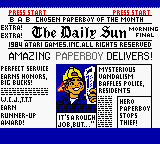
Paperboy for Game Boy Color brings Atari Games’ newspaper-delivery arcade classic to Nintendo’s color handheld in 1999. Digital Eclipse developed this portable version and Midway published it, adapting the familiar suburban bicycle route for a cartridge built around short, repeatable runs. The player is a young newspaper carrier for The Daily Sun, charged with getting papers to paying customers while riding through a neighborhood that is busy, unpredictable, and full of hazards. It is an action game with an unusual everyday premise: a successful route depends as much on steering and timing as on accurate throws.
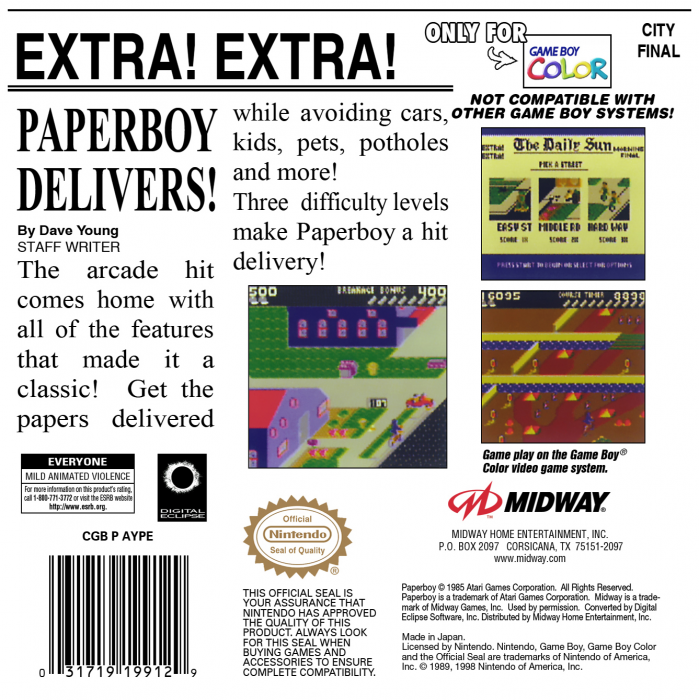
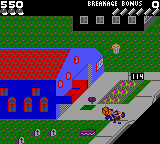
Each day begins with the rider moving down one side of a scrolling street. Brightly marked homes represent subscribers, and the aim is to land a rolled paper at the correct house as the bicycle keeps moving. Cars, pedestrians, loose tires, animals, skateboarders, and other street obstacles create constant pressure. A collision interrupts the run and costs a chance, while missed deliveries have a lasting consequence: homeowners who do not receive their newspaper can cancel their subscription. Paper bundles placed along the way replenish the limited supply, so route planning matters alongside quick reflexes.
The Game Boy Color controls translate the original game’s bicycle-handlebar idea to the handheld’s directional pad and buttons. Players guide the rider’s position and pace while choosing the moment and direction of each throw. The angled, side-scrolling view makes the route feel like a moving obstacle course rather than a simple target gallery. Throwing at the correct porch or mailbox is the essential task, but papers can also strike objects in the street. The game therefore asks the player to balance safe riding, ammunition management, score-building opportunities, and the need to protect a customer list over several in-game days.
Like the arcade Paperboy, this edition frames progression around a week of deliveries, from Monday through Sunday. A completed route leads to a training course where the rider can collect extra points by hitting targets and negotiating ramps or obstacles without the normal threat of losing a life. The course changes the rhythm after a tense neighborhood run: papers are plentiful, and the focus shifts toward accuracy and stunt-like scoring. Strong delivery performance helps retain subscribers and opens the way to later days, while careless throws and missed stops can make the route less forgiving.
Paperboy’s neighborhood is deliberately more animated than a realistic paper route. Non-subscriber houses can be damaged for points, and strange passersby and hazards turn a routine job into an arcade challenge. That contrast is central to the game’s identity: the player has a clear practical objective, yet the street encourages split-second decisions about risk and reward. The Game Boy Color release preserves that direct premise in a compact format, with colorful presentation suited to the system and a structure that works well for quick sessions as well as attempts to finish the entire week.
This 1999 Paperboy Game Boy Color version belongs to a long line of adaptations of the 1985 arcade game. The original was known for its distinctive diagonal perspective and custom handlebar cabinet, while home versions had to reinterpret that control scheme for standard controllers. Digital Eclipse’s port arrived during a period when Midway was returning many of its arcade properties to contemporary consoles and handhelds. For players exploring the Paperboy series on Game Boy Color, it offers the core delivery-and-survival formula in portable form: keep the bicycle upright, make the scheduled stops, preserve the subscriber base, and make it through the neighborhood one day at a time.
Gallery
Details
- Developer
- Digital Eclipse
- Publisher
- Midway
- Genre
- Other Sports
- Players
- 1
- Release Date
- January 1, 1999
- System
- GBC