About
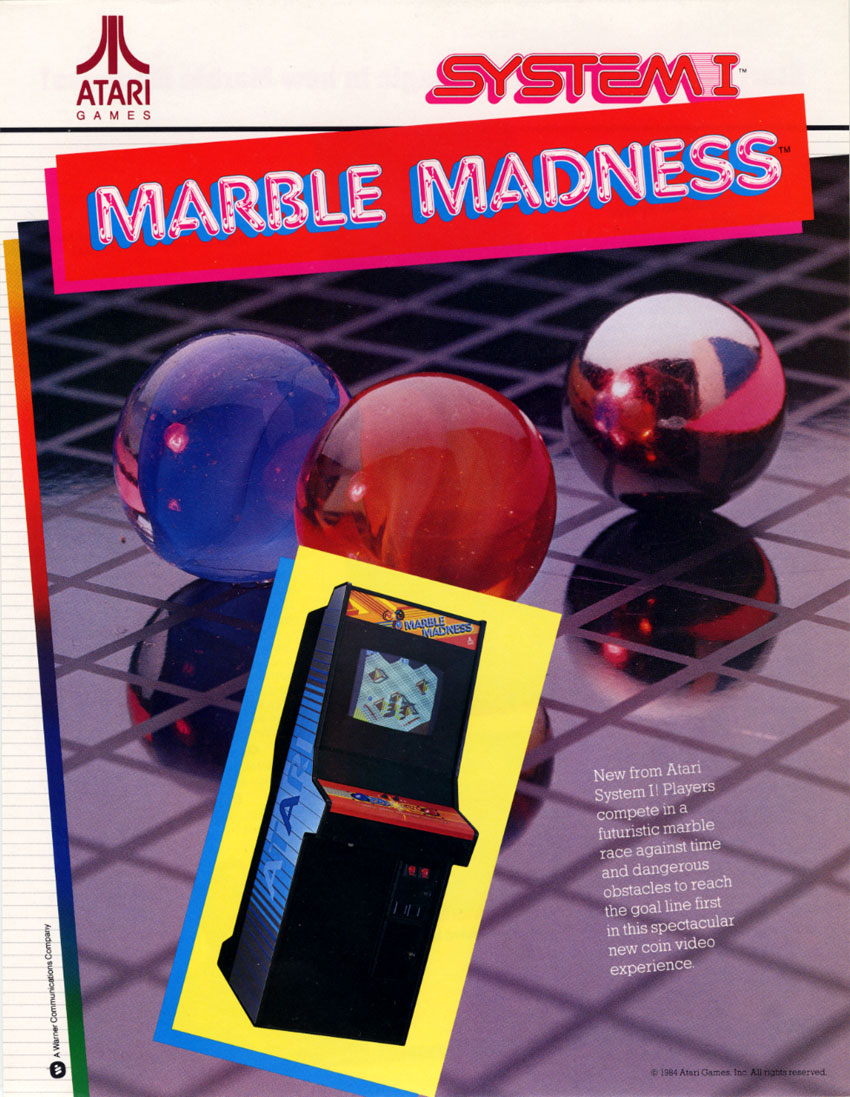
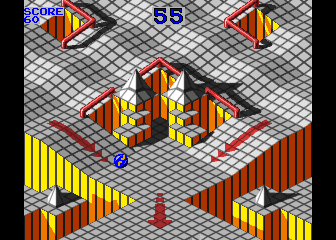
Marble Madness is a 1984 Atari arcade game built around an unusually direct idea: guide a glass marble from the start of an isometric course to its finish before the clock reaches zero. Developed and published by Atari Games for its Atari System 1 hardware, this fast-moving maze racer is associated with designer Mark Cerny and programmer Bob Flanagan. Its angled viewpoint turns each course into a compact three-dimensional-looking landscape of ramps, narrow paths, drops, and sharp turns, where a route that seems clear can become difficult the instant the marble gathers speed.
The dedicated cabinet uses a trackball rather than a joystick. Rolling it moves the marble in the corresponding direction, so quick pushes can build momentum while smaller adjustments help negotiate tight corners. The surface of a course matters as much as its layout: slopes send the marble downhill, raised edges demand care, and a fall from the path costs time while a new marble is put into play. The result is less about collecting items than reading terrain, controlling speed, and making clean decisions under pressure.
There are six races in the original arcade game, beginning with the relatively approachable Practice course and becoming progressively more demanding. Each is a self-contained obstacle course with its own visual character, combining routes, hazards, moving threats, and creatures that can impede or knock the marble away. Reaching the goal with seconds to spare is important because remaining time carries into the next race, alongside that course's time allotment. A strong early run therefore gives the player a better chance against the later stages, while repeated errors can quickly bring a session to an end.
Marble Madness also supports two simultaneous players. Each player guides a separate marble toward the same finish, making the layout a race as well as a navigation challenge. The shared course creates opportunities to surge ahead, recover from a mistake, or lose precious seconds amid its hazards, but the individual time displays keep each competitor responsible for finishing. This mode, together with the cabinet's two trackballs, makes the arcade version distinct from later home adaptations that generally relied on directional controls.
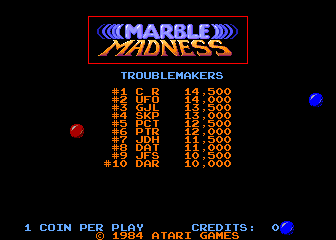
Atari's presentation gives Marble Madness an abstract identity rather than a conventional story or cast of heroes. The courses are viewed from above at an angle, with patterned ground, geometric structures, and enemy designs chosen to be clear at speed. The soundtrack was created by Brad Fuller and Hal Canon, and the arcade hardware delivers it in stereo. The game was also an early Atari arcade release on the interchangeable Atari System 1 platform, a format that paired a common cabinet system with game-specific boards, artwork, and controls.
After its arcade debut, Marble Madness reached a wide range of home computers and consoles through separately produced conversions, including versions published by Electronic Arts. Those ports vary in controls and in some content, so the original arcade machine remains the reference point for its trackball handling, six-race structure, and simultaneous competition. The game is remembered as a notable early example of the marble-navigation style: a short, demanding arcade challenge in which physical-feeling movement and a constantly shrinking timer are the central obstacles.
Gallery

Details
- Developer
- Atari
- Publisher
- Atari
- Genre
- Maze
- Players
- 1-2
- Release Date
- January 1, 1984
- System
- Arcade