About
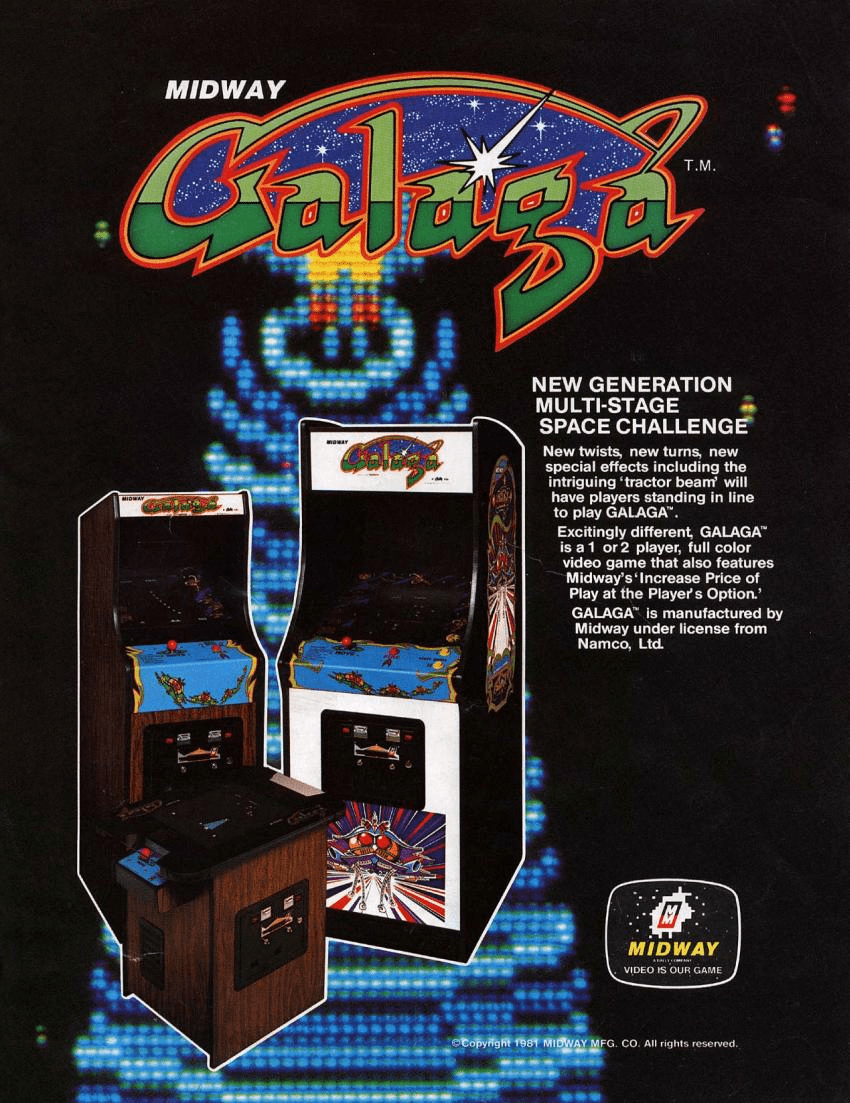
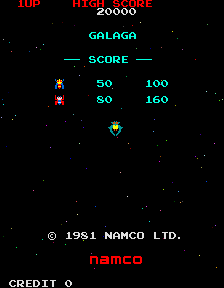
Galaga (Namco rev. B) is the 1981 arcade fixed shooter in which a lone starfighter defends the bottom of a single screen from a descending insect-like alien force. This entry refers specifically to the Namco revision B arcade program set, the parent Galaga set identified by MAME; it is neither a later Galaga sequel nor one of the separately catalogued Midway program sets, rapid-fire modifications, or home conversions. Namco developed Galaga as the follow-up to 1979's Galaxian, while Midway brought the game to North American arcades. Its immediate appeal is wonderfully direct: move left or right, fire upward, and stay alive long enough to turn an orderly alien formation into a higher-scoring mess.
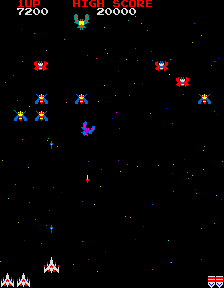
Every round opens with enemies sweeping in from the top and sides before settling into ranks. The player can attack while that formation is still assembling, an important opportunity because a complete wave soon begins to dive, curve, and fire back. The fleet contains smaller Grunts and Guards beneath the larger Boss Galagas at the top. A Boss requires two hits, and the changing pace of the attack keeps the screen from becoming a mere target range. Galaga retains the fixed-screen perspective of Galaxian, but it makes enemy entrances, escort patterns, diving attacks, and timing feel like a changing tactical problem rather than a single repeated formation.
The signature idea is the Boss Galaga's tractor beam. Allowing a Boss to capture the fighter costs a ship, but it can be a calculated risk when another fighter remains. Shoot down the captor while it is diving, without hitting the captive fighter, and the rescued ship joins the new one as a Dual Fighter. Two parallel streams of fire can erase threats and improve the odds in bonus rounds, yet the combined ship is wider and therefore easier to hit. The power-up is not simply handed to the player: it asks for a deliberate sacrifice, precise rescue, and renewed care under pressure.
The game also rewards attention to score as well as survival. Enemies are generally worth more while attacking than while sitting in formation, and a diving Boss with escorts offers a particularly tempting target. After the early regular rounds come Challenging Stages, non-hostile flying exhibitions in which alien groups trace set paths across the screen. Here the player races to hit as many targets as possible and can earn a substantial Perfect bonus for clearing all 40. Learning the routes, maintaining a useful firing position, and deciding when the broader Dual Fighter is worth its danger give each credit more texture than a simple reflex test.
Arcade controls are spare and exact: a joystick moves the fighter horizontally and one button fires. Only two player shots may be on screen at once, so a strong performance depends on cadence as well as aim. The formation grows more assertive as play continues, with faster dives and heavier fire demanding anticipation rather than blind shooting. Lives, bonus-life thresholds, difficulty, and other operating choices could be set by an arcade operator, which is why individual cabinets may not feel identically configured. Galaga is built for repeat attempts: recognizable patterns invite practice, while the risk of a missed rescue or an unfinished Challenging Stage keeps a run tense.
Galaga should not be confused with Galaxian, its earlier Namco predecessor. Galaxian established the basic formation-and-diving-enemy framework, but Galaga adds the capture-and-rescue system, more varied attack behavior, and its dedicated Challenging Stages. Nor is this Galaga '88, Galaga '91, Gaplus, or a later Arrangement version; those are distinct follow-ups or reinterpretations with their own rules and presentation. The Namco rev. B label likewise distinguishes this arcade ROM revision from the separately preserved Namco and Midway sets, without changing the game's identity into a different title.
Its original cabinet hardware and screen presentation are part of the experience: crisp sprites, a starfield, compact electronic effects, and a relentlessly legible playfield make each dive easy to read but difficult to answer. The famous high-score chase comes from this clarity. A player can understand exactly why a formation escaped, why a Boss was worth pursuing, or why a tractor-beam gamble failed, then feed another credit and improve the next attempt. That balance of approachable controls, memorable patterns, and escalating risk helped Galaga become one of arcade gaming's lasting standards.
Many later releases carried Galaga to consoles, computers, compilations, and digital services, but they are ports or re-releases rather than this arcade revision. They may alter controls, display, features, or surrounding presentation. Galaga (Namco rev. B) is best approached as the original arcade contest: one screen, horizontal movement, limited shots, an incoming formation, and the ever-present choice between protecting a single fighter and risking it all to create a more powerful pair. It remains a compact, demanding score game whose most recognizable innovation is also its most dangerous one.
Gallery

Details
- Developer
- Namco
- Publisher
- Midway
- Genre
- Shoot 'em Up
- Players
- 1-2
- Release Date
- January 1, 1981
- System
- Arcade