About
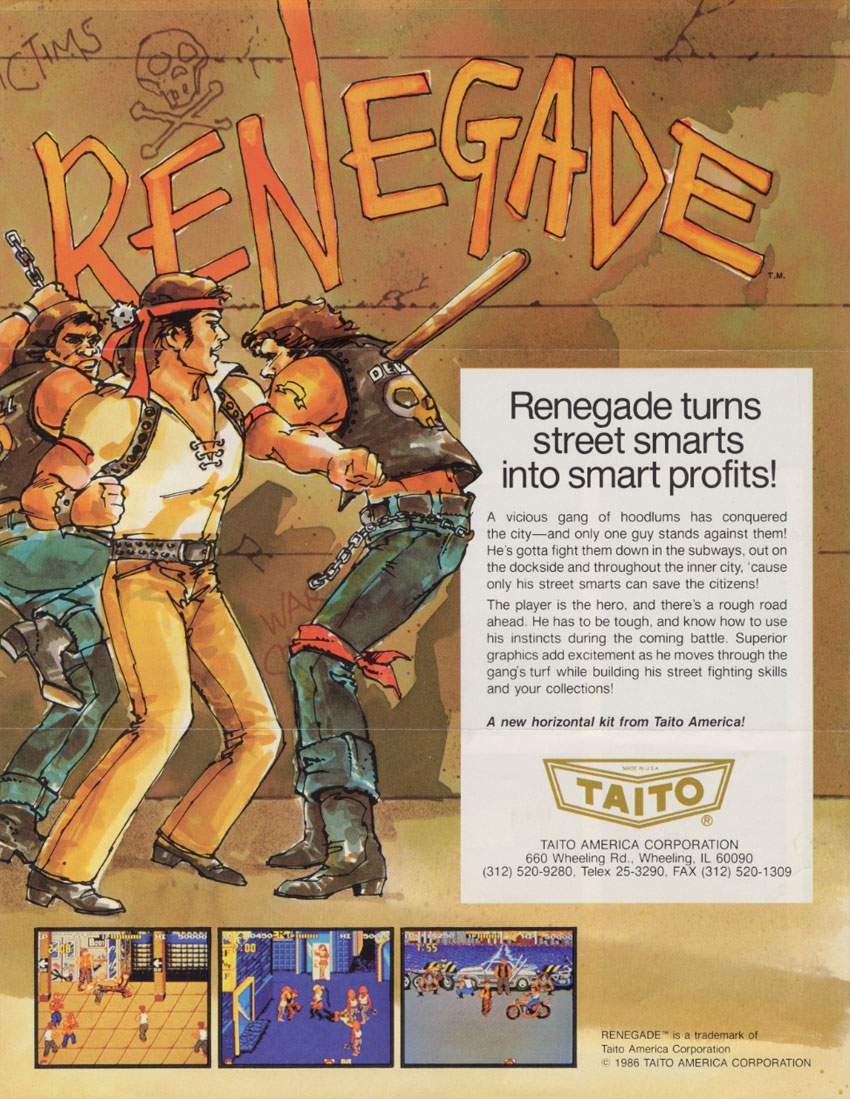
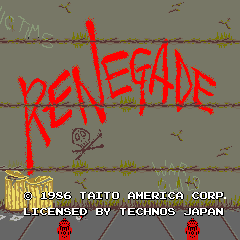
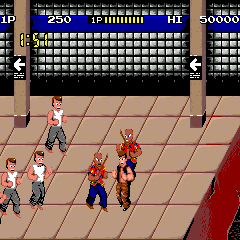
Renegade (US) is a 1986 arcade beat 'em up developed by Technos Japan and released in North America through Taito America. It is the Western version of Technos's Japanese arcade game Nekketsu Kōha Kunio-kun, but it is not merely a title change: its characters, scenery and story were reshaped for an American audience. The U.S. game casts its unnamed street fighter as a man battling through criminal gangs to rescue his kidnapped girlfriend from a mob boss, turning the original school-delinquent scenario into an urban revenge story.
Renegade arcade play takes place across compact, side-on fighting areas with room to move toward and away from the background. An eight-way joystick controls position, while three buttons handle attacks and jumping. Facing a foe and pressing the attack on that side produces punches; the opposite attack can send out a rear kick. Rapid directional input lets the fighter run, opening up running punches, flying kicks and defensive back-kicks. The controls make spacing important, since enemies can approach from either side rather than lining up neatly in front of the player.
Fights reward more than simply repeating one move. Opponents can be stunned, grabbed by the collar, kicked at close range or thrown, and downed enemies can be attacked on the ground. The game’s brawls demand attention to groups as well as individual opponents: a dangerous enemy behind the player can interrupt an attack, while armed gang members add pressure to each encounter. The player must preserve a limited supply of lives, and health returns at the start of a new stage rather than after every skirmish.
The arcade campaign follows four gangs through distinct street-level locations. It begins on a subway platform, moves to a harbor where motorcycle attackers make their entrance, then reaches an alley ruled by a female gang. The last confrontation leads through a parking area and into the boss's hideout, where knife-carrying opponents and a gun-armed final adversary raise the stakes. Early stages send ordinary gang members forward before their leaders join the fight, giving each area a clear escalation from crowd control to a boss encounter.
Renegade (US) is especially notable for the way it localizes Nekketsu Kōha Kunio-kun. In Japan, Kunio protected his friend Hiroshi from rival groups connected to a high-school setting. For the overseas arcade release, Technos redrew the presentation around a harsher Western gang-film atmosphere and replaced that premise with the girlfriend-rescue plot. That distinction matters when comparing versions: the U.S. arcade Renegade shares its underlying play systems with Kunio-kun, yet its narrative framing, visual identity and some character context belong to the localization.
The game arrived at a formative moment for the scrolling beat 'em up. Its wider fighting lane, combination-oriented close combat, throws, running attacks and dedicated jump button helped establish features that soon became familiar in the genre. Yoshihisa Kishimoto's subsequent Technos project, Double Dragon, expanded on many of these ideas. Renegade later reached home computers and consoles in substantially altered forms, but the 1986 U.S. arcade original remains the direct, coin-operated version built around quick gang battles, boss encounters and a tightly focused four-stage rescue.
Gallery

Details
- Developer
- Technos Japan
- Publisher
- Technos Japan
- Genre
- Fighting, Beat 'em Up
- Players
- 1-2
- Release Date
- January 1, 1986
- System
- Arcade