About
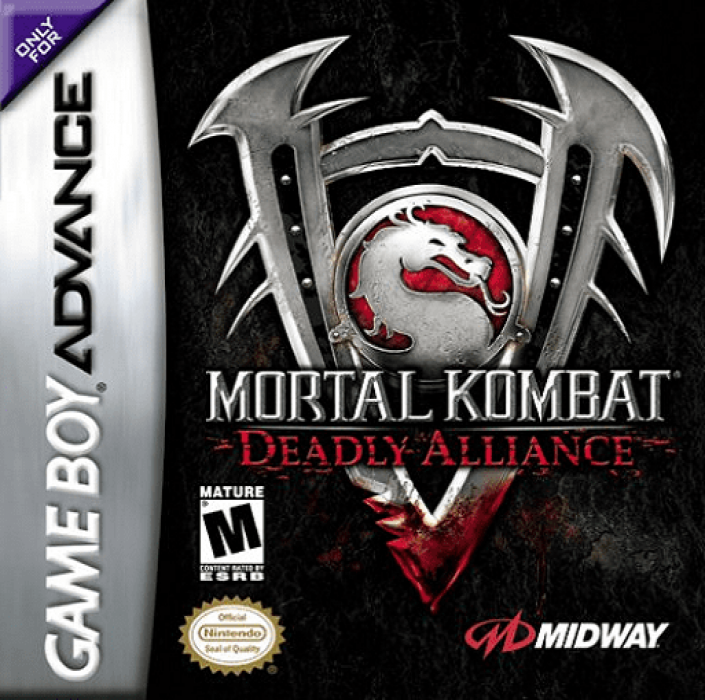
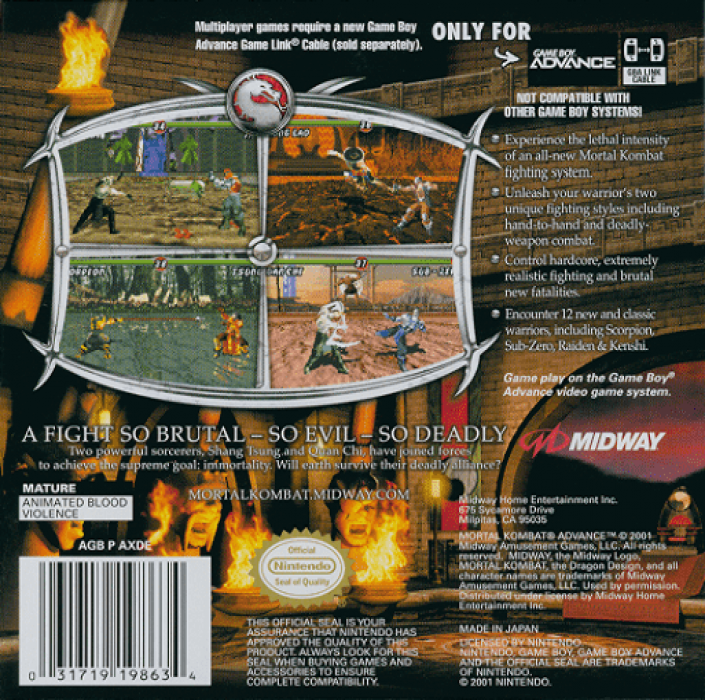
Mortal Kombat: Deadly Alliance for Game Boy Advance brings Midway’s 2002 fighting-game revival to Nintendo’s handheld in a version designed around portable, head-to-head combat. Released in North America in November 2002, this Mortal Kombat: Deadly Alliance GBA game follows the series’ conflict between the sorcerers Quan Chi and Shang Tsung, whose partnership threatens Earthrealm and Outworld. Rather than duplicating the PlayStation 2, Xbox, and GameCube editions, the cartridge reworks the material for Game Boy Advance hardware with a smaller lineup, a streamlined fighting system, and a distinctive pseudo-3D presentation. It remains a one- or two-player fighting game built around best-of-three matches, special moves, brutal finishers, and the rivalry-driven cast that defines Mortal Kombat.
The portable roster contains 12 combatants, combining familiar faces such as Scorpion, Sub-Zero, Sonya Blade, Jax, Kitana, Kano, Kung Lao, and Shang Tsung with Deadly Alliance-era fighters including Frost, Kenshi, Li Mei, and Quan Chi. The story backdrop reflects the fifth main Mortal Kombat game: Shang Tsung and Quan Chi join forces while the series’ warriors are drawn into the struggle across its fantasy realms. Liu Kang is notably absent as a playable fighter, a consequence of the game’s opening conflict. Each available character has an individual set of attacks, special moves, and a Fatality, while Shang Tsung has a feature unique to this GBA release: he can morph into other fighters during battle.
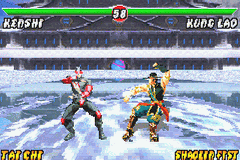
Matches take place on a side-to-side fighting plane, but the game uses a rotating, scaled floor and allows fighters to sidestep, giving the arenas a sense of depth without attempting to reproduce the console games’ full 3D combat. The controls are condensed for the handheld: A and B handle the main strikes, the right shoulder button blocks, and the left shoulder button changes between a character’s two fighting styles. Those styles alter available moves and combo options, so a fight is not simply about choosing the quickest button sequence. Jumps, throws, sweeps, projectiles, and character-specific techniques provide the rest of the duel, while positioning and well-timed blocks matter when opponents close in.
Arcade mode provides the classic run of consecutive bouts, and Survival tests endurance by carrying a limited health reserve from one opponent to the next. Local multiplayer is available through the Game Boy Advance Link Cable, letting two players settle matches directly and wager the in-game Koins they have earned. Test Your Might returns as a button-pressing challenge, while Test Your Sight turns its task into a shell-game-style memory test. These diversions, along with regular victories, feed the game’s progression system instead of standing apart from it.
Koins are spent in the Krypt, the handheld version of Mortal Kombat’s unlock gallery. Its 120 koffins hold additional content, including fighters, arenas, alternate costumes, and other extras, giving repeated play a clear purpose beyond single matches. Seven of the 12 fighters and nine of the 13 arenas are initially available, with the rest opened through Krypt rewards. That compact structure marks this release as its own adaptation rather than a reduced console disc: it preserves the Deadly Alliance setting, style-switching idea, and collectible secrets while making choices for the Game Boy Advance’s buttons, screen, and cartridge space. A separate 2003 GBA follow-up, Mortal Kombat: Tournament Edition, later used a different selection of combatants, making the original Deadly Alliance cartridge a specific chapter in the series’ handheld history.
Gallery

Details
- Developer
- Criterion Games
- Publisher
- Midway
- Genre
- Fighting
- Players
- 1-2
- Release Date
- December 20, 2002
- System
- GBA