About
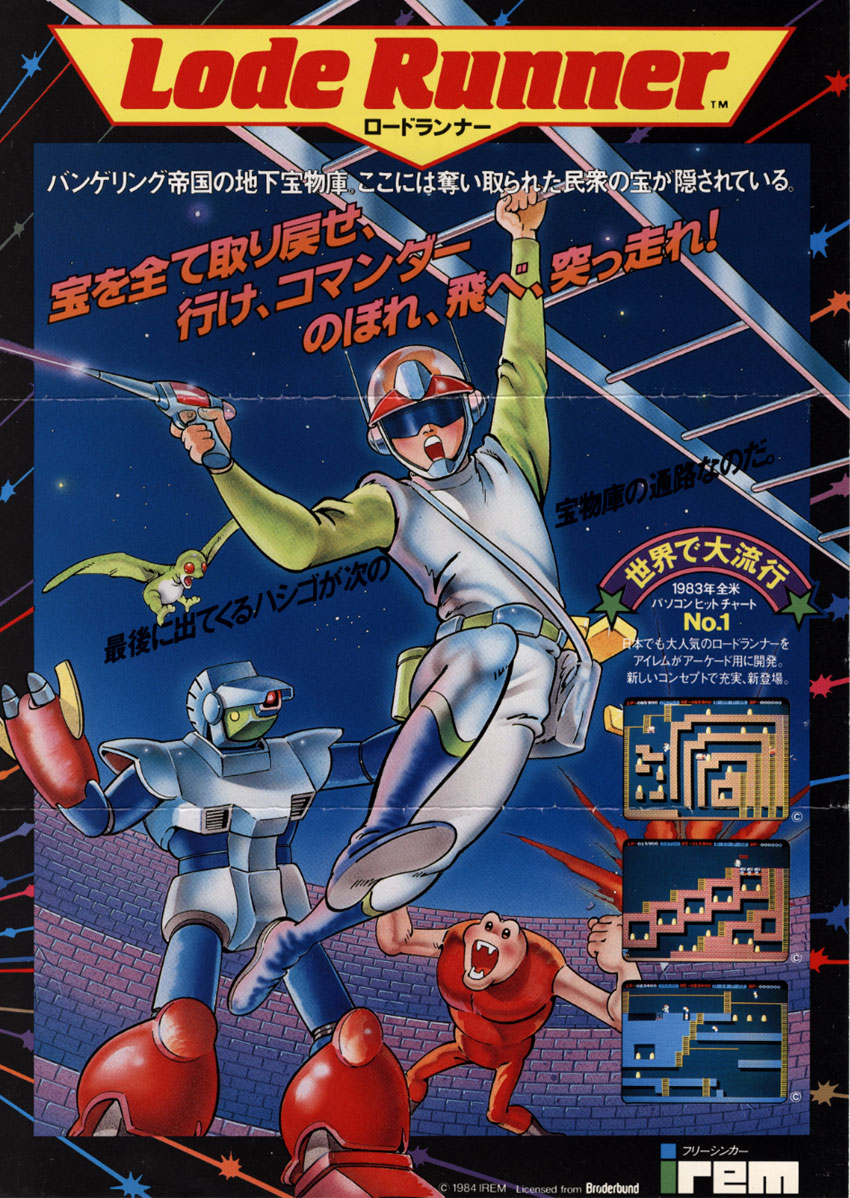
Lode Runner (set 1) is Irem's 1984 coin-operated adaptation of Doug Smith's influential puzzle-platform game, released under license from Broderbund. Rather than simply asking players to run and jump through a course, it turns every screen into a compact planning problem. The lone runner must recover every gold bar while avoiding pursuing guards, then use the exit route that appears once the stage has been cleared. This arcade version brings the computer-game idea to Irem's M62 hardware, giving its ladders, brick floors, hanging bars, and animated enemies the immediacy of a cabinet game.
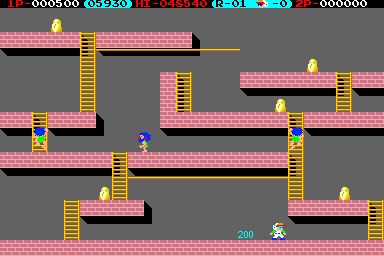
Each stage is a single-screen maze built around routes that look simple only at first glance. The runner can move across platforms, climb ladders, descend certain openings, and cross horizontal bars, but cannot jump or shoot. His essential defensive tool is the ability to dig through a brick tile immediately to his left or right. A guard can be lured into that temporary hole, buying time to escape, redirect the enemy, or retrieve gold that the guard drops. The pit repairs itself after a short delay, so every excavation has a cost: dig at the wrong time and the player can trap the runner or cut off a necessary path.
The guards make the familiar chase into a tactical contest. They climb, fall, and pursue through the same architecture, and they can pick up gold bars as they pass over them. That behavior turns enemies into moving complications and, on some layouts, useful pieces of the solution. A successful route may involve persuading a guard to carry a hard-to-reach bar, trapping it in a hole, and taking the treasure after it falls. Players can also run across the head of a guard caught below them, a small but important rule that creates daring escapes and precise puzzle solutions.
Lode Runner's arcade stage design rewards observation as much as reflexes. Collecting a tempting piece of gold too early can make a later area unreachable, while taking a detour may place a guard in exactly the wrong corridor. Brick repair timers demand quick movement, and the safest route is not always the shortest one. The player can fall long distances without damage, yet careless drops and dead-end holes still cost a life. These rules make a brief round surprisingly thoughtful: the screen is always readable, but its ladders and platforms support several possible routes and many ways for a plan to collapse.
Irem's conversion is not a straight recreation of all 150 stages from the 1983 home-computer original. It presents a focused arcade selection of 24 remixed levels, shaped for coin-operated play, with enhanced presentation and enemy behavior associated with the arcade release. Set 1 identifies the particular arcade program revision catalogued by MAME rather than a separate sequel or a different home version. The cabinet also supports alternating two-player play, letting competitors compare scores and progress as they work through the same demanding collection.
The game belongs to a landmark series whose original design helped establish the idea that an action game could be both immediately legible and deeply strategic. The 1983 Lode Runner was also notable for its level editor, while Irem's 1984 arcade adaptation carried its core of digging, pursuit, and route planning into Japanese arcades. For retro puzzle-platform fans, Lode Runner (set 1) remains an elegant test of timing and foresight: every bar of gold changes the objective, every guard can become an obstacle or tool, and every hole in the floor is both an escape route and a risk.
Gallery

Details
- Developer
- Irem
- Publisher
- Irem
- Genre
- Platformer
- Players
- 1-2
- Release Date
- January 1, 1984
- System
- Arcade