About
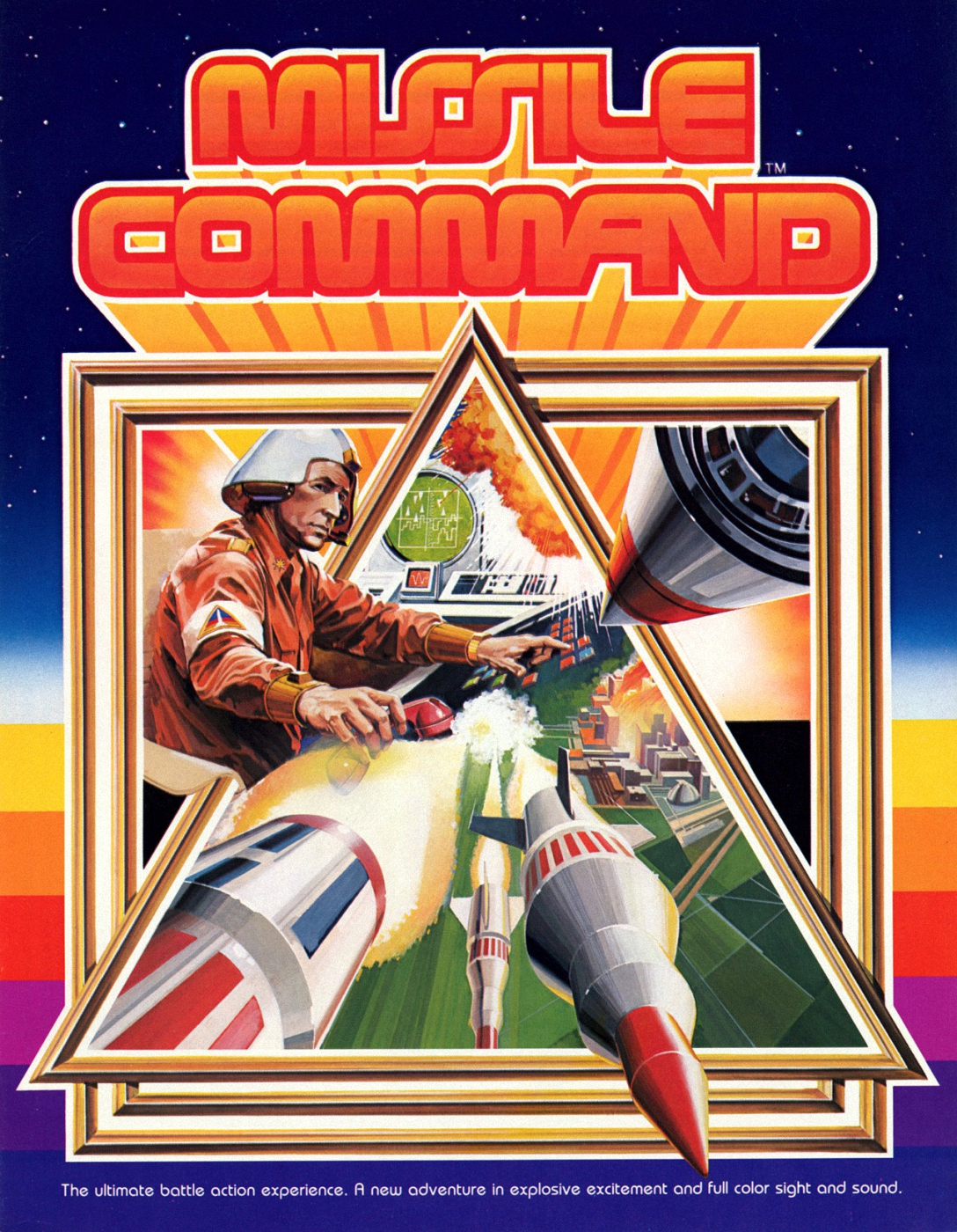
Missile Command (rev 3) is Atari's 1980 arcade defense game, a Cold War-era shoot 'em up built around a trackball and three launch buttons. This revision is an arcade program version of the original Missile Command cabinet, not one of the later home conversions or remakes. One player, or two players taking turns, faces a deliberately unwinnable battle to keep a small group of cities alive beneath a rain of enemy weapons.
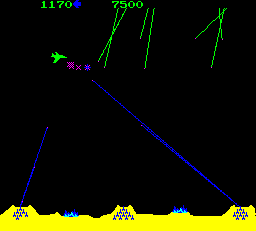
The playfield is presented as a radar-like horizon: six cities sit along the bottom, with Alpha Base, Delta Base, and Omega Base supplying the defenses. Moving the trackball steers a crosshair anywhere in the sky. Pressing the button for a base sends one interceptor from that battery toward the selected point, making the control scheme both direct and demanding. The middle battery's missiles travel faster, giving its position a particular tactical value.
Interceptors do not need to strike an incoming missile directly. Each one bursts at the crosshair and leaves a temporary expanding fireball capable of destroying enemy missiles and airborne attackers that pass through it. This makes placement and timing central to the game: a well-positioned blast can catch several threats, while a shot spent too early or too far away leaves a gap in the defense. Every base begins with a finite stock of missiles and is permanently lost if hit or emptied.
The assault grows more complicated as the waves continue. Ballistic missiles descend toward the cities and bases, while later attacks add evasive smart bombs as well as bombers and satellites that release more missiles. A wave ends only after its attackers have been eliminated or have struck their targets. Even if every launcher is empty, the remaining attack continues, emphasizing the need to preserve ammunition as well as population.
Surviving cities and unused missiles are converted into bonus points after each wave, and score thresholds can award replacement cities for use after a loss. The score multiplier rises as the game advances, but so does the pressure: enemy weapons become faster and more numerous. Since the game has no final stage to conquer, the objective is survival and scoring—holding on for one more wave, then another, before the cities are finally exhausted.
Atari developed and published Missile Command for the arcade, with Dave Theurer leading its design. Its unmistakable trackball interface, bright missile trails, and stark defense-only premise made it a defining game of the early-1980s arcade period. The revision 3 version preserves that original cabinet experience, including the alternating two-player option, horizontal display, and three-button launch panel.
The game's scenario reflects the anxieties of its release period without naming opposing nations or asking the player to retaliate. That restraint is part of its identity: the player can only protect what remains, never end the conflict. Missile Command later reached numerous home systems and compilations, but the arcade original remains the source of its fast, spatially focused defensive action and its memorable final sense that survival can only be temporary.
Gallery

Details
- Developer
- Atari
- Publisher
- Atari
- Genre
- Shoot 'em Up
- Players
- 1-2
- Release Date
- January 1, 1980
- System
- Arcade