About
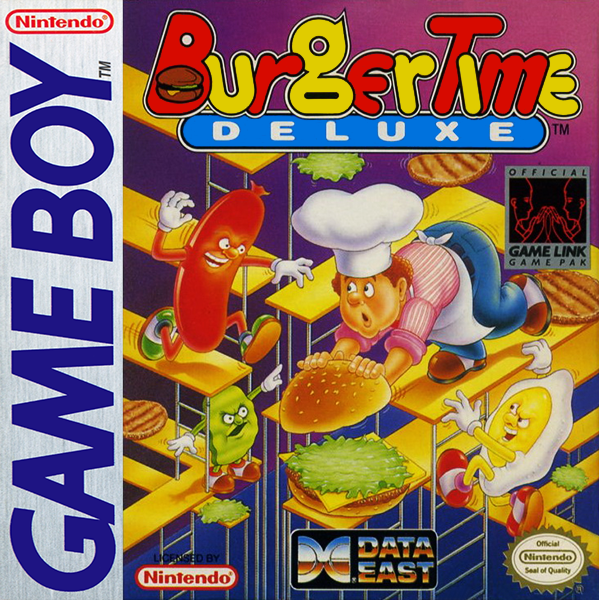
BurgerTime Deluxe for Game Boy is Data East's 1991 handheld take on the company’s 1982 arcade game, BurgerTime. It puts the familiar chef Peter Pepper in compact, monochrome kitchen mazes filled with oversized burger ingredients and roaming food foes. The goal is simple to explain but demanding to carry out: build every hamburger on a stage by stepping across each bun, patty, cheese slice, and other ingredient so it drops onto the plate below. Once every stack is complete, Peter can move on. Data East kept the defining arcade premise while shaping it around the Game Boy’s portable format and adding enemy characters not found in the original game.
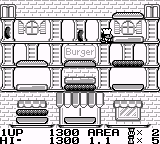
Each playfield is a network of narrow platforms and ladders. Peter moves with the Control Pad, climbing between levels to reach ingredients that are often positioned directly in an enemy’s path. Walking the full length of a burger piece sends it down one tier, and a falling piece can continue the assembly process below. Positioning matters: a well-timed drop can advance several layers of a burger and create breathing room, while an awkward route can leave Peter trapped in a corner. Stages become progressively harder by combining more complicated layouts, additional ingredients, and greater pressure from the pursuing characters.
The food enemies are the central obstacle. Contact with an active pursuer costs Peter a life, so players must read the maze and choose when to climb, retreat, or use the game’s limited pepper supply. A pepper shake briefly stops an enemy in front of Peter, making it possible to slip past. Falling ingredients offer another defensive tool, as they can squash opponents caught underneath or carry them downward. Bonus food items occasionally appear on the stage; collecting them boosts the score and can replenish pepper, encouraging players to balance the immediate need to escape against the chance to restore a valuable resource.
BurgerTime Deluxe retains the score-driven structure that made the arcade concept work so well. Points come from building burgers, dropping ingredients, dealing with enemies, and collecting temporary bonus items. The action has a constant push and pull: Peter needs to cover ingredient surfaces to finish the order, but every move also gives the enemies time to close in. The Game Boy screen keeps attention on a small section of the kitchen, making route planning and quick reactions equally important. Rather than relying on elaborate attacks, the game builds its challenge from ladder placement, enemy traffic, limited pepper, and the consequences of every falling ingredient.
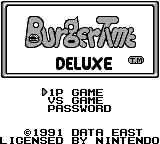
The cartridge supports both solo play and two-player games through the Game Link cable. In the multiplayer option, each player uses a Game Boy and the pair can set the number of games needed to determine the winner as well as the starting pepper supply. The contest is still based on completing hamburgers, turning a game normally focused on personal score and survival into a direct kitchen showdown. A password option also lets players resume progress, a useful feature for a portable game with multiple increasingly difficult areas.
As a BurgerTime entry, BurgerTime Deluxe connects a Game Boy audience to one of Data East’s best-known arcade ideas without trying to duplicate every version of the series. The original BurgerTime began in Japanese arcades as Hamburger before becoming BurgerTime in overseas releases, and its chef-versus-food setup had already appeared on several home systems by the time this edition arrived. This Game Boy release is a distinct adaptation rather than merely the 1982 arcade program in miniature: it preserves the burger-building chase gameplay, accommodates linked competition, and expands its cast of hazards for a new platform.
Gallery

Details
- Developer
- Data East
- Publisher
- Data East
- Genre
- Platformer
- Players
- 1
- Release Date
- February 25, 1992
- System
- GB