About
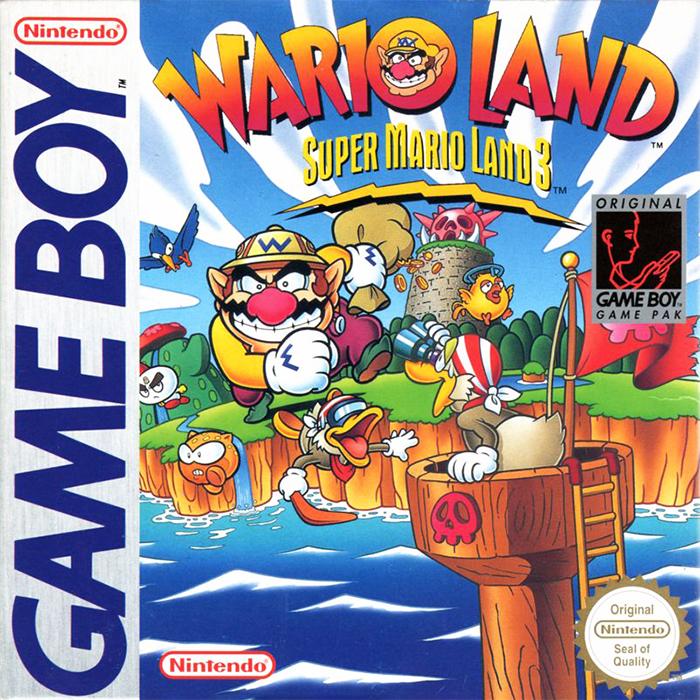
Wario Land: Super Mario Land 3 is a 1994 side-scrolling platform game for Nintendo Game Boy, developed and published by Nintendo. It follows Wario’s debut as a playable lead after his role as Mario’s rival in Super Mario Land 2: 6 Golden Coins. Released in Japan as Super Mario Land 3: Wario Land, the Game Boy adventure sends the treasure-hungry antihero to Kitchen Island, where the Brown Sugar Pirates have hidden riches—including a golden statue of Princess Toadstool that Wario hopes will pay for a grand castle of his own.
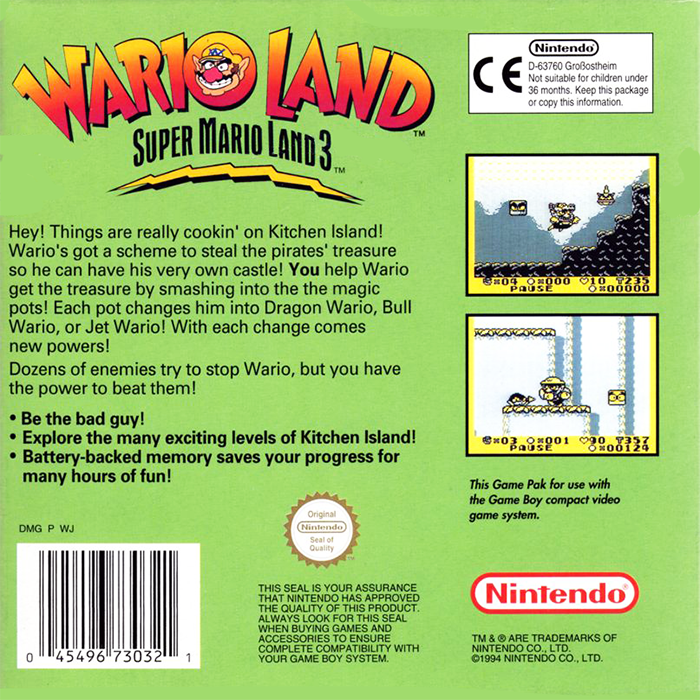
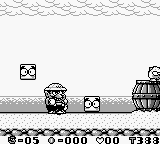
The basic goal is to guide Wario through island routes, reach each course’s exit, and ultimately break into the pirates’ stronghold. The game retains the clear, compact screen-by-screen platforming associated with the Super Mario Land games, but builds its action around Wario’s heavier, more forceful style. He can jump on enemies or knock them over, pick up stunned foes, and throw them. In his larger form, a shoulder charge lets him attack, smash certain blocks, and uncover concealed paths and containers.
Money is central to Wario Land’s progression. Coins are collected from the scenery, blocks, and enemies, and Wario can spend them at some checkpoints and exits. A player carrying enough coins can also use a large coin as a projectile, then retrieve it. Rather than making coins merely an extra-life counter, the Game Boy game turns them into an ongoing resource connected to exploration, level choices, and the final result. Hearts earned during play contribute toward extra lives, while the ends of stages offer a chance to use collected money in a bonus game for more heart points.
Wario’s helmets give the platforming a useful variety of approaches. The Bull Helmet reinforces his charge and grants abilities such as clinging to ceilings and performing a ground-shaking stomp. The Jet Helmet increases his movement speed and enables horizontal flight, as well as a charge underwater. The Dragon Helmet trades the charge for long-range fire breath that works on land and in water. Damage normally shrinks Wario; finding garlic, obtaining a helmet, or reaching the goal restores his larger state, while a further hit when small costs a life.
Treasure hunting adds another layer to the Game Boy courses. Some stages contain locked treasure rooms, and collecting their rewards requires locating a key and carrying it to the chest. Holding that key restricts Wario’s usual helmet powers and shoulder charge, so the trip to the treasure is its own challenge. The treasures are later exchanged for coins, which makes thorough exploration meaningful beyond the immediate completion of a stage.
The campaign moves through themed areas toward confrontations with the pirates and their leader, Captain Syrup. Wario’s objective is deliberately unlike Mario’s usual rescue quest: he intends to take the statue and the pirates’ wealth for personal gain. After the climactic events at Syrup Castle, the number of coins and treasures accumulated determines what the genie can provide for Wario, producing different ending outcomes. This system gives the final tally a direct narrative payoff and rewards players who search beyond the most obvious route.
As the first Wario Land, Wario Land: Super Mario Land 3 established the character’s own branch of Nintendo platform games while still carrying the Super Mario Land name. Its Game Boy design distinguishes Wario through object throwing, charging, collectible helmets, and treasure-driven goals, instead of simply placing him in a standard Mario role. Nintendo later reissued the game through the Nintendo 3DS Virtual Console, but this original monochrome Game Boy release remains the starting point for the Wario Land series.
Gallery
Details
- Developer
- Nintendo
- Publisher
- Nintendo
- Genre
- Platformer
- Players
- 1
- Release Date
- May 13, 1994
- System
- GB