About
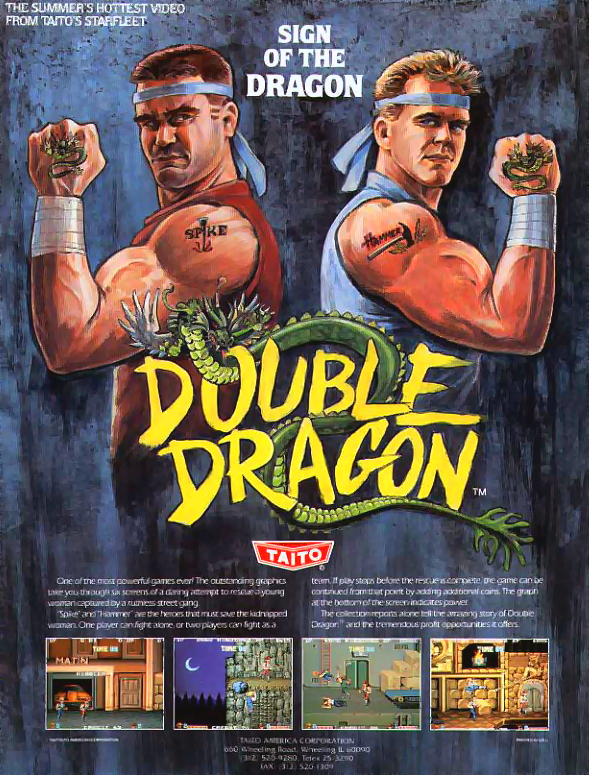
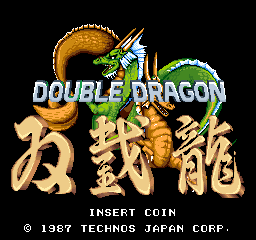
Double Dragon (US set 1) is the 1987 arcade beat ’em up developed by Technos Japan and published in North America by Taito America. Built around a two-player street-fighting adventure, it sends two martial artists into the territory of the Black Warriors after Marian is abducted. The U.S. arcade presentation identifies the partners as Hammer and Spike; the Billy and Jimmy Lee names closely associated with the series were established by the later Famicom and NES version. This is the coin-op original: a hard-edged, continuously scrolling action game designed for quick cooperation, crowded confrontations, and a dramatic rescue.
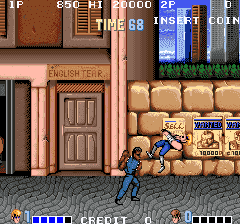
One or two players advance through the game from left to right, using an eight-way joystick and separate punch, kick, and jump buttons. Simple inputs handle basic strikes, while direction and button combinations open up stronger techniques such as jump kicks, throws, and elbow attacks. A shared screen lets partners surround foes or capitalize when one fighter grabs an opponent from behind, though the gang can use the same tactic against the heroes. Each life is governed by both a vitality gauge and a time limit, so careless brawling, stage hazards, and delay all carry a cost.
The Black Warriors bring more than bare fists to the fight. Knives, baseball bats, whips, and dynamite can be knocked from enemies’ hands and turned against them, while rocks, crates, and oil drums become dangerous objects in the right places. This makes spacing and timing as important as button mashing: players can disarm a thug, seize the dropped weapon, and clear room before the next wave arrives. Larger opponents such as Abobo change the rhythm with their strength and ability to throw heavy objects, while regular gang members appear with different attack patterns and equipment.
Its four missions form a journey through a ruined urban setting: the opening slum, an industrial area, a forest, and the Black Warriors’ stronghold. Rather than keeping every encounter inside a single enclosed arena, the arcade game carries the action through long side-scrolling spaces, with boss encounters and brief transitions marking progress. Environmental dangers become increasingly important on the route to the final hideout, where traps and enemy groups stand between the players and gang leader Willy. The arcade campaign can be completed alone, but its design is especially associated with two people fighting side by side at the cabinet.
Double Dragon also gives its cooperative premise an unusual conclusion. If both fighters survive the battle with Willy, the rescue does not simply end the game: the two players are made to fight each other for Marian’s affection. That final reversal turns the partnership into a brief versus match and is one of the arcade version’s most memorable features. It also distinguishes this original from several home conversions, which changed character roles, level layouts, combat systems, or multiplayer arrangements to suit their hardware.
Following Technos Japan’s earlier Nekketsu Kōha Kunio-kun, released overseas as Renegade, Double Dragon expanded the scrolling brawler format with a longer journey, weapon use, and cooperative play. Its success made it a major arcade hit and led to sequels, numerous home adaptations, and a long-running Double Dragon series. For players seeking the foundational coin-op version, this U.S. set preserves the brisk four-mission structure, the Black Warriors’ escalating gauntlet, and the competitive twist waiting at the end of a successful two-player run.
Gallery

Details
- Developer
- Technos Japan
- Publisher
- Taito
- Genre
- Fighting, Beat 'em Up
- Players
- 1-2
- Release Date
- January 1, 1987
- System
- Arcade