About
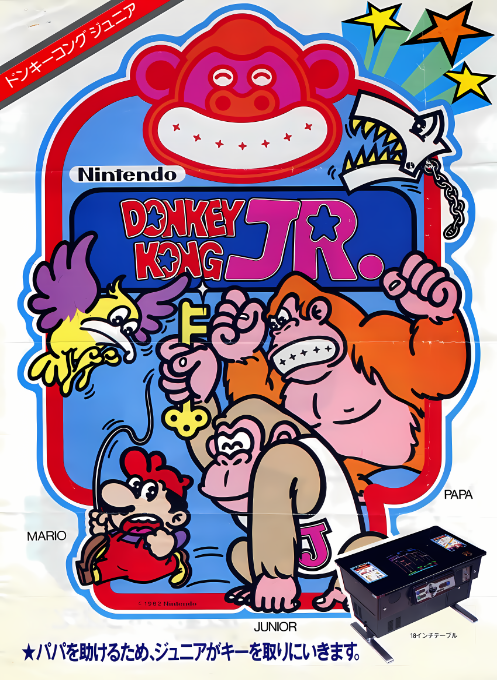
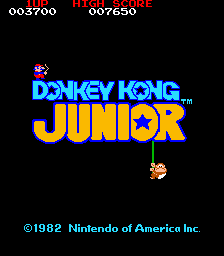
Donkey Kong Jr. (US set F-2) is Nintendo's 1982 arcade platform game and the direct follow-up to the original Donkey Kong. This time the familiar rescue story is reversed: Mario has captured Donkey Kong, and players guide Donkey Kong's son, Junior, through a series of hazardous vertical screens to free him. The North American arcade release used the Donkey Kong Junior title on its cabinet, while the shorter Donkey Kong Jr. name became common elsewhere. Nintendo developed and published this coin-operated sequel during the formative years of its arcade success.
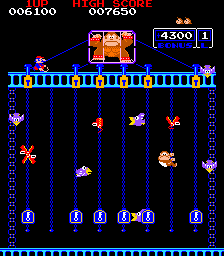
Each round puts Junior at the bottom of a tall, single-screen obstacle course with Donkey Kong held above. A joystick moves him along ledges and between the climbing routes, while a jump button handles gaps, evasive moves, and attacks on the ground. The central challenge is reading the changing arrangement of vines, chains, ropes, platforms, and hazards, then finding a safe route upward before the bonus timer expires. Reaching a key near the cage clears the early screens; the final screen instead asks Junior to work several keys into their locks before his father can escape.
The climbing system gives Donkey Kong Jr. its own rhythm. Junior can hold one support or use two at once, trading flexibility for faster upward movement. Moving between adjacent supports helps avoid enemies, but positioning matters because foes occupy the same routes and projectiles can cut off a climb. Fruit placed above the courses can be knocked down to sweep enemies from their path, turning an apparently defensive dash into a carefully timed offensive move. Contact with an enemy, a long fall, a plunge into water, a fall off-screen, or the end of the timer costs a life.
Four distinct arcade stages provide the basic structure: a vine-covered opening climb, a conveyor-belt area, a high wire-and-springboard screen, and Mario's hideout, where electrical hazards join the pursuit. Mario appears as Junior's opponent rather than the hero of the first game, while Snapjaws, Nitpickers, and Sparks make the routes progressively less forgiving. After a successful escape, the game cycles back to earlier layouts at greater difficulty, so scoring depends on efficient clears as well as survival. Two players can take turns, but the original arcade game is a one-player-at-a-time contest rather than simultaneous cooperative play.
This US set F-2 revision is specifically notable for its stage sequence. The Japanese arcade version cycles through its four screens in straightforward order, but the American sequence begins with selected combinations before settling into the full four-stage rotation: the third round omits the hideout, the next omits the springboard screen, and later rounds use all four. That regional programming difference makes this arcade set more than a generic label, while leaving its rescue premise and core play intact.
Donkey Kong Jr. followed one of Nintendo's breakthrough arcade hits at a moment when the company was expanding the Donkey Kong series. Its changed point of view gave Junior a rare starring role and placed Mario on the other side of the conflict. The arcade game later reached numerous home systems and inspired related Nintendo releases, but its cabinet version remains the source of its compact climbing design: a fast score-driven platform game built around choosing routes, using fruit at the right moment, and racing to unlock Donkey Kong's cage.
Gallery

Details
- Developer
- Nintendo
- Publisher
- Nintendo
- Genre
- Platformer
- Players
- 1-2
- Release Date
- January 1, 1982
- System
- Arcade