About
Virtua Fighter is Sega's 1993 arcade fighting game for the Sega Model 1 system, built around one-on-one martial-arts contests in a fully polygonal 3D presentation. Developed by Sega's AM2 team and released into a period dominated by sprite-based fighters, the original Virtua Fighter arcade game made its opponents, stages, and camera feel strikingly different from the 2D competition. Its fighters occupy square rings set in broad outdoor environments, while the action retains a deliberately direct side-on contest between two competitors.
The control scheme is compact: a joystick and three buttons for Punch, Kick, and Guard. That economy is central to the game. Individual moves come from direction-and-button inputs, timing, range, stance, and the relationship between the two combatants rather than from a large panel of attack buttons. Attacks have high, middle, and low properties, and guarding is an active part of reading an opponent's choices. Throws, counters, and character-specific techniques give the simple interface considerable tactical depth.
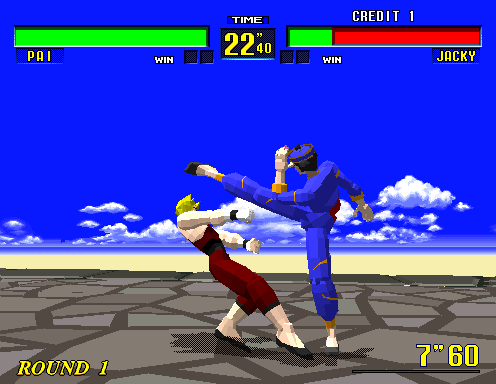
A round can end in more than one way. Players may deplete the opposing life gauge, finish with more health when the timer expires, or force the other fighter beyond the edge of the ring. That ring-out rule makes position as important as damage: a player pushed toward a boundary must consider escape routes as well as incoming strikes, while an attacker can turn pressure and throws into a quick victory. Matches use best-of-three rounds, making each opening exchange and recovery from a setback matter.
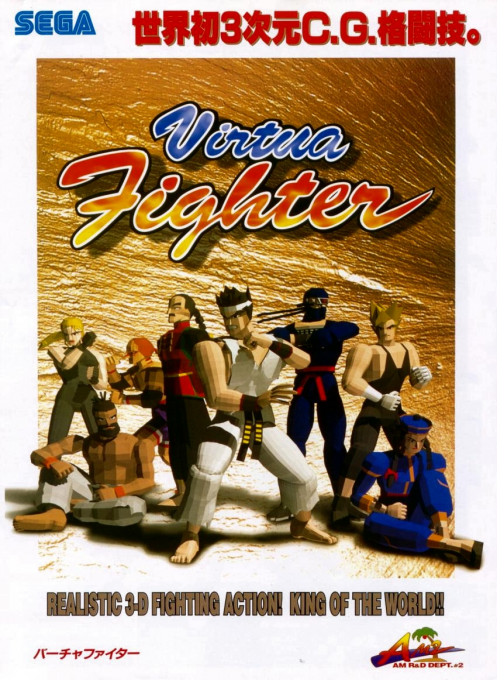
The arcade roster has eight selectable combatants drawn from different parts of the world, each presented with a distinct fighting approach. Akira Yuki uses Bajiquan, while Pai Chan and her father Lau Chan bring separate Chinese martial-arts styles. The remaining lineup includes wrestler Wolf Hawkfield, fisherman Jeffry McWild, ninja Kage-Maru, and siblings Sarah and Jacky Bryant. In the single-player course, the chosen fighter progresses through a fixed sequence of opponents before facing Dural, the game's boss. A second player can join for head-to-head matches.
Virtua Fighter's presentation is inseparable from its Model 1 hardware. The characters are assembled from flat-shaded polygons rather than hand-drawn sprites, and the camera can shift around the ring to frame the clash from changing angles. The visual style is unmistakably early 3D, but it supports the game's focus on spacing, movement, and the physical contact of each blow. Character animation and individual stances help make the fighters readable even before a move is launched.
This entry is the original arcade Virtua Fighter, released in December 1993, rather than the later Virtua Fighter Remix update or a home conversion. Remix revised the first game's presentation and arrived later, while versions for systems such as Sega Saturn and 32X translated the arcade concept for home play. The Model 1 release remains the starting point: the game that established the series' basic three-button vocabulary, ring-based tactics, and internationally varied cast.
For arcade fighting-game history, Virtua Fighter is notable for helping demonstrate how polygonal 3D graphics could serve competitive play rather than merely provide spectacle. Its mechanics keep the emphasis on observation and decision-making: learn a fighter's options, judge distance, protect the ring edge, and respond to an opponent's pattern. Sega followed it with Virtua Fighter 2 in 1994, but the first Virtua Fighter arcade game is where the series' grounded approach to digital martial arts began.
Gallery

Details
- Developer
- SEGA
- Publisher
- SEGA
- Genre
- Fighting
- Players
- 1-2
- Release Date
- January 1, 1993
- System
- Arcade