About
Dig Dug rev 2 arcade is the MAME-identified revision of Namco’s 1982 underground action game, originally developed and published for coin-operated arcades. The game places the player in a cutaway field of colored earth, where the title character digs a changing network of horizontal and vertical passages while hunting every monster on the screen. Its simple cabinet controls—a four-way joystick and an air-pump button—support a quick, readable contest of positioning, timing, and escape routes. This rev 2 designation identifies an arcade program set; it should not be confused with the many home conversions, later collections, or the Famicom Disk System release.
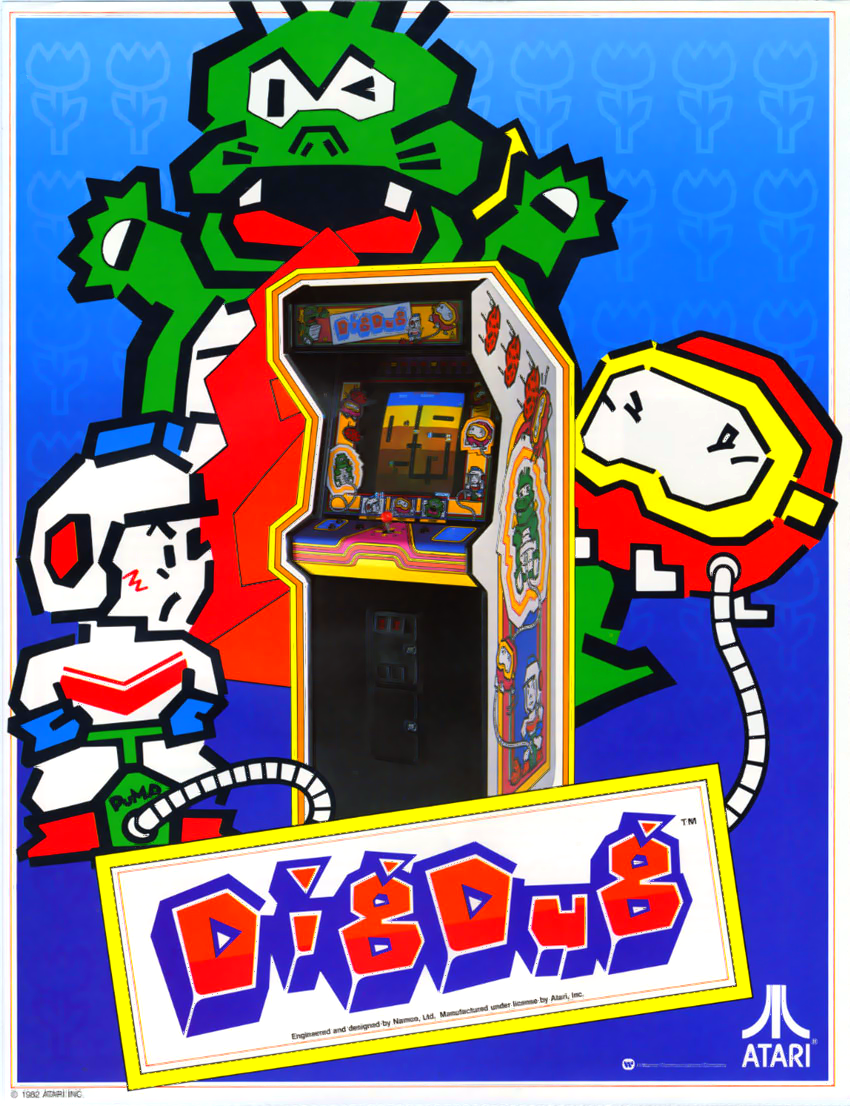
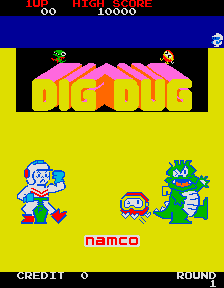
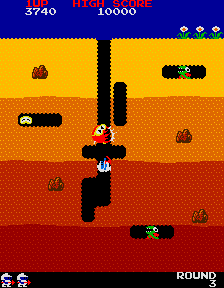
Each round begins with Dig Dug and a group of Pookas and Fygars separated by solid soil, open caverns, and boulders. Moving through dirt carves permanent tunnels, creating both access to targets and dangerous paths for pursuers. Pookas are round, goggle-wearing opponents, while Fygars are dragon-like enemies that can breathe fire along a horizontal tunnel. Contact with an enemy, a Fygar flame, or a falling rock costs a life. Clearing the active enemies advances the player to the next round, where the mix, speed, and pressure steadily increase.
Dig Dug’s signature weapon is an air pump. A successful jab attaches its hose to a nearby enemy; repeated presses inflate the target until it bursts. Pulling away or waiting too long breaks the connection, however, and the partially inflated foe slowly recovers. That small risk gives the game much of its tension: a player can finish an enemy quickly at close range, retreat to create space, or abandon the attempt before another monster arrives. Enemies are not limited to the tunnels Dig Dug has carved. When they turn into disembodied eyes, they can travel through the dirt to find a new route, although they are unable to attack in that form.
The other method of attack uses the rocks embedded in every stage. Dig beneath a boulder, step clear, and it drops after a brief delay; one well-placed fall can crush several monsters at once. Rocks therefore serve as hazards and as high-value opportunities, since multi-enemy drops earn more points than a single defeat. Dropping two rocks in a round also produces a bonus item near the surface for an additional score opportunity. The items change as rounds progress, encouraging players to balance immediate survival with routes that leave time to collect them.
The arcade game is designed for one or two players taking turns rather than simultaneous co-operative play. Its short rounds make the score chase easy to understand, but the layout is never merely a fixed maze to memorize: every tunnel dug by the player changes the next confrontation. Leaving broad corridors may make movement safer yet give monsters direct approaches; narrow routes can create traps but also limit an escape. The movement jingle that plays while Dig Dug walks and stops when he stands still gives this constant digging a distinctive rhythmic character.
Namco released Dig Dug in Japan in 1982, and Atari distributed the arcade game in North America. It arrived during the early-1980s arcade boom alongside other Namco hits, but its digging mechanic set it apart from games built around a pre-drawn maze. The original arcade design later reached numerous platforms through ports and collections, and it led to sequels including Dig Dug II as well as connections to Namco’s broader character history. For an arcade player, though, Dig Dug rev 2 remains centered on the same concise challenge: carve a safe path through the earth, choose between pump and boulder, and clear the underground before its remaining enemies close in.
Gallery

Details
- Developer
- Namco
- Publisher
- Namco
- Genre
- Maze
- Players
- 1-2
- Release Date
- January 1, 1982
- System
- Arcade