About
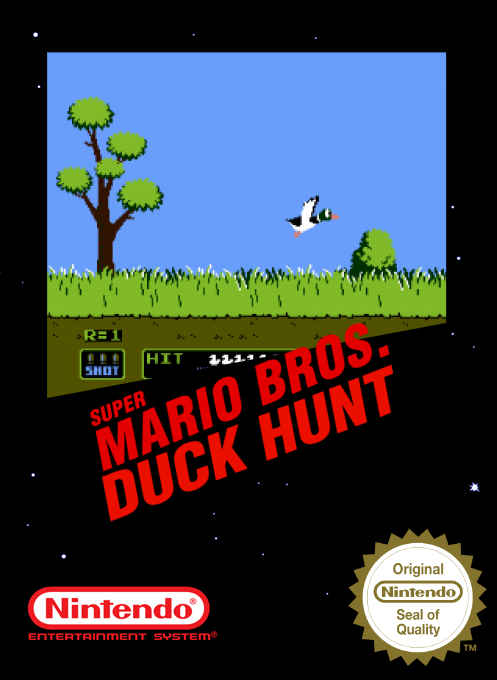
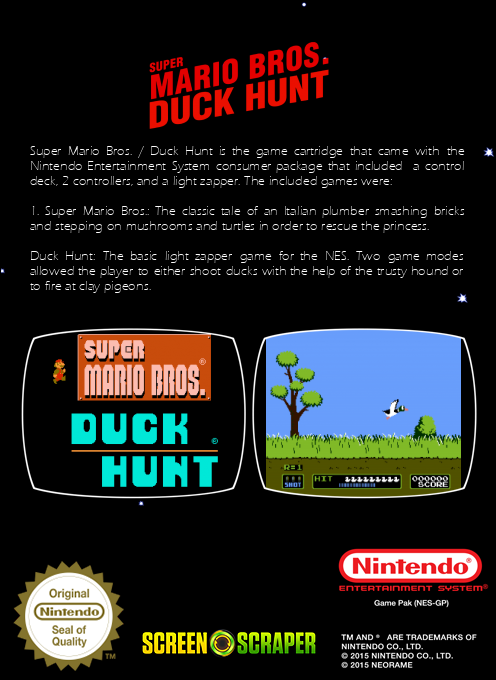
Released by Nintendo in North America in 1988, Super Mario Bros. + Duck Hunt combines two defining NES experiences on one Game Pak. This is the two-game cartridge associated with the NES Action Set: it places the Mushroom Kingdom platform adventure and the Zapper shooting game behind a shared title screen, while keeping each game as its own complete program. It is not a new crossover or a version in which Mario appears in Duck Hunt; players select one of the two games after starting the cartridge.
In Super Mario Bros., one player controls Mario through side-scrolling courses across the Mushroom Kingdom, while a second player can take alternating turns as Luigi. The direction pad moves the character, A jumps, and B runs or throws fireballs after a Fire Flower. Timing a running jump carries Mario farther, and momentum matters when crossing gaps, breaking brick blocks, or stomping enemies. Question blocks, hidden blocks, pipes, underground areas, and warp routes reward exploration as the brothers pursue Princess Toadstool through eight worlds of stages, castles, and Bowser encounters.
The platform game is built around changing Mario's abilities. A Super Mushroom turns small Mario into Super Mario, giving him one extra hit before shrinking, while a Fire Flower grants fireball attacks. A Starman offers brief invincibility, and coins, 1-Up Mushrooms, enemy chains, and shell kicks can earn extra lives. The original game sends players back to the beginning of the current world after a Game Over when they continue, so routes, secrets, and careful use of power-ups become part of the challenge.
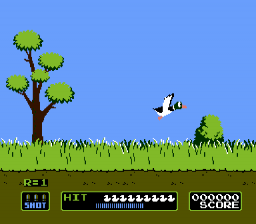
Duck Hunt shifts the action to a shooting range designed for the NES Zapper. Point the light gun at the screen and pull its trigger when ducks cross the field; the dog retrieves fallen birds and reacts to missed shots. Game A presents one duck at a time, Game B sends two ducks at once, and Game C replaces birds with clay targets. A second player can use an NES controller in the duck modes to influence the ducks' flight, making it a competitive twist rather than a second gunner role.
Duck Hunt requires an original NES Zapper connected to controller port 2, while Super Mario Bros. uses the standard NES controller. The Zapper reads the rapid bright-screen flash used by the original game, so it was designed for CRT televisions; a typical modern flat-panel display does not reproduce that timing in a way the original accessory can reliably detect. A combo cartridge alone therefore supports the Mario game, but the Duck Hunt portion needs both compatible Zapper hardware and an appropriate display setup.
Collectors should distinguish this 1988 two-in-one Super Mario Bros. + Duck Hunt Game Pak from standalone releases of either game and from the later North American three-in-one Super Mario Bros. + Duck Hunt + World Class Track Meet cartridge included with the NES Power Set. The latter adds a third game and was paired with the Power Pad, whereas the two-game Action Set package centered on the Zapper. Label variations and bundle components can differ across production runs, but the essential two-title program and its separate Mario-controller and Duck Hunt-Zapper play styles define this NES release.
Gallery
Details
- Developer
- Nintendo
- Publisher
- Nintendo
- Genre
- Compilation
- Players
- 1-2
- Release Date
- November 1, 1988
- System
- NES
/Kekkyoku_Nankyoku_Daibouken.png)