About
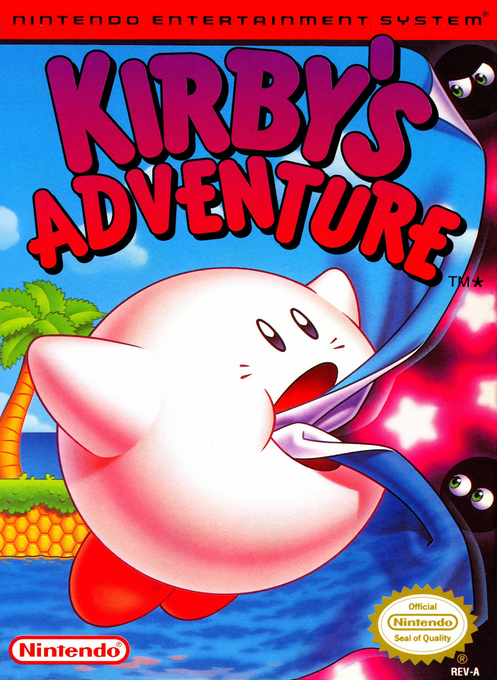
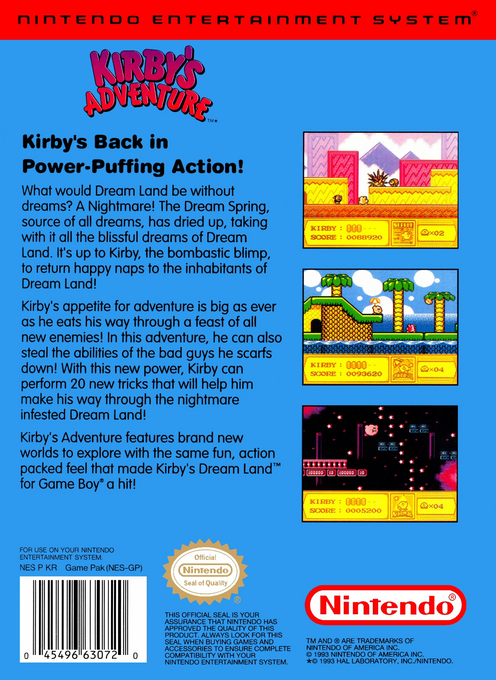
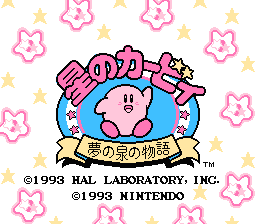
Kirby's Adventure for NES is a 1993 side-scrolling platform game developed by HAL Laboratory and published by Nintendo. Released in Japan as Hoshi no Kirby: Yume no Izumi no Monogatari before reaching North America in May 1993, it is Kirby's second adventure and his only original outing on Nintendo's 8-bit console. Dream Land has lost its dreams after King Dedede takes the Star Rod from the Fountain of Dreams and divides it among his allies. Kirby sets out to recover the pieces, initially treating Dedede as the culprit before the wider danger behind the crisis becomes clear.
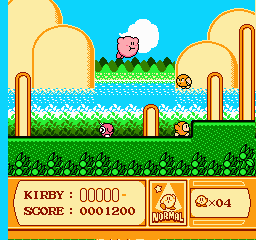
The NES adventure builds on Kirby's familiar fundamentals: he walks, jumps, crouches, inhales foes and loose objects, then spits them back as stars. He can also inflate himself to fly over gaps and obstacles, though doing so changes how he attacks. Running and sliding give the small hero extra momentum and a close-range option, while food restores health and certain items grant brief invincibility. A health meter, extra lives, and automatic saves after cleared stages shape the trip through Dream Land, and the cartridge can keep three save files.
Its defining addition is the Copy Ability system. Swallowing particular enemies lets Kirby borrow their specialties, turning an ordinary inhaling attack into powers such as Sword, Beam, Fire, Hammer, Ice, Tornado, and more. These abilities can open routes, alter how a hazard is approached, or simply provide a different way to handle enemies. Kirby can discard a borrowed power, but a hit may knock it loose, creating a brief chance to inhale it again. This system made experimentation a central part of the journey and became a lasting feature of the Kirby series.
Kirby's Adventure organizes its single-player quest around a colorful map of seven main Dream Land regions. Doors on each regional map lead to compact platforming stages, boss encounters, and Warp Star routes back to earlier areas. The game also includes arenas where Kirby faces a miniboss and can claim its power, museums that supply select abilities, hidden switches and secrets, and bonus games for earning additional lives. The straightforward goal within a standard stage is to reach its exit, but the changing enemy sets and abilities give each route its own texture.
The story eventually sends Kirby beyond his confrontation with King Dedede. Restoring the Star Rod reveals that Nightmare has been corrupting the Fountain of Dreams, so Kirby pursues the threat and uses the restored rod in the final battle. The plot supplies a simple but memorable frame for environments that range from grassy valleys and icy islands to a towering building, gardens, ocean, and a resort-like final region. Meta Knight also makes an early series appearance as a masked adversary during the adventure, though the NES game does not give him the later prominence he would receive.
Arriving late in the NES lifecycle, Kirby's Adventure demonstrates the amount of color, animation, and layered scenery HAL Laboratory drew from the hardware. It was the first game to show Kirby in color, establishing the pink look associated with the character after the monochrome Game Boy debut. The original game was later reissued through several Nintendo services and collections. It also received a separate Game Boy Advance remake, Kirby: Nightmare in Dream Land, which retains the core quest but updates the presentation and adds modes and multiplayer; that remake should not be confused with this single-player NES original.
For players exploring classic Nintendo platformers, Kirby's Adventure NES is a substantial 8-bit campaign built around flexible movement, collectible powers, secret routes, and a clear progression from Dream Land's opening crisis to its final confrontation. Its mix of accessible controls and ability-based variety explains why the game remains an important early entry in Kirby's history: it takes the basic mechanics of Kirby's Dream Land and turns them into a broader adventure with the Copy Ability at its center.
Gallery
Details
- Developer
- HAL Laboratory
- Publisher
- Nintendo
- Genre
- Platformer
- Players
- 1
- Release Date
- May 1, 1993
- System
- NES
/Urusei_Yatsura_Lum_no_Wedding_Bell.png)