About
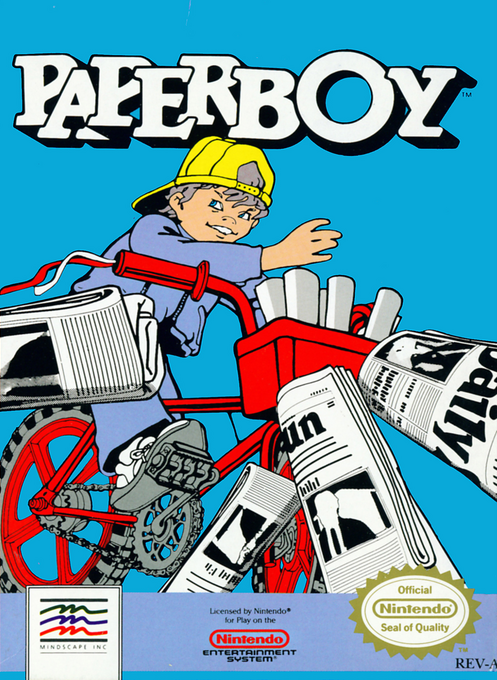
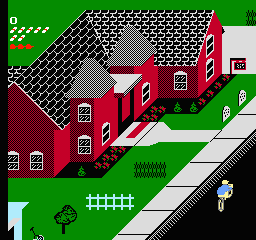
Paperboy for the NES is a 1988 action game published in North America by Mindscape and developed by Eastridge Technology, adapting Atari Games' arcade hit for Nintendo's 8-bit console. It puts the player in the role of a bicycle-riding newspaper carrier working a suburban route for The Daily Sun. Rather than presenting a conventional race or a straight shooting game, Paperboy makes the job itself the challenge: stay upright, make deliveries, protect the paying customers, and reach the end of the week.
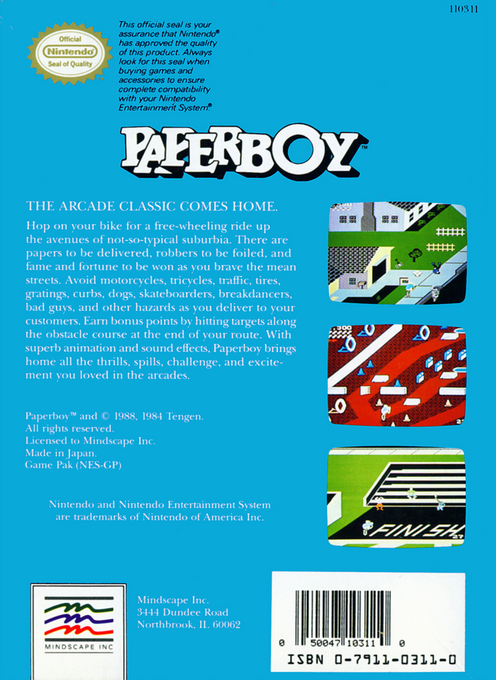
Each day begins at the bottom of an angled, scrolling street. The paperboy rides forward continuously, while the NES controller lets the player guide the bicycle across the road and throw newspapers toward houses, mailboxes, and hazards. Speed matters because a quicker route earns more points, but the street is crowded and its perspective makes precision essential. Papers are limited during the delivery run, so bundles placed along the route are valuable chances to refill the supply.
The central objective is to serve the marked subscribers. A well-aimed throw can land on a porch or in a mailbox, while a missed delivery—or damage to a subscriber's property—can cost that household its subscription. The same rules create a mischievous counterpoint on the other side of the street: non-subscribers do not need papers, and breaking their windows or striking objects can add points. The game therefore asks players to balance an accurate delivery route with opportunistic scoring, all while keeping the newspaper account intact.
Obstacles make every trip unpredictable. Cars, pedestrians, skateboarders, animals, loose tires, construction activity, and stranger sights can force quick changes in position. A collision costs a life, and some threats are best avoided while others can be hit with a thrown paper for points. The neighbourhood is not merely scenery; it is a moving obstacle course whose hazards, house fronts, and targets demand that players read the street while steering and aiming at the same time.
At the end of a route, Paperboy moves to a training course where the player can throw freely at targets and use ramps for stunt-like jumps. Successful deliveries earn bonuses before the next day begins, and a perfect route can preserve the customer base and add another subscriber. The structure spans a Monday-through-Sunday workweek, so the goal is not simply one high-scoring run but surviving a succession of increasingly demanding deliveries without losing every life or every customer.
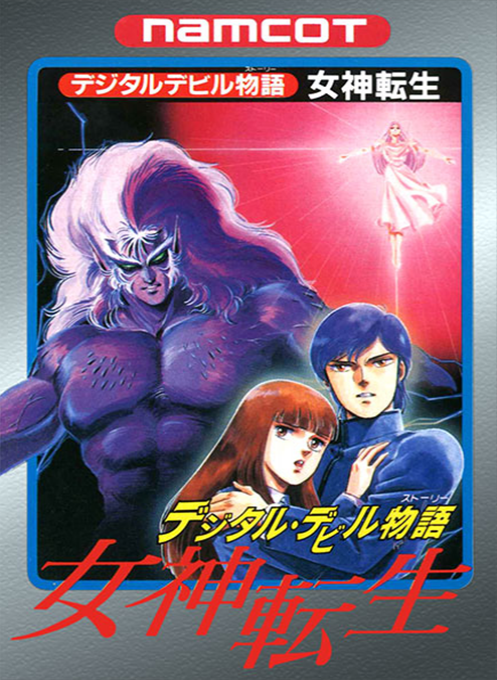
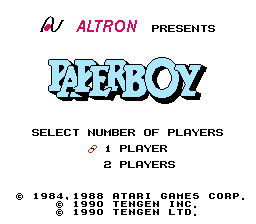
The NES edition uses a standard controller in place of the original arcade cabinet's distinctive handlebar controls, while retaining the oblique view and the essential route-and-delivery design. It was released later in other regions, including Europe through Mindscape and Japan through Altron, but it remains part of the same early Paperboy lineage that began in arcades. A sequel, Paperboy 2, followed on home systems in 1991, while the original Paperboy's unusual mix of driving, target throwing, and household route management kept this NES conversion recognizable as a singular arcade-style challenge.
Gallery
Details
- Developer
- Atari
- Publisher
- Mindscape International
- Genre
- Other Sports
- Players
- 1-2
- Release Date
- December 1, 1988
- System
- NES
/Ninja_Jajamaru-kun.png)