About
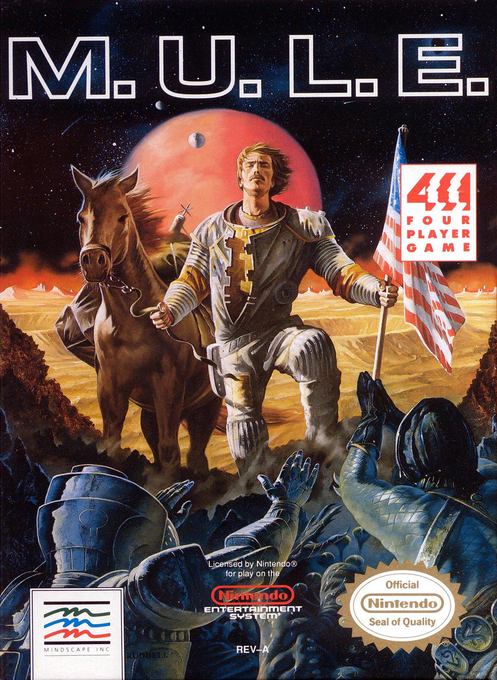
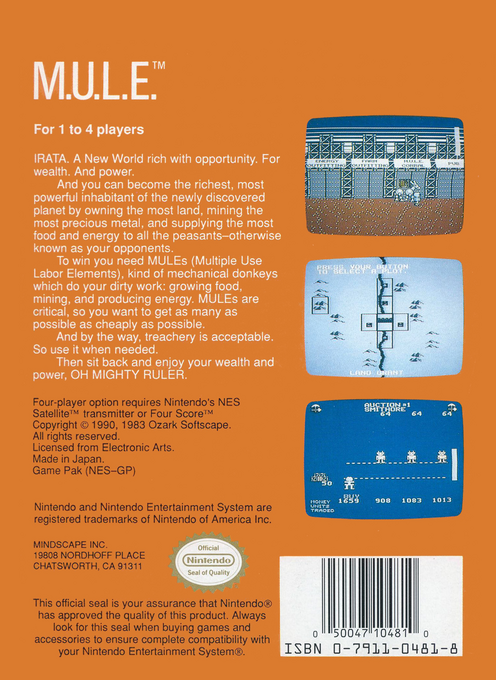
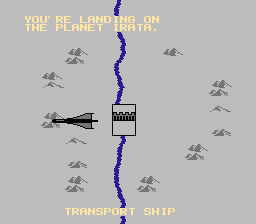
M.U.L.E. is the Nintendo Entertainment System version of Ozark Softscape's influential economic strategy game, published in North America by Mindscape in 1990. Rather than asking players to defeat enemies or clear stages, it drops up to four colonists on the frontier planet Irata and makes their fortunes depend on land, labor, timing, negotiation, and an economy that can turn against anyone. The title refers to Multiple Use Labor Elements, the robotic work units that make a settlement's resource production possible.
A match begins with players choosing colonists with different strengths and weaknesses, then claiming plots on a map divided among river, plains, and mountain terrain. Terrain matters: river land is well suited to food, plains support energy production, and mountains are valuable for smithore. Each round gives colonists limited time to travel, buy equipment, outfit M.U.L.E.s, explore, and pursue small opportunities such as hunting the mountain Wampus. Food is not simply money in another form; a low food supply reduces the time available during the next turn.
The M.U.L.E. system supplies the game's central decisions. A newly purchased unit can be fitted to produce food, energy, smithore, or, in the more demanding Tournament game, crystite. Energy keeps developed land productive, smithore supports the supply of new M.U.L.E.s, and crystite can bring substantial income. Players therefore have to assess their own needs while considering what the whole colony lacks. A profitable private plan can become dangerous when an essential resource shortage leaves everyone unable to produce or act effectively.
After the development phase, production and market trading turn those plans into results. The auction screen makes buying and selling a direct contest, as players move to signal prices and try to complete deals before time expires. Supply and demand influence store prices, while private transactions create room for cooperation, opportunism, and brinkmanship. A player can make money by holding back scarce goods, but the colony must meet its broader goals as well, giving the competition a deliberately uneasy cooperative edge.
Random events keep a carefully laid strategy from becoming routine. A runaway M.U.L.E., pest attack, acid rain, sunspot activity, planetary disturbance, store fire, pirate raid, or meteorite can change output and prices without warning. The design also cushions the trailing players in several situations, helping close games remain competitive. Those shifts make a turn-by-turn understanding of food, energy, land placement, and reserves more useful than a single rigid formula.
On NES, M.U.L.E. brings this unusual blend of board-game planning and real-time pressure to a cartridge release years after the original Atari 8-bit debut. Its clean, icon-driven structure makes the settlement's loop readable: choose land, prepare production, see the consequences, and trade for the next round. Computer-controlled colonists fill open positions, so the game works for a smaller group while retaining its multiplayer-centered design.
M.U.L.E. remains notable for making economic ideas tangible without reducing them to a lecture. Every purchase consumes time or cash, every field has an opportunity cost, and every market decision affects other settlers. Whether played as a competitive local strategy game or explored as a landmark of early simulation design, the NES release offers a distinctive contest of resource management, changing prices, and social negotiation on an alien frontier.
Gallery
Details
- Developer
- Ozark Softscape
- Publisher
- Mindscape International
- Genre
- Turn-Based Strategy
- Players
- 1-4
- Release Date
- September 1, 1990
- System
- NES



/Dash_Yarou.png)
/Superstar_Pro_Wrestling.png)