About
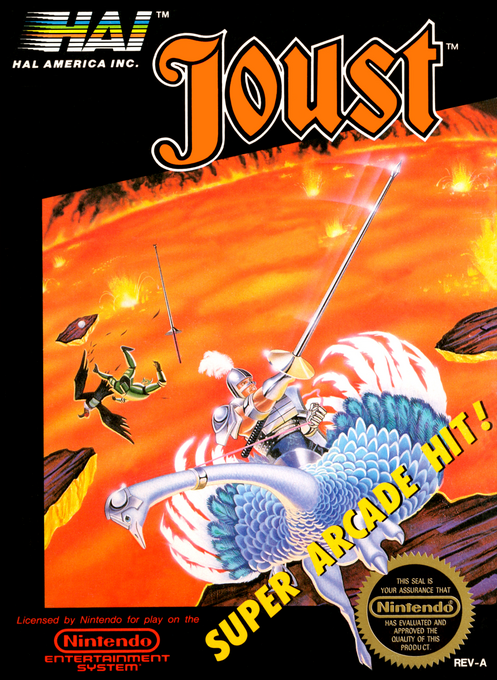
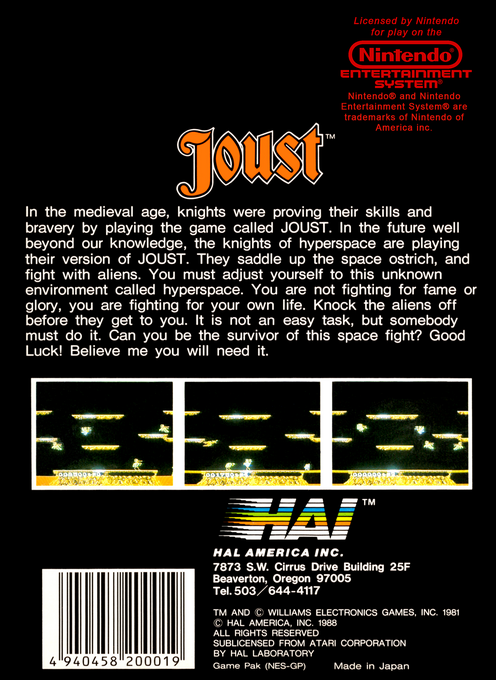
Joust for the Nintendo Entertainment System brings Williams Electronics' 1982 arcade action game to Nintendo's 8-bit console. HAL Laboratory developed this home conversion, releasing it in Japan as Joust in 1987 and in North America through HAL America in 1988. It turns the medieval sport of lance combat into a compact fantasy contest: a lone armored rider takes to the air on an enormous ostrich and faces hostile knights mounted on buzzards. Its single-screen arenas, direct controls, and room for one or two players preserve the central idea that made the original arcade game distinctive.
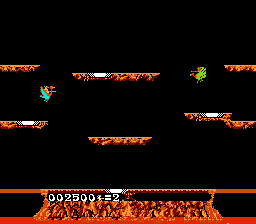
Each round takes place over a field of floating platforms above a lava-filled lower edge. The goal is to clear successive waves of enemy riders, not by firing projectiles, but by meeting them with a lance at a better height. A hit from above unseats the opponent; a clash on equal terms sends the combatants away to try again. The directional controls steer the mount left and right, while repeated presses of the flap button determine how it rises, hovers, or descends. Moving off one side of the screen wraps the rider to the other, so positioning, momentum, and the route around the platforms all matter in every encounter.
Defeated opponents leave eggs behind. Collecting an egg earns points and removes it from the field, while leaving it alone allows it to hatch and return an enemy rider to the fight. The opposition escalates through the color-coded Bounders, Hunters, and Shadow Lords, whose increasing speed and aggression make later waves harder to manage. This gives Joust NES a clear rhythm: remove immediate threats, decide when it is safe to chase an egg, and keep enough altitude to win the next collision. The action can become crowded quickly, especially when several riders share the same stretch of airspace.
The arena itself is part of the challenge. Platforms provide brief places to regroup, but they also shape approaches and can turn a poor flight path into a dangerous collision. A lava troll reaches for characters that fly too low, and a pterodactyl appears to pressure players who linger. These hazards make the screen more than a backdrop: survival depends on watching the lower boundary as carefully as the incoming buzzards. Lives are lost when a rider loses a joust or falls victim to the arena's dangers, so success comes from balancing aggressive attacks with controlled flapping.
Joust supports one or two players. The first player rides an ostrich, while the second joins on a stork. Two riders can cooperate to reduce each wave, compete for eggs and scoring opportunities, or collide with one another in the same shared arena. That flexibility makes the NES version work as both a solo score-chasing game and a local multiplayer contest. Because the rules are based on relative height rather than a complicated move list, the game is easy to understand at the start, yet every flap and approach can change the outcome of a duel.
The NES release belongs to a broad line of Joust conversions, but it has a specific place in the series' history. HAL Laboratory published the Famicom edition in Japan in 1987, retaining Atari copyright information for the licensed game, before HAL America issued the North American cartridge the following year. The move from arcade controls to an NES controller changes the physical interface, while the port keeps the game's recognizable loop of aerial movement, lance-versus-lance encounters, hatching eggs, advancing waves, and simultaneous two-player play. For players exploring classic NES action games, Joust remains a focused adaptation of an arcade design built around flight, timing, and split-second control of the vertical advantage.
Gallery
Details
- Developer
- HAL Laboratory
- Publisher
- HAL America
- Genre
- Platformer
- Players
- 1-2
- Release Date
- October 2, 1988
- System
- NES
/Dragon_Ball_Z_Gaiden_Saiya_Jin_Zetsumetsu_Keikaku.png)