About
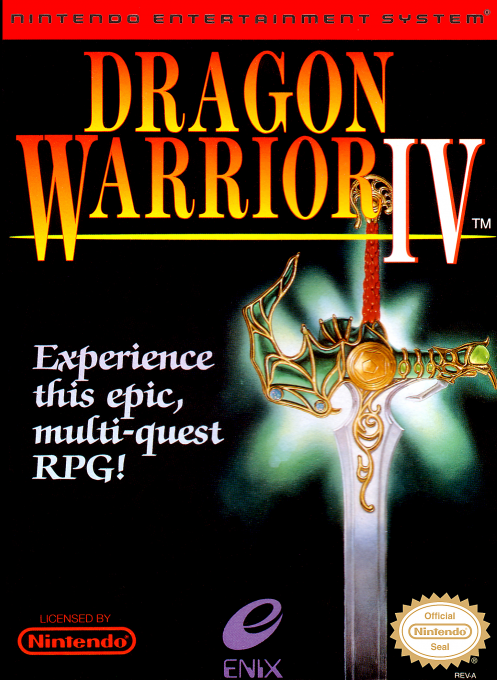
Dragon Warrior IV is the North American NES edition of the fourth Dragon Quest adventure, developed by Chunsoft and published by Enix in 1992. It arrived under the Dragon Warrior name, rather than the Dragon Quest title used in Japan and by later releases, and it closes the series' original NES run in North America. This is the cartridge-era version: a large, menu-driven fantasy role-playing game built around exploration, towns, equipment, spells, and deliberate turn-based battles. Its strongest idea is not simply the scale of the journey, but the way it introduces a whole party before asking that party to save the world together.
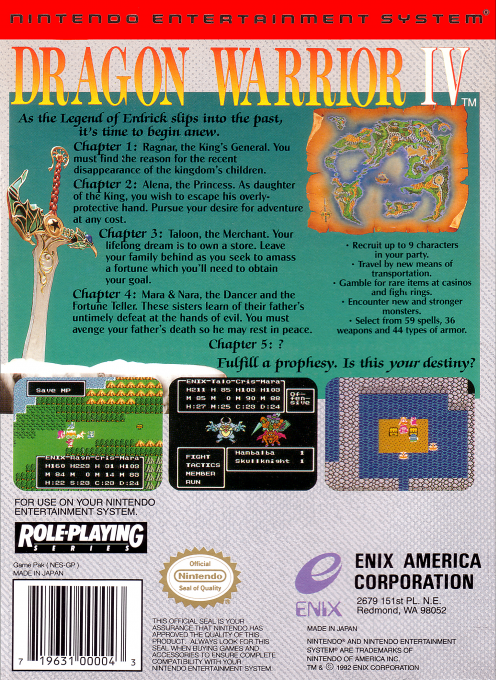
The adventure is divided into five chapters. The opening four chapters each put a different future companion at the center of a separate story, giving the game several distinct starting points before the main quest begins. A soldier investigates the disappearance of children, a spirited princess enters a tournament, a merchant pursues the means to open his own shop, and two sisters follow clues connected to their father's death. These episodes have their own towns, objectives, and small casts, so the eventual gathering in Chapter 5 has the feeling of separate travels finally intersecting.
In the final chapter, the player takes the role of the Hero and retraces a broader world with the companions introduced earlier. Conversations with townspeople, clues from kings and travelers, locked routes, caves, and distant castles gradually point the group toward the larger threat. Progress follows the recognizable rhythm that made early Dragon Warrior games so absorbing: prepare in town, explore beyond its safety, fight for experience and gold, improve the party's gear, and return with enough strength or information to press onward. The pace rewards note-taking and persistence without abandoning the pleasures of finding a new settlement or opening a previously barred path.
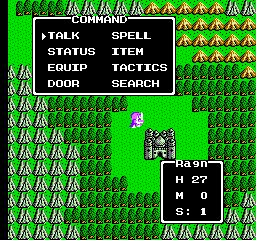
Combat uses straightforward, turn-based commands, but the NES release makes an important distinction between the early chapters and the last one. In Chapter 5, the Hero remains directly commanded while the other regular party members act through the game's Tactics system. Rather than selecting every ally's action each round, the player chooses an overall approach that can favor aggressive attacks, careful use of magic points, healing, or a balanced response. That system gives battles a different texture from the fully directed opening chapters and makes party composition, supplies, and tactical priorities especially important in the original NES version.
The wagon expands that strategic layer once it becomes available. It carries companions who are not in the active battle line, allowing the larger group to travel together and giving the player more options when choosing who should face a dungeon or boss. Different characters contribute different weapons, spells, resilience, and support, so deciding who rides in the wagon and who fights is part of the expedition planning. The game also includes familiar RPG essentials such as weapon and armor shops, inns, item management, healing services, and a casino where tokens can be used in its games.
Dragon Warrior IV is notably varied for an 8-bit role-playing game. The merchant chapter temporarily shifts the emphasis toward earning money and establishing a business, while the other chapters frame their quests through investigation, travel, revenge, and competition. The game uses those contrasting roles to make its eventual party feel like a collection of people with their own reasons for joining the journey, not merely a set of interchangeable combat classes. Its episodic structure also lets new players sample several kinds of goals before the longer Hero-led quest takes over.
Visually, this NES entry presents its world through top-down fields, compact towns, tile-based dungeons, and first-person battle screens. Its limitations are part of its character: menus ask the player to make careful choices, long journeys make preparation matter, and victories can come from understanding an enemy or conserving a scarce spell rather than reacting quickly. The music, enemy designs, and fantasy setting belong to the foundational era of the series, while the chapter format and tactical automation set this installment apart from the three earlier North American Dragon Warrior games.
For players seeking the original NES experience, Dragon Warrior IV is best approached on its own terms rather than as a substitute for the later Dragon Quest IV remakes. Subsequent versions added audiovisual updates and changed how party control works, but this release preserves the particular structure and tactical constraints of Enix's 1992 localization. It is a substantial retro RPG about assembling a fellowship through five connected stories, then guiding that fellowship across a dangerous world one measured command at a time.
Gallery
Details
- Developer
- Chunsoft
- Publisher
- Enix
- Genre
- JRPG
- Players
- 1
- Release Date
- October 2, 1992
- System
- NES