About
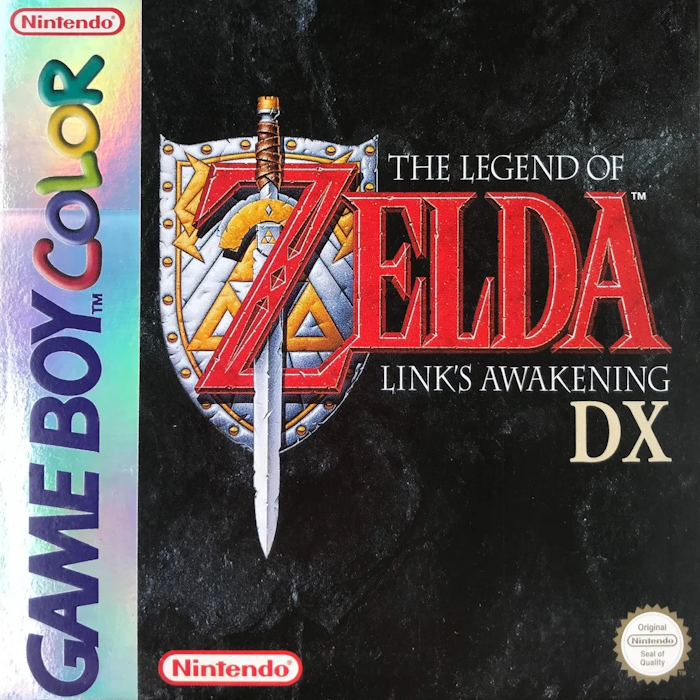
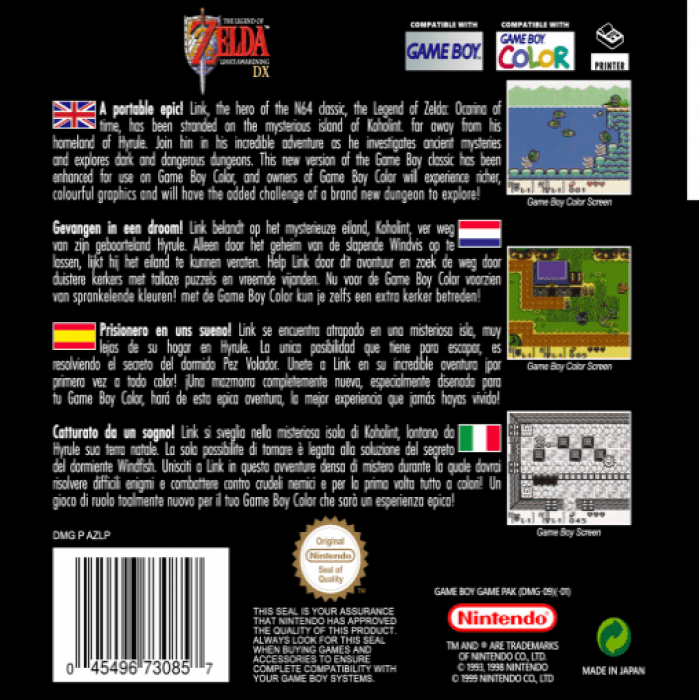
The Legend of Zelda: Link's Awakening DX for Game Boy Color is Nintendo's 1998 color-enhanced edition of the 1993 Game Boy adventure. Developed by Nintendo EAD and published by Nintendo, it sends Link away from Hyrule and onto Koholint Island after a storm leaves him shipwrecked. An owl explains that the only way to leave is to wake the island's sleeping Wind Fish, beginning a solitary fantasy quest that remains separate in setting and tone from the series' usual struggle over Hyrule and the Triforce. This is the original handheld game rebuilt for Game Boy Color, rather than the later Nintendo Switch remake.
Play unfolds from a top-down view across an interconnected island of beaches, forests, mountains, caves, villages, and underground labyrinths. Link moves with the directional pad, swings his sword, raises his shield, and assigns the tools he discovers to the handheld's action buttons. Progress comes from exploring, speaking with Koholint's inhabitants, uncovering hidden routes, and using each new item to reach places that had been inaccessible. Keys, switches, blocks, enemy encounters, and environmental puzzles make each dungeon a compact challenge, while hearts and other upgrades help Link withstand increasingly dangerous battles.
The central objective is to recover the eight Instruments of the Sirens from eight major dungeons and use them to awaken the Wind Fish. Every completed dungeon adds a new tool or ability to Link's inventory, changing how he navigates the overworld as well as how he approaches later puzzles. Familiar Zelda equipment such as bombs, a boomerang, a hookshot, and other usable items works alongside dungeon-specific obstacles, so exploration often means recognizing when a recently acquired tool can solve an earlier problem. The game also includes side activities and item exchanges that reward curiosity beyond the main route.
Koholint gives Link's Awakening DX its unusual character. The island's residents include Marin, her father Tarin, and a broad cast of people and creatures whose dialogue gradually makes the setting feel stranger and more dreamlike. The adventure mixes original characters and locations with playful nods to other Nintendo games, while its enemies and bosses keep the journey focused on combat, puzzle solving, and discovery. Link travels alone, and the Game Boy Color release is a single-player game, built around methodical exploration rather than a multiplayer mode.
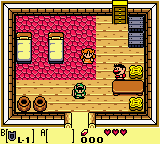
DX adds the most visible change in its fully colored presentation, making the island's environments, characters, enemies, and dungeon details easier to distinguish than in the monochrome Game Boy original. It can still run in monochrome on an original Game Boy, but its exclusive content is designed around the Game Boy Color. The added Color Dungeon uses color-coded puzzles, switches, and foes; finishing it lets the player choose a Red Tunic for stronger attacks or a Blue Tunic for reduced damage. Revised owl-statue hints also offer extra direction inside dungeons.
The Game Boy Color version also introduces a Camera Shop and a photo album. At specific moments around Koholint, a photographer can capture scenes featuring Link; the images can be reviewed in-game and, with the appropriate Game Boy Printer and Game Link Cable setup, printed as stickers. These additions do not replace the original adventure's eight-dungeon structure, but they give returning players new discoveries alongside the color artwork and extra dungeon. Link's Awakening DX was later made available through Nintendo's 3DS Virtual Console, preserving this particular Game Boy Color version for another generation of players.
Gallery
Details
- Developer
- Nintendo EAD
- Publisher
- Nintendo
- Genre
- JRPG
- Players
- 1
- Release Date
- December 1, 1998
- System
- GBC