About
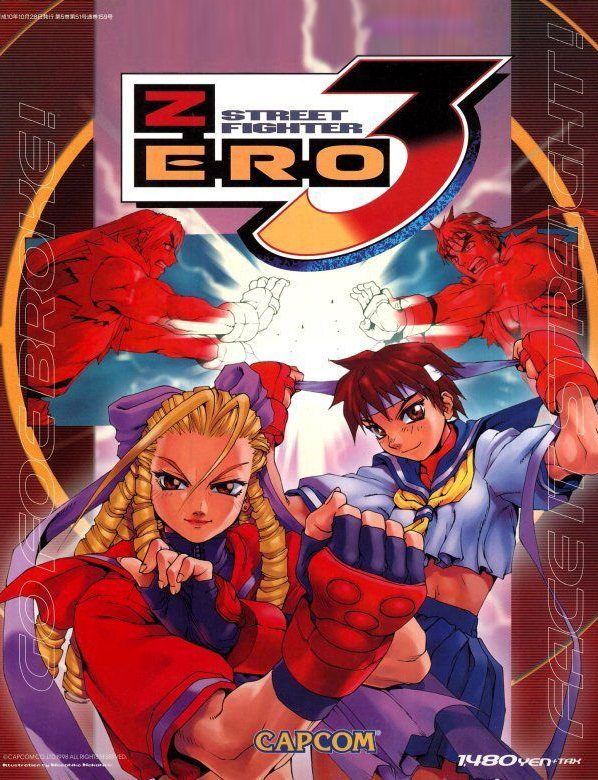
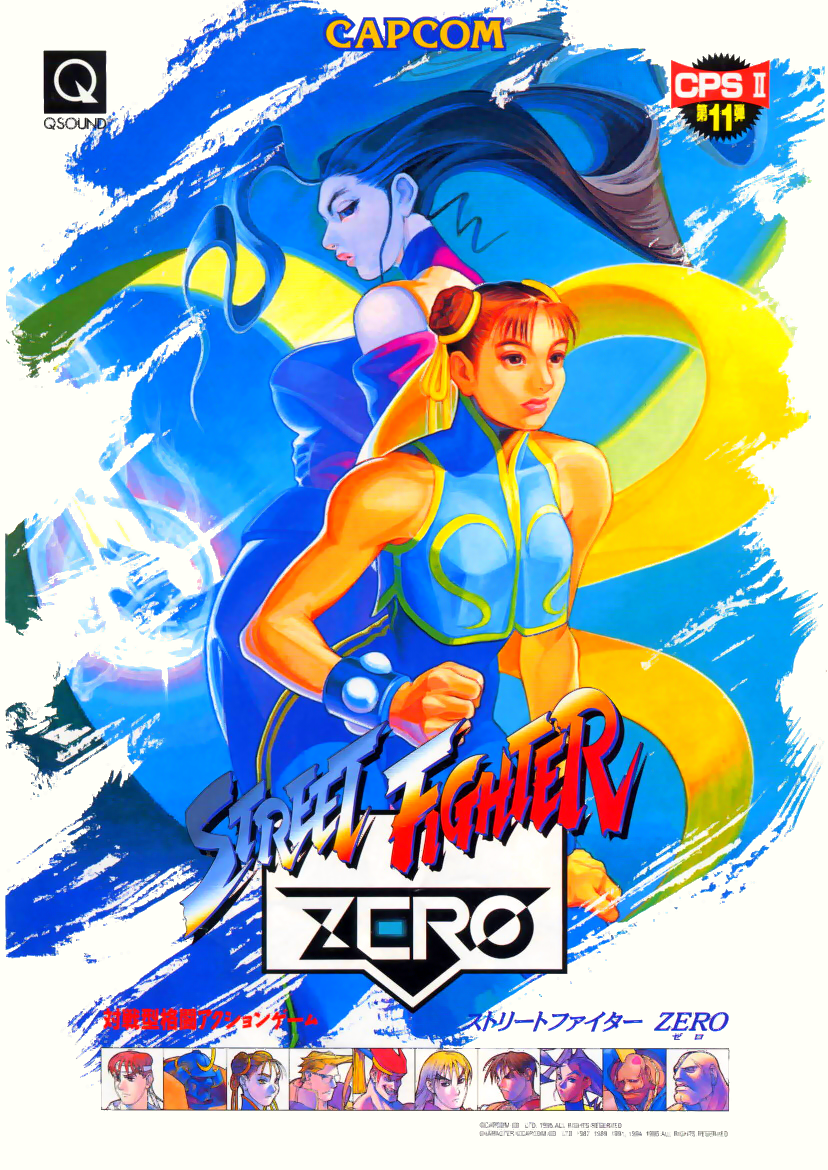
Street Fighter Zero is Capcom’s 1995 arcade fighting game for the CP System II hardware, released in Western territories as Street Fighter Alpha: Warriors’ Dreams. The “Clone” label identifies this catalogue entry as a regional arcade set rather than a different game. It is the first entry in the Alpha/Zero branch of Street Fighter, positioned before Street Fighter II in the series chronology and presenting several familiar fighters at an earlier point in their stories. Capcom developed and published the original coin-operated release, which supports one or two players.
Each match is a best-of-rounds contest between two combatants viewed from the side. Players use an eight-direction joystick and six attack buttons—three punches and three kicks—to control spacing, jump, crouch, block, throw, and perform each character’s special moves through directional inputs and button presses. Ryu’s fireballs and dragon punches, Chun-Li’s rapid kicks, and other returning techniques make the fundamentals immediately recognisable, while individual move sets reward learning a chosen fighter’s range and timing. A single-player run sends the selected character through computer-controlled opponents and a character-dependent final confrontation; head-to-head play is the central competitive mode.
The game’s most important addition is its three-level Super Combo gauge. Attacking and using special techniques build meter during a fight, and a filled level can be spent on a more powerful Super Combo. The button strength chosen for the command determines how much available meter is used, creating a choice between taking an earlier opening and saving resources for a larger attack. Street Fighter Zero also adds the Alpha Counter, called the Zero Counter in Japanese versions: after blocking, a player can spend meter to answer the opponent with a counterattack. Air blocking, recoveries after throws, ground rolls after knockdowns, and chainable normal attacks further change the rhythm from earlier Street Fighter II games.
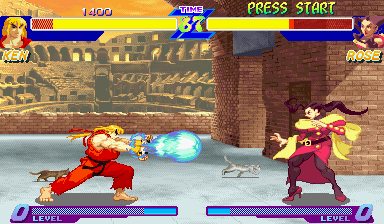
The cast combines Street Fighter regulars with characters drawn from other corners of Capcom’s fighting-game history. Ryu, Ken, Chun-Li, Sagat, and the villain M. Bison return, while Birdie and Adon reappear from the first Street Fighter. Final Fight contributes Guy and Sodom. Newcomers include Charlie Nash, Guile’s military ally, and Rose, a fortune teller associated with Soul Power and Bison’s story. Dan, Capcom’s deliberately comic martial-arts parody, appears as a hidden challenger and selectable character, while Akuma can serve as a secret opponent. These connections give the game a roster that looks backward to the original Street Fighter while establishing the Alpha series’ own identity.
Street Fighter Zero uses bold, hand-drawn-looking character art and animated visual effects rather than simply repeating the presentation of Street Fighter II. Its arcade release also includes selectable Normal and Auto styles. Auto assists with a limited amount of guarding and offers a simplified Super Combo input, but restricts the maximum gauge level, making the trade-off clear. A hidden Dramatic Battle lets two players team up as Ryu and Ken against a computer-controlled M. Bison, echoing the confrontation from Street Fighter II: The Animated Movie. The Japanese and overseas versions differ in title and in some regional presentation, but share the same core tournament fighting game.
After the arcade debut, Capcom brought the game to PlayStation and Sega Saturn, where dedicated versus and training options made its systems easier to practise away from the arcade. Later releases included a CPS Changer edition in Japan, a Windows version based on the PlayStation release, a scaled-down Game Boy Color adaptation, and appearances in collections such as Street Fighter Alpha Anthology and Street Fighter 30th Anniversary Collection. Street Fighter Zero began a trilogy followed by Street Fighter Alpha 2 and Street Fighter Alpha 3, and its meter management, defensive counters, and animated style remain defining features of this 1990s Street Fighter offshoot.
Gallery

Details
- Developer
- Capcom
- Publisher
- Capcom
- Genre
- Fighting
- Players
- 1-2
- Release Date
- January 1, 1995
- System
- Arcade