About
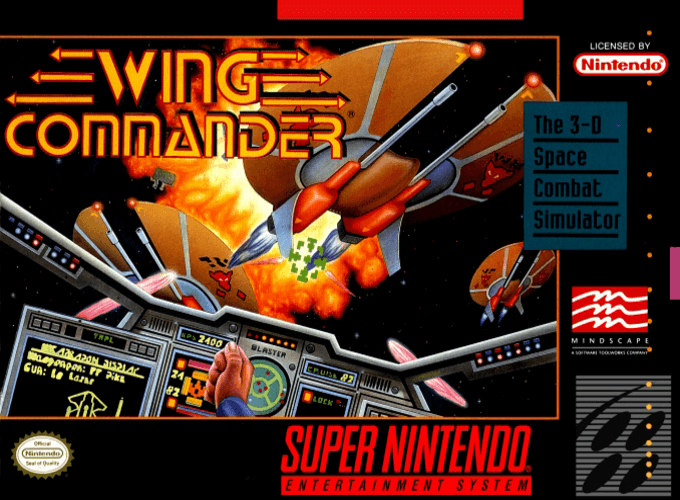
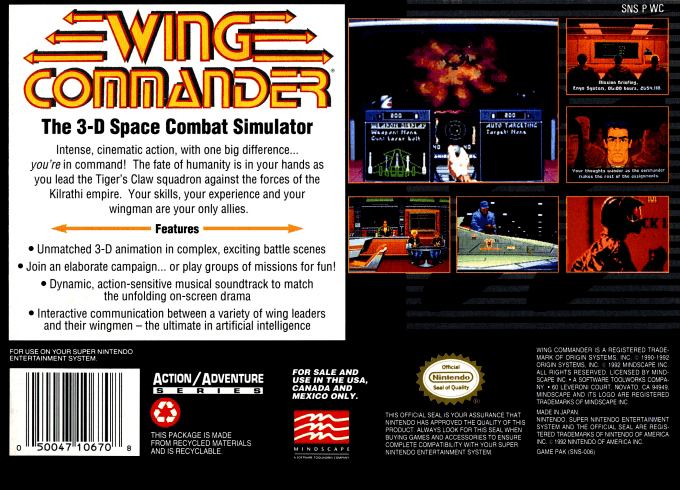
Wing Commander SNES brings the opening chapter of Origin Systems' space-combat series to the Super Nintendo Entertainment System. Released in 1992 and developed and published for the console by Mindscape, it adapts Chris Roberts' original Wing Commander campaign for a one-player cartridge release. The game places a newly assigned Terran Confederation pilot aboard the carrier TCS Tiger's Claw, where a long war with the feline Kilrathi Empire has pushed the Vega Sector to the front line.
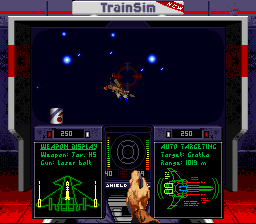
Play alternates between briefings and conversations aboard the Tiger's Claw and first-person flights in a fighter cockpit. Before each sortie, the pilot learns the assignment and meets fellow members of the ship's flight wing. In space, the Super NES control pad handles pitch and turning while the shoulder buttons adjust speed. The cockpit presents the tools needed to fly, acquire targets, manage weapons, communicate, and keep track of the battle as enemy fighters move through three-dimensional space.
Missions ask the player to defend friendly craft, intercept hostile forces, scout important locations, or escort larger ships. Navigation points guide a sortie from one objective to the next, but reaching them safely is only part of the job: Kilrathi patrols, capital ships, and named enemy aces can turn a routine route into a dogfight. The Tiger's Claw carries four Terran fighter types—the Hornet, Scimitar, Raptor, and Rapier—whose differing speed, protection, and armament encourage a change in tactics from mission to mission.
Combat rewards a measured approach to pursuit, range, and energy. Guns generate heat, missiles have their own uses, and a pilot can alter speed or brake hard to set up a new angle on an opponent. A radar and target information help with situational awareness, while radio commands let the player direct an accompanying wingman. Wingmen can be asked to keep formation or attack a selected target, and enemy craft can be taunted over communications. Returning to the carrier requires requesting landing after the work in the field is done, leading into a debriefing before the next assignment.
The SNES Wing Commander campaign is not simply a chain of isolated battles. Performance influences how the larger Vega campaign unfolds, so successes can lead toward a more favorable route while setbacks push the war onto harder, more defensive assignments. The player creates a pilot handle at the start, and the cartridge's password system ties later mission progress to that handle. Fellow pilots such as Angel, Hunter, Iceman, Paladin, Spirit, Maniac, and Knight give the carrier sections a recurring cast alongside the anonymous rookie at the center of the story.
Mindscape's conversion retains the series' mixture of military science fiction, character-driven shipboard scenes, and cockpit action while fitting it to Nintendo's 16-bit hardware. The SNES release has its own Mindscape programming, art, and audio credits, with Origin Systems credited for the original game's direction and creative work. It was issued in North America and Europe by Mindscape, while ASCII handled the Japanese release, making it a distinct console version of a game that first appeared on MS-DOS in 1990.
For retro players, Wing Commander on Super NES stands out as an early console space-flight campaign built around both moment-to-moment dogfighting and a changing war narrative. Its place at the start of the Wing Commander series is especially clear in the Tiger's Claw setting, the Confederation-Kilrathi conflict, and the pilots who would become familiar names in the franchise. A separate Super NES release of The Secret Missions later continued this era, but this cartridge is the main campaign's starting point.
Gallery
Details
- Developer
- Mindscape
- Publisher
- Mindscape
- Genre
- Flight Simulator, Shoot 'em Up
- Players
- 1
- Release Date
- November 1, 1992
- System
- SNES