About
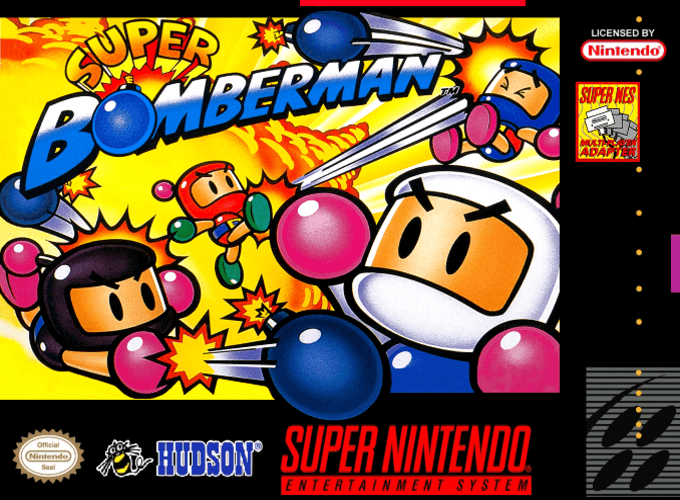
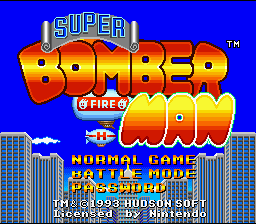
Super Bomberman SNES is a 1993 top-down action maze game from Produce and Hudson Soft, and the first Bomberman title made for Nintendo's 16-bit Super NES and Super Famicom. It brings the series' compact, grid-based bomb-laying formula to a new generation of hardware while keeping the rules immediately legible: move through a maze, place bombs, escape their cross-shaped blasts, and use the newly opened paths to reach the next goal. Hudson released the game in Japan in April 1993, followed by North American and European editions later that year. Its cartridge combines a structured adventure for one or two players with the competitive Battle Game that became one of the system's best-known multiplayer attractions.
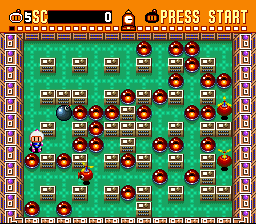
Every playfield is viewed from above and confined to a single screen of square spaces. Solid blocks form the permanent layout, while breakable soft blocks obstruct routes and conceal useful items. A bomb placed at Bomberman's feet ticks down before firing in the four cardinal directions; a player caught in the flames is defeated, and one blast can ignite another bomb early to create a chain reaction. This simple arrangement makes positioning matter as much as timing. A bomb can block a corridor just as easily as it can trap an enemy, so a careless placement may leave its owner with no safe exit. Power-ups found by clearing blocks can increase the number of bombs available, lengthen the flame, improve movement speed, or otherwise alter how a maze can be approached.
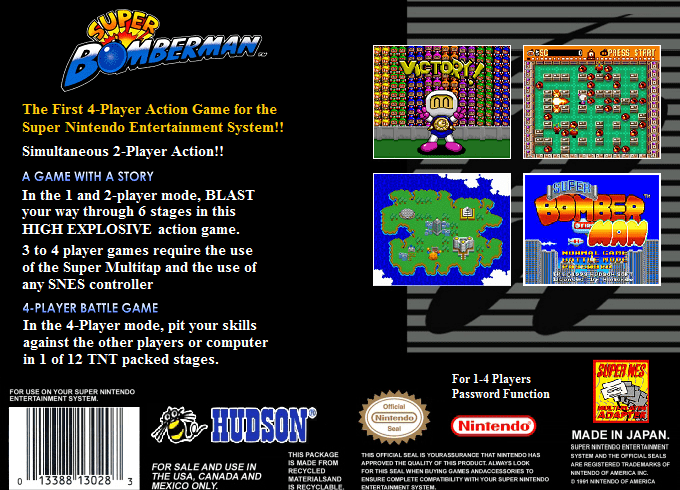
The Normal Game sends White Bomberman and Black Bomberman into trouble surrounding Diamond City. Villains Carat Diamond and Dr. Mook use hostile machines in their campaign, giving the campaign a light science-fiction cartoon setting rather than treating its mazes as abstract arenas. Players clear enemies, search beneath the destructible blocks for the exit, and advance through six themed worlds. Each world has eight stages, with a boss encounter closing the set. The campaign supports one player or two people working together, though the friendly-fire rules never disappear: a partner can be caught in a badly timed blast as readily as an opponent. Passwords provide a way to resume at later stages, a practical feature for a cartridge game with a lengthy sequence of maps.
The Battle Game turns the same mechanics into a round-based contest for one to four participants, with computer-controlled Bombermen able to fill empty slots. Competitors begin in a maze of open lanes and breakable barriers, collecting items as they carve paths and trying to be the last survivor. Rounds award trophies to the winner, and players choose the number of trophies required to take the match. A two-minute limit prevents a round from stalling; if time runs low, falling indestructible blocks squeeze the arena inward and force the remaining players into closer danger. This escalating boundary, combined with chain reactions and upgrades, means that a moment of advantage can vanish when the field becomes too tight to retreat.
Two players can use the Super NES controller ports directly, but the game was closely associated with Hudson's Super Multitap accessory for larger groups. With the accessory attached, four people can play Battle Game together on one console. That hardware connection was a major part of Super Bomberman's identity: instead of merely adding a competitive option to a solo game, it made shared-screen elimination matches a central feature. The first Super Bomberman was sold in configurations tied to the multitap in some markets, and its success established the foundation for a continuing Super Bomberman line on the system.
Although Bomberman had appeared on earlier machines, this installment marked the series' Super NES debut and introduced the sequence later continued by Super Bomberman 2, Super Bomberman 3, Super Bomberman 4, and Super Bomberman 5. Its appeal rests on rules that are easy to understand but difficult to master: learn the blast pattern, watch the escape routes, and anticipate where another player will be when the fuse expires. Whether played as a co-operative trip through Diamond City or a local contest full of sudden reversals, Super Bomberman remains a clear example of how a small set of maze-game rules can support both deliberate planning and fast shared-screen play.
Gallery
Details
- Developer
- Hudson
- Publisher
- Hudson
- Genre
- Maze
- Players
- 1-4
- Release Date
- September 1, 1993
- System
- SNES
/Wizardry_I-II-III_Story_of_Llylgamyn.png)