About
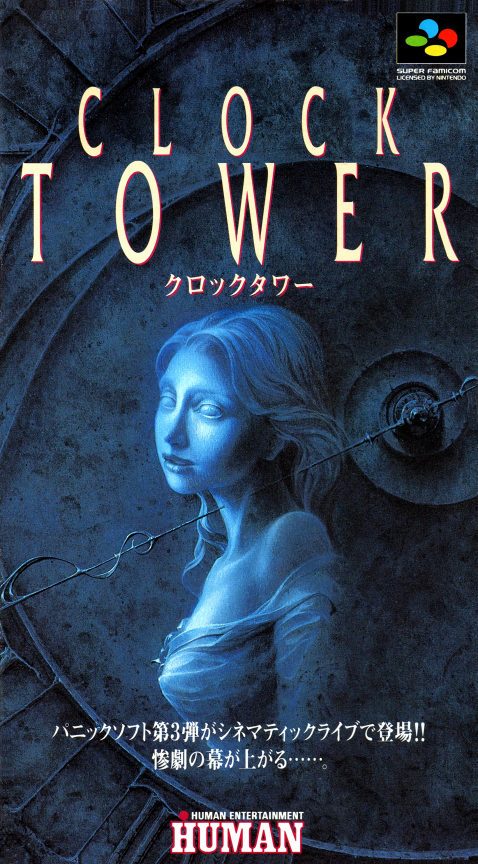
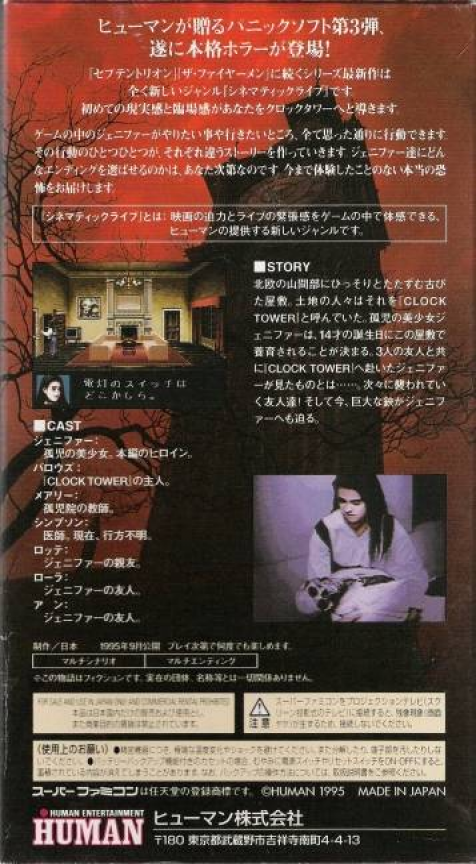
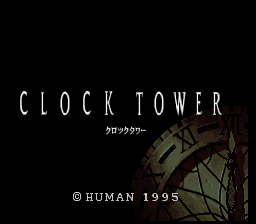
Clock Tower is Human Entertainment's 1995 Super Famicom survival-horror adventure and the opening entry in the Clock Tower series. Released in Japan on September 14, 1995, this is the original 16-bit game, not the later PlayStation title that shared its name in the West and not the enhanced PlayStation, Windows, or WonderSwan version known as Clock Tower: The First Fear. Directed by Hifumi Kono and developed and published by Human Entertainment, it places tension, uncertainty, and escape ahead of combat. Its Japanese Super Famicom release established the basic ideas, setting, and antagonist that later versions and sequels would build on.
The story begins with Jennifer Simpson and several other girls from Granite Orphanage traveling to the isolated Barrows Mansion after an adoption arrangement. Their arrival promises a new home, but the mansion soon becomes a trap when the girls disappear and Jennifer hears evidence that something is terribly wrong. Exploring the enormous, clock-tower-topped estate reveals its unsettling family history and the presence of Scissorman, a murderous child carrying oversized scissors. Jennifer is not a trained fighter or an action hero; she is a frightened teenager trying to understand the danger around her and find a way out alive.
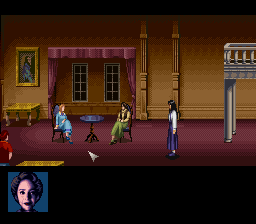
Clock Tower uses a cursor-driven point-and-click interface on the Super Famicom. Players move the cursor across hand-drawn rooms to direct Jennifer, inspect suspicious furniture, open doors, collect useful objects, and trigger events. The mansion functions as an interconnected puzzle box full of locked routes, concealed clues, and items whose uses must be inferred from the environment. Rather than making every encounter a fixed sequence, the game rearranges some item placements and circumstances between playthroughs. That structure encourages observation and repeat visits to rooms that may seem safe or unimportant at first.
The central threat is Scissorman, whose appearances turn ordinary exploration into a frantic attempt to survive. When he catches up with Jennifer, the game enters panic mode and her portrait communicates her condition. Running and repeated stress drain her stamina, leaving her less capable of escaping, while resting can restore her composure. Jennifer has no conventional weapon with which to defeat her stalker. Survival depends on locating hiding places, fleeing through the mansion, using environmental traps, and sometimes rapidly pressing buttons to break free. This vulnerability is essential to the game's horror: progress can be interrupted at any moment by the sound of scissors and the need to improvise an escape.
Player decisions, discoveries, and the fates of supporting characters lead to multiple endings. Clock Tower contains nine possible conclusions, ranging from incomplete escapes to outcomes that uncover more of the Barrows mystery. Important choices can affect which characters remain alive, what Jennifer learns, and which paths become available. The result is a horror adventure designed for replay rather than a single perfectly scripted route. A player who reaches an ending quickly may still have missed rooms, story details, and possibilities hidden elsewhere in the mansion and its underground spaces.
Kono conceived Clock Tower as a small experimental project inspired by the atmosphere and imagery of horror cinema, especially Dario Argento's 1985 film Phenomena. The connection is visible in Jennifer's character concept, the isolated setting, and the blend of distressed young protagonists, strange family secrets, and vivid horror imagery. Human Entertainment also used digitized photographs of real people for many character graphics, giving Jennifer's movements and reactions an unusual presence for a 16-bit adventure. The game presents a two-dimensional screen view while asking players to navigate a mansion intended to feel like a larger physical space, a design choice that supports both its mood and its deliberate sense of disorientation.
Clock Tower was a Japan-only Super Famicom release in 1995, and it did not receive an official international release in its original form at the time. Its later ports added features and presentation changes, but the Super Famicom game remains the starting point: a cursor-controlled escape story shaped around tension rather than firepower. Contemporary and retrospective discussion has often highlighted its frightening sound design, sudden encounters, and oppressive atmosphere, while also noting the demanding navigation and puzzle solving. For players interested in the roots of Japanese survival horror, Clock Tower offers a distinctive mid-1990s vision of the genre, where every opened door can lead either to a clue or to Scissorman.
Gallery
Details
- Developer
- Human Entertainment
- Publisher
- Human Entertainment
- Genre
- Survival Horror
- Players
- 1
- Release Date
- September 14, 1995
- System
- SNES