About
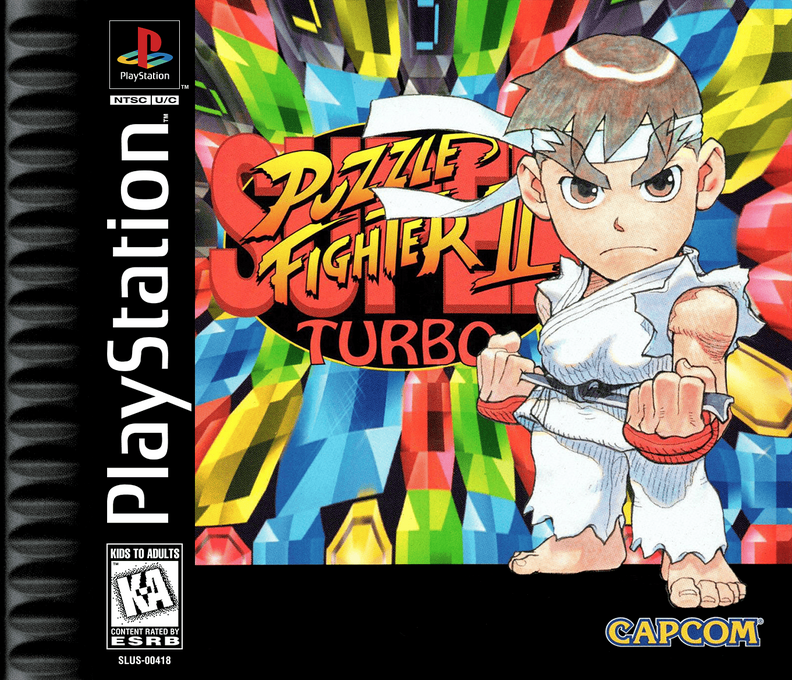
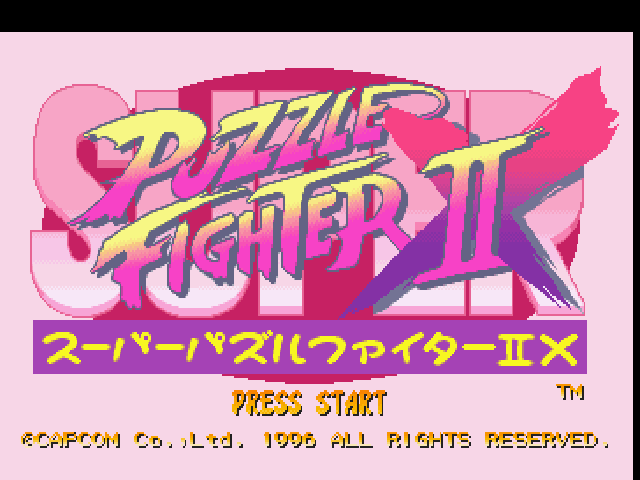
Super Puzzle Fighter II Turbo for PlayStation is Capcom's head-to-head falling-gem puzzle game, released in North America in late 1996 after its arcade debut earlier that year. Known in Japan as Super Puzzle Fighter II X, it turns the presentation of Capcom's fighting games into a colorful competitive puzzler rather than a one-on-one brawler. Super-deformed versions of Street Fighter and Darkstalkers characters frame every match, while the title, music, menus, and exaggerated attacks knowingly echo Super Street Fighter II Turbo and the Street Fighter Alpha era. Capcom developed and published the PlayStation version, which brought the arcade contest home for solo challenges and local two-player matches.
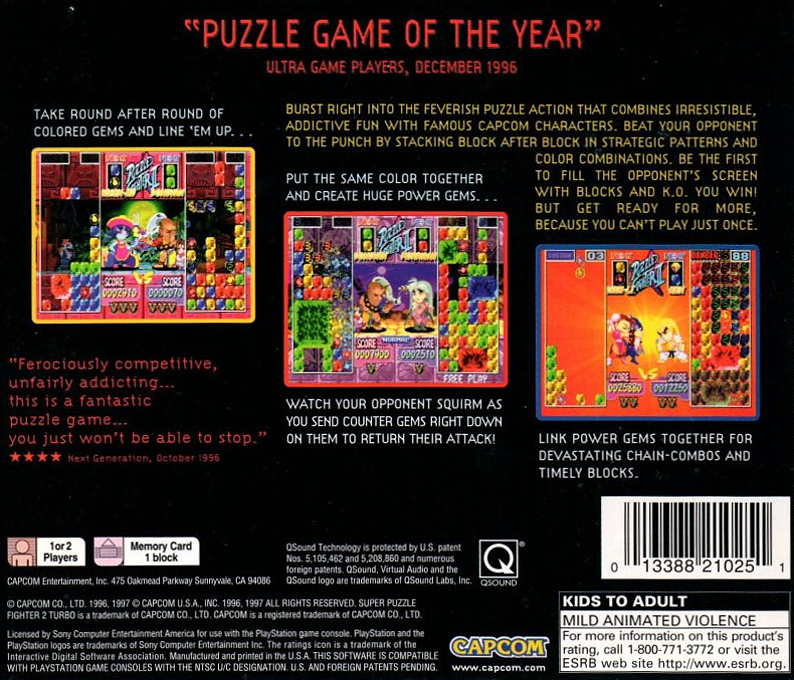
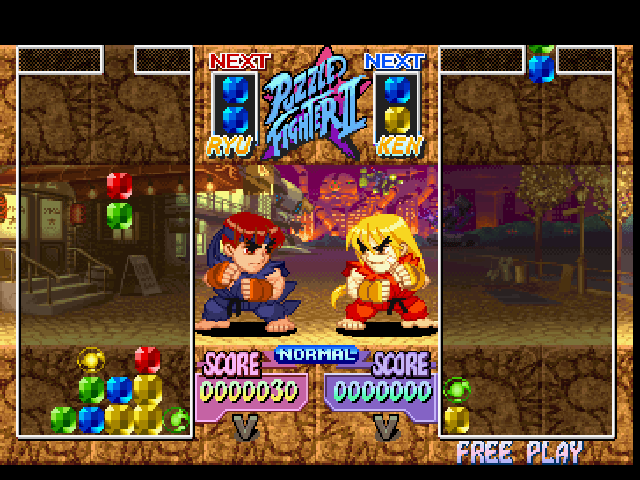
Each player manages a narrow vertical well as pairs of colored gems fall from above. The goal is not simply to clear pieces as quickly as possible: players build arrangements that can become increasingly destructive when the right trigger piece arrives. A Crash Gem removes touching gems of its own color, potentially starting a chain that clears further connected groups. Matching gems into a rectangle at least two blocks high and two blocks wide creates a large Power Gem, and breaking one as part of a chain can produce a far more substantial attack. A rare diamond clears every gem of the color it lands on, making its placement an important opportunity to reshape a crowded board or set off a prepared reaction.
Cleared gems become Counter Gems on the opposing field. These blocks carry a countdown before turning into ordinary gems, so an attack may create an immediate obstacle but can also leave material that the opponent can later exploit. Players can reduce or cancel incoming pressure by making chains of their own; a strong response can send the remaining attack back across the screen. This back-and-forth gives the game its fighting-game rhythm. Small clears can disrupt an opponent's construction, while a carefully timed Power Gem or long chain can bury them under a much larger delivery. A round ends when gems reach the top of the entry column, leaving no room for the next pair to fall.
The cast makes the competition feel like a Capcom crossover. Ryu, Ken, Chun-Li, Sakura, Morrigan, Donovan, Hsien-Ko, and Felicia appear in miniature form, with additional hidden fighters including Dan, Akuma, and Devilot. They do not use punches or special moves to alter the puzzle rules; instead, their comic on-screen actions visualize the scale of a successful attack. Each selectable character has a distinct Counter Gem drop pattern, however, so choosing a fighter affects the colors and shapes delivered to the other player's field. That detail adds matchup awareness to the basic gem mechanics and makes character selection more than a cosmetic decision.
On PlayStation, Super Puzzle Fighter II Turbo offers the immediate arcade-style contest alongside options suited to home play, including versus matches and single-player progression. Adjustable falling speed lets players decide whether to emphasize deliberate building or faster reactions, while the console release preserves the arcade game's bright art, character banter, and playful Capcom references. The game's rules are quick to understand but reward attention to the board's geometry: a simple-looking color grouping can become a valuable Power Gem, a helpful clear can expose a damaging counter, and an opponent's apparent advantage can be reversed by one well-placed Crash Gem.
Super Puzzle Fighter II Turbo occupies a distinctive place among 1990s Capcom games because it uses recognizable fighting-game personalities to sell a puzzle game built around direct competition. Its arcade original later reached several home formats, and Capcom has continued to include it in modern collections such as Capcom Fighting Collection. For PlayStation owners, this version remains a compact example of the era's local competitive design: two players share a familiar set of falling pieces, but every placement can be part of a larger plan to clear gems, counter an attack, and fill the other side of the screen first.
Gallery
Details
- Developer
- Capcom
- Publisher
- Capcom
- Genre
- Logic Puzzle
- Players
- 1-2
- Release Date
- November 30, 1996
- System
- PS1