About
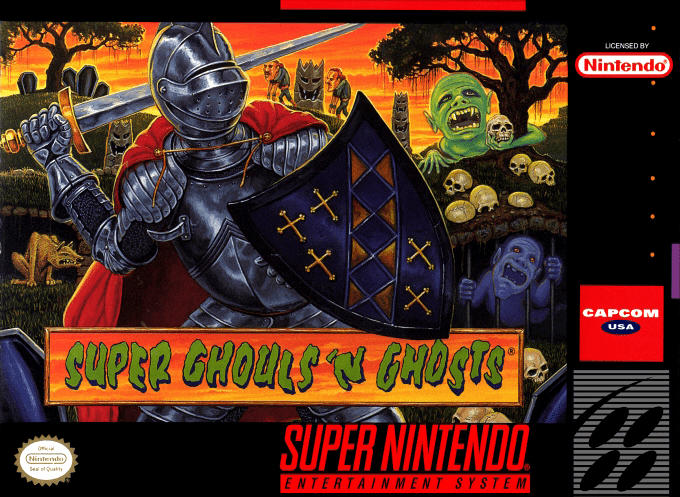
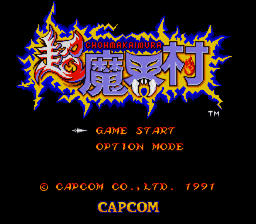
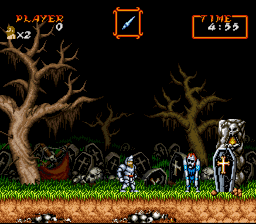
Super Ghouls 'n Ghosts is Capcom's 1991 Super NES action-platform game and the third main entry in the Ghosts 'n Goblins series. Known in Japan as Chō Makaimura, it puts the armored knight Arthur back on a desperate rescue mission after Emperor Sardius revives the Ghoul Realm, attacks the kingdom, and takes Princess Guinevere. It is a purpose-built 16-bit sequel rather than an arcade conversion, using the Super NES to deliver a darker fantasy world of animated graveyards, stormy seas, volcanic caverns, ice fields, and an enemy fortress packed with grotesque creatures.
The familiar series premise is only the start of a demanding journey. Arthur begins with his lance and steel armor, but a single hit strips him down to his underwear and a second hit costs a life. Enemies arrive from the ground, air, and scenery while stage hazards force quick, deliberate movement. The game is a side-scrolling platformer with combat at its center, yet survival depends at least as much on reading terrain, learning attack patterns, and making precise jumps as it does on defeating monsters.
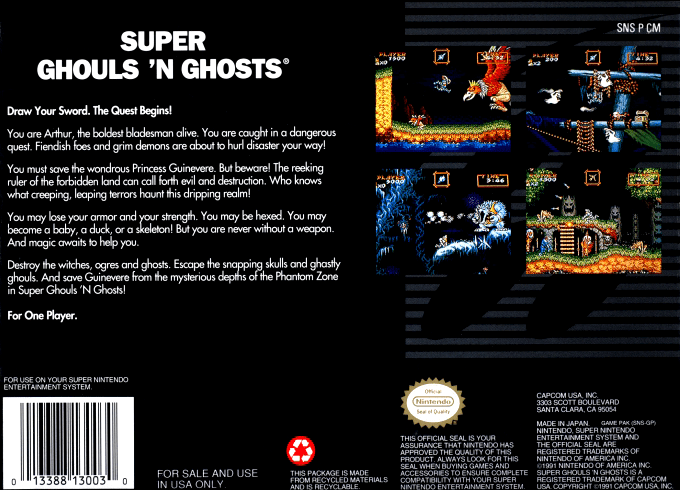
Its signature new movement ability is the double jump. Arthur can leap once and then jump again in midair, allowing him to clear gaps and alter direction after committing to a jump. That extra flexibility opens up more elaborate stage design, but the first leap still has fixed momentum, so every route requires forethought. Environmental dangers make the worlds feel active: rising waves can sweep Arthur away, snowfall obscures movement, caverns erupt with fire, and moving or rotating structures turn simple crossings into timing tests.
Weapons appear in treasure chests throughout the adventure, and each changes Arthur's attack range, speed, or trajectory. Knives travel quickly, axes arc through the air, and torches explode after landing, while other picks include lances, crossbows, and daggers. Only one weapon can be carried at a time, making pickups a strategic choice rather than a simple upgrade. Chests can also contain traps or a magician that temporarily transforms Arthur into a weaker form, preserving the series' talent for making useful-looking discoveries feel dangerous.
Armor deepens that risk-and-reward structure. Bronze armor gives Arthur stronger enchanted versions of the weapons he finds, while gold armor adds screen-filling magic and the Moon Shield, which can block a projectile when Arthur stands still. These powers are valuable against the game's large Foul Guardians, but they disappear when Arthur is hit. The result is a tense rhythm of recovering equipment, deciding when to press forward, and protecting a hard-earned advantage through hostile level sections.
Like earlier Ghosts 'n Goblins games, Super Ghouls 'n Ghosts asks players to prove their mastery twice. Completing the adventure once reveals that Arthur still needs the Goddess's Bracelet to defeat Sardius, sending him through the ordeal again to locate the required weapon. The structure is famously unforgiving, especially without modern save conveniences, but it gives the game a clear long-term goal and rewards players who gradually memorize each encounter, route, and weapon placement.
The project was led by Tatsuya Minami, managing a Capcom team for the first time after prior work that included Final Fight and Street Fighter II console projects. The development was reportedly difficult and underwent repeated work on its master ROM near the deadline, yet the finished game became one of the best-known Super NES action titles. Critics have frequently praised its imaginative enemies, detailed backgrounds, music, and variety of set pieces, while also noting the slowdown that can occur when the screen fills with sprites.
Super Ghouls 'n Ghosts remains a defining showcase for players who enjoy difficult retro platformers built around repetition and improvement. Its balance of gothic imagery, carefully placed threats, weapon experimentation, and uncompromising two-run challenge has kept Arthur's quest visible through later rereleases and Capcom compilations. Whether approached for its technical 16-bit presentation or its exacting gameplay, the Super NES original is a major chapter in Capcom's long-running Ghosts 'n Goblins lineage.
Gallery
Details
- Developer
- Capcom
- Publisher
- Capcom
- Genre
- Platformer
- Players
- 1
- Release Date
- November 1, 1991
- System
- SNES