About
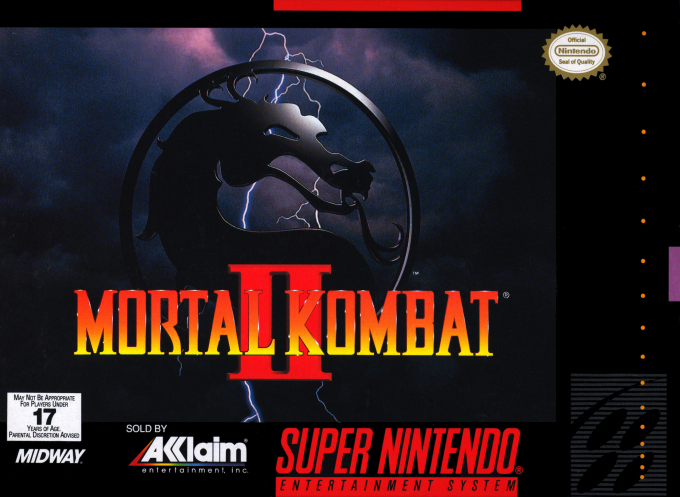
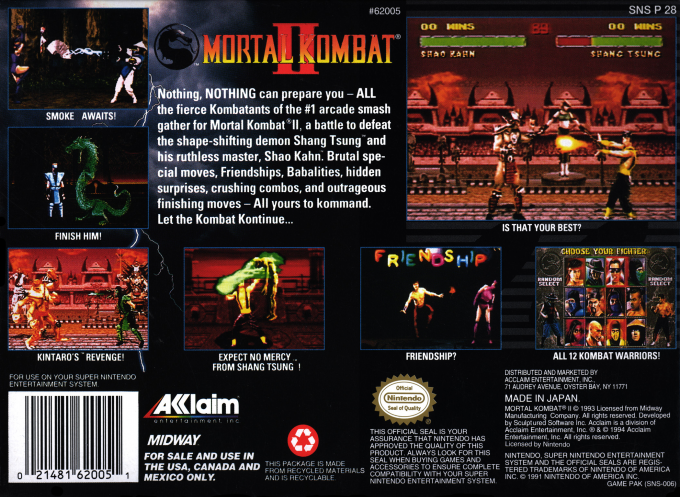
Mortal Kombat II brings Midway's 1993 arcade fighting game to the Super Nintendo Entertainment System in 1994. Sculptured Software developed this SNES conversion, and Acclaim published it. The story carries the Earthrealm warriors into Outworld after Shang Tsung persuades Shao Kahn to stage a new tournament on his own territory, where the emperor has every advantage.
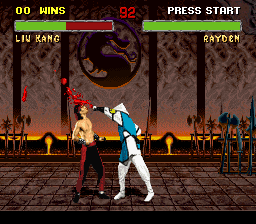
The game is a one-on-one fighter built around best-of-three-round matches. Each combatant has high and low punches and kicks, throws, sweeps, uppercuts, jumping attacks and blocking, while movement and a six-button Super NES controller layout support quick offensive exchanges. Reduced recovery after attacks and harder-hitting roundhouses make it easier to string ordinary strikes together than in the first Mortal Kombat.
Its 12 standard selectable fighters are Baraka, Jax, Johnny Cage, Kitana, Kung Lao, Liu Kang, Mileena, Raiden, Reptile, Scorpion, Shang Tsung and Sub-Zero. Returning fighters gained extra special techniques, and the newcomers establish distinct tools such as Kitana's fans, Kung Lao's hat attacks, Jax's energy projectile and Baraka's blade-based assaults. Shang Tsung can change into other fighters, making his place on the ladder especially unpredictable.
A solo game sends the chosen warrior through a sequence of opponents, then confronts Shang Tsung, Kintaro and finally Shao Kahn. Local two-player matches let two people select fighters and settle separate bouts, including mirror matches. The cartridge also offers configurable difficulty and credits, while hidden conditions can produce encounters with Jade, Smoke and Noob Saibot.
Outworld's arenas provide much of the game's mood: locations include the Dead Pool, the Pit II, the Kombat Tomb, the Living Forest, the Armory, the Wasteland and Kahn's Arena. Several stages contain their own lethal traps. At the appropriate distance and with the right input, a winner can send a defeated opponent into acid, off a precipice or onto spikes instead of ending with a character-specific move.
Victory after a normal match opens the familiar finishing window. Each fighter has multiple Fatalities, while the lighter alternatives include Babalities, which turn the loser into a baby, and Friendships, humorous non-lethal displays. These techniques require specific directional and button commands, so mastery extends beyond winning rounds to learning timing, position and individual move lists.
Unlike the first Super NES Mortal Kombat, this version includes red blood and the violent Fatalities without requiring an unlock code. It remains a 16-bit conversion rather than a perfect copy of the arcade hardware, but it preserves the full 12-character playable roster, major bosses, secret opponents and core arenas. The Japanese Super Famicom release is a separate censored regional version: its blood is green and character Fatalities shift the screen to black and white.
Digitized actor sprites, sinister stage backdrops and Dan Forden's arcade-style sound give the SNES port its theatrical look and sound. By combining a larger cast, faster combat, more special moves and a broad set of finishers with accessible home play, it expands substantially on the first game while keeping the tournament format at the center of every match.
Gallery
Details
- Developer
- Sculptured Software
- Publisher
- Acclaim
- Genre
- Fighting
- Players
- 1-2
- Release Date
- September 9, 1994
- System
- SNES