About
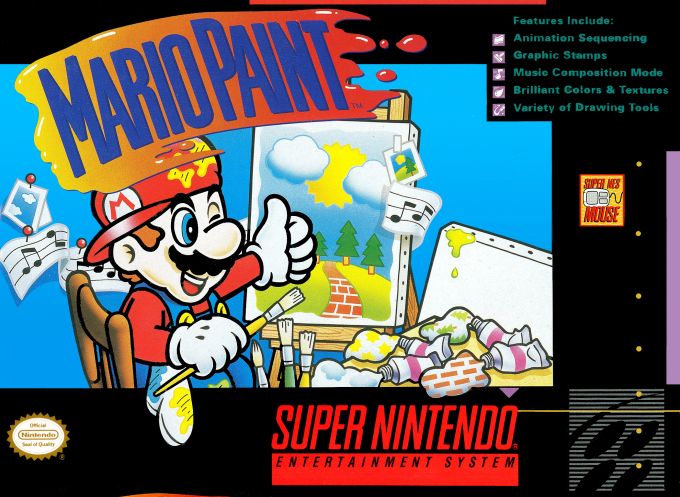
Mario Paint for the Super Nintendo Entertainment System is Nintendo's 1992 creative software package, developed by Nintendo R&D1 and Intelligent Systems and published by Nintendo. Built around the Super NES Mouse included with the original package, it turns a television screen into a playful Mario-themed workspace for drawing, animation, and music. Rather than following a conventional game campaign, Mario Paint invites one player at a time to make pictures and short creations with a collection of tools presented through an animated desktop-style interface.
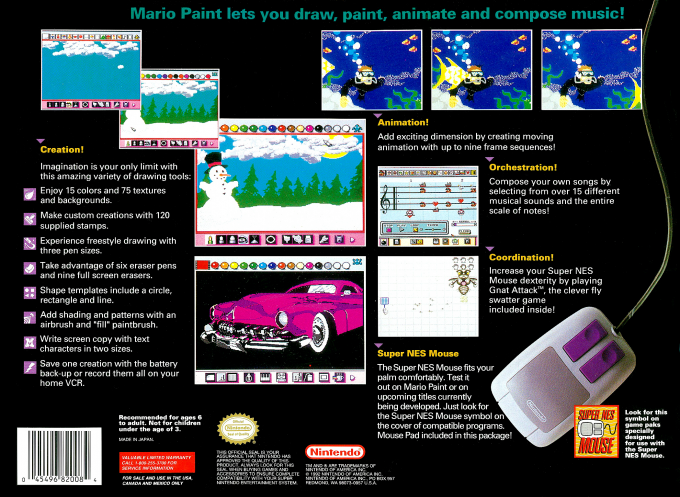
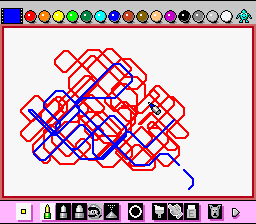
The Drawing Board is the program's central canvas. Using the mouse, players choose colors, patterned fills, brush sizes, an airbrush, lines, boxes, circles, erasers, and selection tools to build an image. The software also supports copying, moving, and flipping selected artwork, while its deliberately lively cursor and Mario-inspired visual touches make experimentation part of the experience. A coloring-book area supplies outline drawings to fill in, providing a more guided starting point for users who do not want to begin with a blank canvas.
Mario Paint also lets players personalize their work with stamps. Its included collection contains familiar Mario-style imagery and other pictures, and the stamp editor allows a user to design or alter small custom stamps on a grid. Those stamps can be placed into drawings or used while working on animation frames, giving a simple way to repeat characters, decorations, and effects. Text stamps include Latin letters as well as Japanese writing systems, reflecting the software's original Super Famicom roots and its broad range of creative uses.
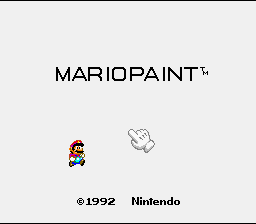
Animation Land expands the drawing tools into a compact frame-by-frame studio. Players can prepare short animations using sets of four, six, or nine frames, carry visual elements between frames, and combine moving art with a background. The mouse is fundamental throughout: it supplies the direct pointing and drawing control that a standard Super NES controller was not designed to provide. The title screen itself is interactive, with clickable details that help introduce the peripheral and reward curiosity with small audiovisual surprises.
The music composer offers another kind of canvas. Players arrange icon-based instrument and sound-effect notes on a staff to create melodies and simple multi-note passages, then use their pieces alongside the program's other creative modes. Its sounds include musical instruments and characterful effects such as animal noises, so compositions can range from straightforward tunes to playful sound experiments. The composer has clear limits on note selection and song length, but those boundaries are part of the challenge of arranging music within Mario Paint's accessible interface.
For a change of pace, Gnat Attack is a mouse-controlled action minigame in which the player swings a flyswatter at invading insects. It functions both as a standalone diversion and as a quick way to get comfortable aiming and clicking with the Super NES Mouse before returning to the creative tools. The contrast between this reflex-based challenge and the slower drawing, composing, and animating modes gives Mario Paint a distinctive identity among SNES releases.
Released during the Super Nintendo era, Mario Paint brought an art-and-music creation kit to a home console at a time when comparable computer tools were far less common in living rooms. Its colorful presentation draws on the world and sound palette associated with Super Mario World, but its focus is personal expression rather than platforming. The program later informed the lineage of Nintendo creative software, with Mario Artist: Paint Studio on 64DD often regarded as a follow-up in spirit. For players exploring the Super NES library, Mario Paint remains a notable example of Nintendo designing a game system around making as well as playing.
Gallery
Details
- Developer
- Nintendo
- Publisher
- Nintendo
- Genre
- Educational
- Players
- 1
- Release Date
- May 5, 1992
- System
- SNES