About
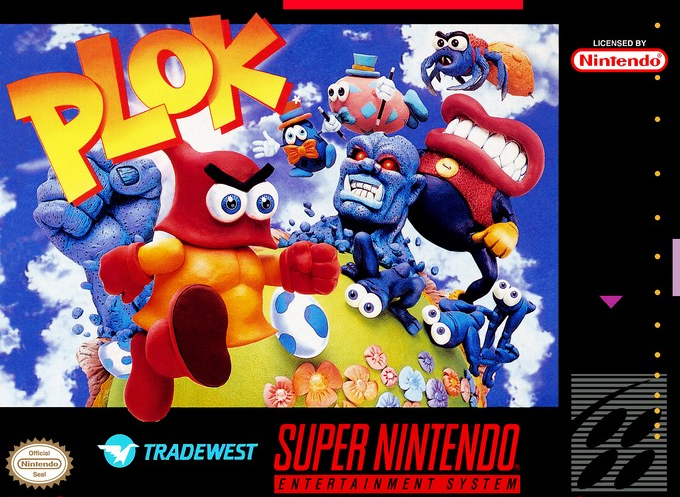
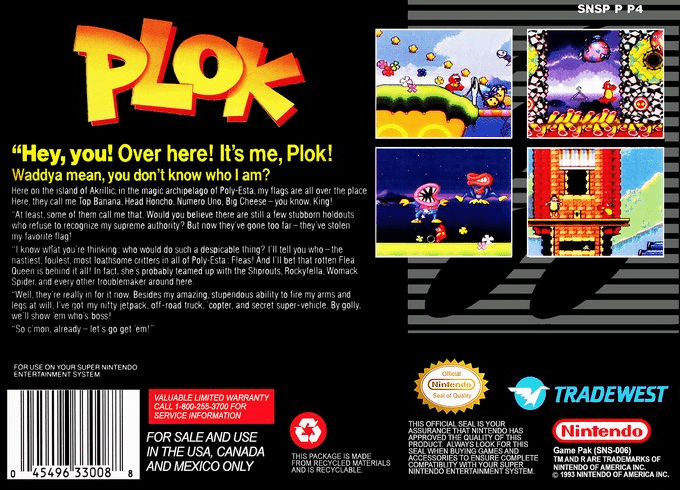
Plok for the Super Nintendo Entertainment System is a 1993 single-player platform game from Software Creations, created by John and Ste Pickford. It stars Plok, the self-styled ruler of Akrillic, one island in the fanciful Poly-Esta archipelago. The North American cartridge was published by Tradewest, while publishing differed by territory, including a Nintendo release in Europe and an Activision Japan release for Super Famicom. Its colorful 16-bit presentation frames a deliberately odd quest: Plok wakes to discover that his prized square flag has been stolen, then returns from the neighboring Cotton Island to find his home overrun by flag-planting fleas.
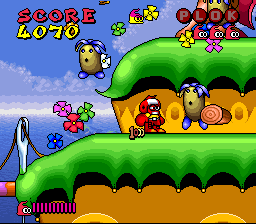
The adventure is built around side-scrolling stages in which Plok jumps between platforms, searches for routes forward, and clears the enemies required to restore each area. His movement includes a regular jump and a higher somersaulting jump, so judging height, momentum, slopes, and hazards is central to getting through the island. The game offers a full Normal mode and a more forgiving Child’s Play setting that trims difficult material and tones down enemy pressure, making the same core journey approachable in two different ways.
Plok’s defining attack is as unusual as his design. He can fire his oversized arms and legs as separate projectiles, then receive them back after a hit or a miss. This gives combat a different rhythm from a conventional stomp-based platformer: players must consider range and timing, and later sections turn detached limbs into tools for operating stage devices. Certain switches need a particular limb to be left behind, which can leave Plok hopping along with fewer body parts until he recovers them. The result is a platform game where the hero’s attack, animation, and puzzle-solving are all tied to the same simple idea.
Akrillic’s problem grows beyond the missing flag. Plok’s initial trip brings him into conflict with the Bobbins Brothers, and the broader campaign sends him across several distinct island areas as he eliminates the flea infestation and confronts larger opponents. Midway through the story, the game shifts into a sepia-styled chapter about Grandpappy Plok’s earlier search for an amulet. That detour supplies backstory as well as a change of setting, before the present-day quest resumes with a useful new ability for dealing with the fleas.
The stages continually add temporary variations through presents, the game’s power-up packages. Some outfit Plok for specialized attacks, while others put him in armed machines or altered forms, including a helicopter, tank, jetpack, and flying saucer. These sequences do more than change the visuals; they alter how players move and attack through their portion of a stage. Collectible shells, health-restoring fruit, bonus areas, and P-L-O-K letters that contribute to earned continues add further reasons to explore, although progress still demands careful play through long and increasingly elaborate levels.
Plok began life before the SNES release as Fleapit, an unfinished arcade-oriented project the Pickford brothers developed while at Zippo Games. The concept survived that project’s cancellation and was reworked at Software Creations for Nintendo’s 16-bit hardware, with John Buckley programming and Lyndon Brooke contributing to the game’s visual design. Tim and Geoff Follin composed its striking score, an element that has remained closely associated with the game in later retrospectives. The finished release combines that strong audio identity with dense cartoon scenery, exaggerated animation, and a succession of mechanics that make individual areas feel different from the last.
For players exploring the SNES platform library, Plok remains a distinctive early-1990s mascot game because its central gimmick is woven into nearly every part of play. The detachable-limb attack makes ordinary encounters, switches, and recoveries feel unlike those in most contemporaries, while the world of flags, fleas, bizarre bosses, and vehicle gifts gives the journey its own personality. It is a self-contained Super Nintendo adventure, rather than a port or compilation entry, and its regional releases preserve the same eccentric platform quest under the titles Plok and Plok!.
Gallery
Details
- Developer
- Software Creations
- Publisher
- Nintendo
- Genre
- Platformer
- Players
- 1
- Release Date
- September 1, 1993
- System
- SNES