About
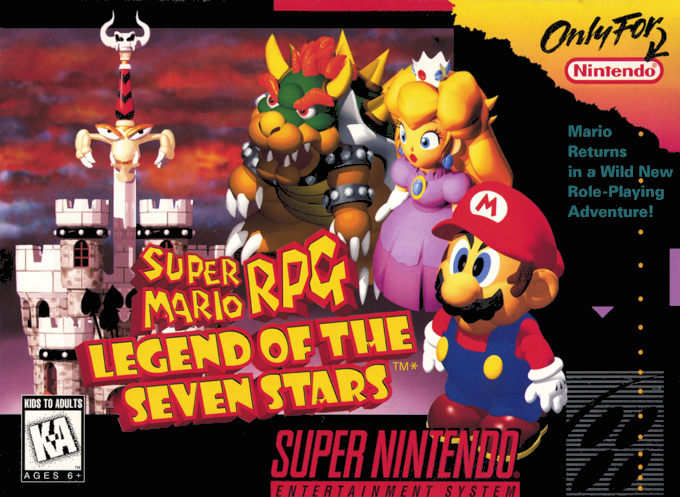
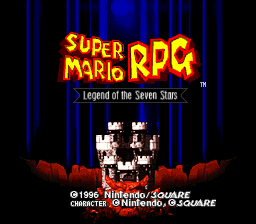
Super Mario RPG: Legend of the Seven Stars is a 1996 role-playing game for the Super Nintendo Entertainment System, developed by Square and published by Nintendo. It arrived in North America on May 13, 1996, near the end of the SNES era, and represents an unusual collaboration between Nintendo’s Mario creators and the studio then known for Final Fantasy. Rather than treating Mario as a guest in a conventional fantasy RPG, the game builds its adventure around Mushroom Kingdom characters, playful visual gags, and the physical movement associated with Mario games. It was the final Mario game released for the SNES and the first role-playing game in the Mario franchise.
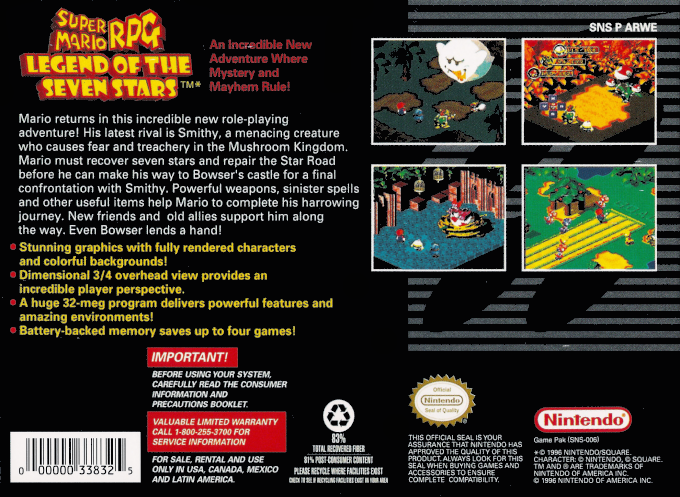
The story begins with a familiar rescue attempt at Bowser’s Castle, but the opening is abruptly derailed when Exor, a gigantic living sword, crashes down from the sky. The impact shatters Star Road, the route through which wishes are granted, and scatters seven Star Pieces across the world. Mario’s mission becomes a journey to recover those pieces and stop the Smithy Gang, an invading force led by the robotic blacksmith Smithy. The premise lets Mario, Princess Toadstool, and Bowser occupy unexpected roles: Bowser loses his castle and eventually joins Mario’s side, while the usual rescue setup gives way to a broader quest.
Mario travels through a connected, isometric world whose towns and regions have distinct inhabitants and tones. Mushroom Kingdom, Moleville, Rose Town, Yo’ster Isle, Monstro Town, Nimbus Land, and Bowser’s Castle all support the progression toward Smithy’s factory beyond Exor. The party includes Mallow, a gentle boy raised as a tadpole who learns he belongs to Nimbus Land, and Geno, a wooden doll animated by a spirit from Star Road. Their additions gave the game characters created specifically for this adventure alongside familiar faces, while each companion also brings a different combat role to the group.
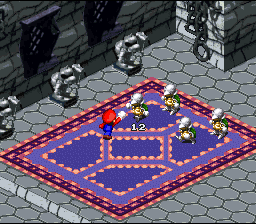
Exploration combines role-playing structure with platforming-style movement. Mario can run and jump through three-quarter-view areas, strike question blocks, find hidden routes, and avoid many encounters because enemies are shown directly on the field instead of appearing randomly. Touching an enemy starts a battle. This design keeps ordinary movement active between fights and makes the overworld feel closer to a Mario adventure than to a menu-driven dungeon crawl. The pre-rendered sprites and isometric presentation were especially striking on 16-bit hardware, helping convey depth in environments, characters, and cinematic moments.
Battles are turn-based, with Mario and up to two selected companions active at once from a five-character party. Players choose attacks, special techniques, items, defense, or retreat options, but the system adds Action Commands: well-timed button presses can strengthen an attack, improve an ability, or reduce damage from an enemy hit. Victories award experience, and level-ups let the party improve attributes such as health and Flower Points, the shared resource used for special moves. Equipment, consumable items, minigames, puzzles, and side activities add variety around the central battles without losing the game’s brisk, approachable tone.
The original game was directed by Chihiro Fujioka and Yoshihiko Maekawa, produced by Shigeru Miyamoto, and scored by Yoko Shimomura. Its battle structure drew on Square’s RPG experience, but its developers deliberately emphasized jumping, dashing, and Mario’s physical presence rather than simply placing Mario characters into a standard RPG framework. The soundtrack combines Shimomura’s compositions with arrangements of Mario music by Koji Kondo, and it also includes music by Nobuo Uematsu. The SNES cartridge used Nintendo’s SA-1 enhancement chip, which supported the game’s technical ambitions with extra processing and memory-management capabilities.
Super Mario RPG: Legend of the Seven Stars later returned through Wii and Wii U Virtual Console releases and as part of the Super NES Classic Edition. It also influenced the Mario role-playing tradition that continued through Paper Mario and Mario & Luigi, particularly in its use of timed battle inputs and Flower Points. This SNES record should not be confused with Super Mario RPG for Nintendo Switch, a separate 2023 remake developed by ArtePiazza. The remake retains the core quest and characters while adding full 3D graphics, revised features, and new battle options; it is not the 1996 Square-developed SNES game described here.
Gallery
Details
- Developer
- Square
- Publisher
- Nintendo
- Genre
- JRPG
- Players
- 1
- Release Date
- May 13, 1996
- System
- SNES
/Wizardry_I-II-III_Story_of_Llylgamyn.png)