About
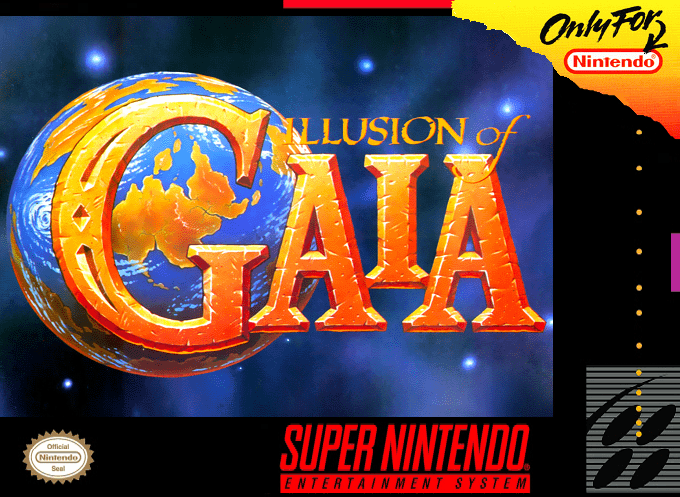
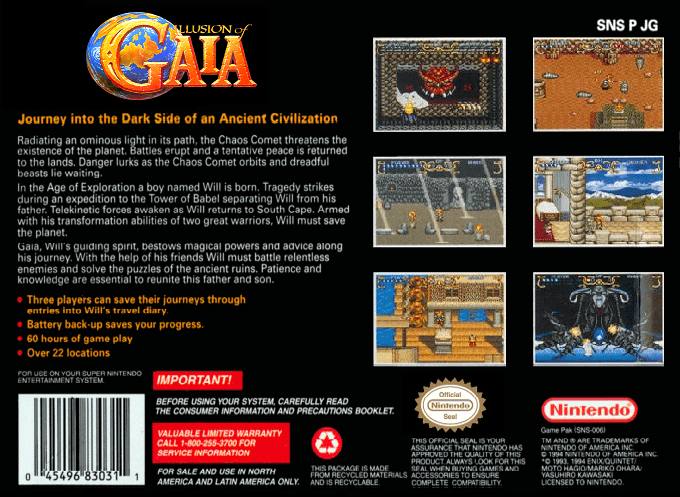
Illusion of Gaia for the Super Nintendo Entertainment System is a single-player action role-playing adventure developed by Quintet. Originally released in Japan as Gaia Gensouki by Enix in 1993, it reached North America as Illusion of Gaia through Nintendo in 1994. Known as Illusion of Time in PAL territories, the game follows a young explorer named Will through a fantastical version of Earth during an age of exploration, where ancient ruins and the returning Chaos Comet point to a danger far larger than one missing expedition.
Will comes home to South Cape as the only survivor of a journey to the Tower of Babel led by his father, Olman, but he cannot remember what happened there. His unexplained telekinetic ability becomes the first clue that his life has changed. Guided by Gaia and joined by friends including Princess Kara, Will leaves home to investigate the comet's influence, search for answers about his father, and gather the Mystic Statues needed to confront the threat. The route carries the party across places inspired by the Incan ruins, Nazca Plain, the Great Wall of China, Angkor Wat, and the pyramids, combining recognizable landmarks with a deliberately fantastical setting.
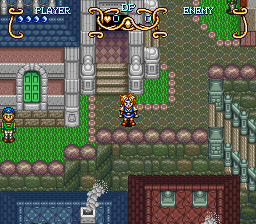
Exploration in Illusion of Gaia takes place in towns, story scenes, ruins, and combat-focused areas rather than a freely revisitable world. Will attacks at close range with his flute, can perform a stronger forward attack, and uses the instrument for defensive moves and certain environmental interactions. Puzzles ask players to examine rooms, move objects with telekinesis, find keys, and use learned melodies at the right locations. Conversations and item discoveries advance the journey, while Dark Spaces serve as places to save, recover health, receive guidance, and use the transformations that are central to the game.
Will can change into Freedan, a dark knight with a sword and a longer melee reach, and later Shadow, an energy-based form with its own attacks and traversal abilities. Choosing the right form is essential because some obstacles and passages can only be handled by a particular character. Instead of conventional experience points, clearing every enemy in a combat room awards a permanent increase to attack, defense, or health. Enemies may leave Dark Gems that contribute toward extra chances to continue in the same area, while limited Herbs provide healing. The result is an action RPG built around room-by-room encounters, form-specific problem solving, and steady character growth.
The Super NES release also encourages thorough exploration through its Red Jewels, which can be handed to Gem the Jeweler for rewards; finding all 50 unlocks additional content. The North American version represented one regional edition of a game that changed names overseas, while some localization details and content differed among releases. Illusion of Gaia is often grouped informally with Quintet's Soul Blazer and Terranigma because of the developer, platform, and broad themes, but it stands on its own as a focused adventure about lost history, changing identities, and a global journey through imagined ancient worlds.
Gallery
Details
- Developer
- Quintet
- Publisher
- Enix
- Genre
- JRPG
- Players
- 1
- Release Date
- September 1, 1994
- System
- SNES