About
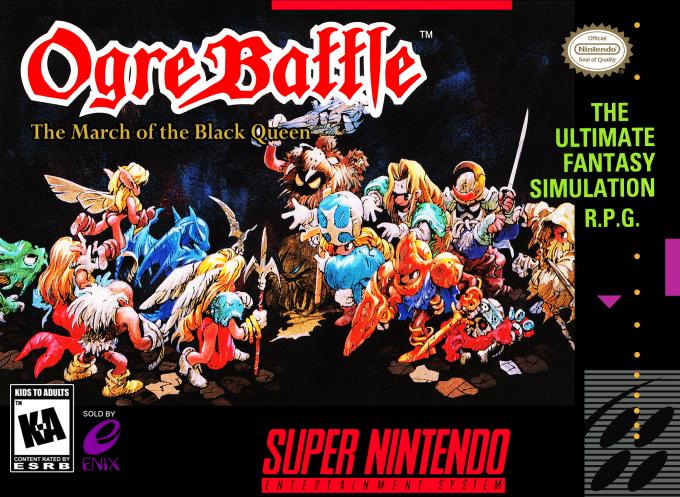
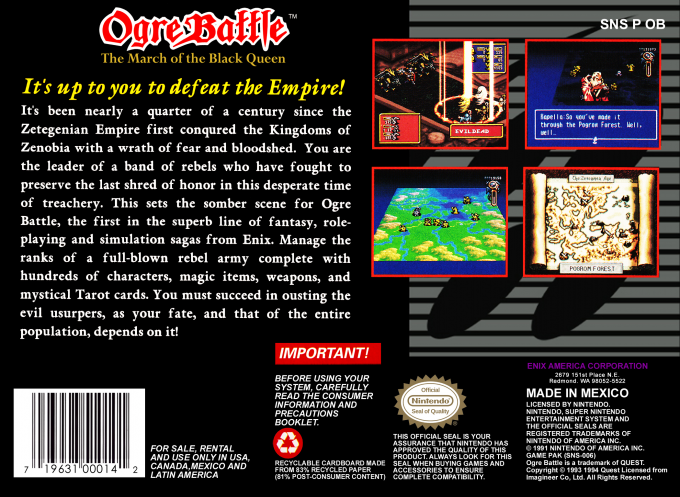
Ogre Battle: The March of the Black Queen for Super NES is Quest’s hybrid tactical role-playing game, originally released in Japan in 1993 as Densetsu no Ogre Battle and published in North America by Enix America in May 1995. Directed and planned by Yasumi Matsuno, it opened the Ogre Battle series with a distinctive blend of real-time map movement, party management, and automated tactical clashes. Its title combines two Queen song names, while its fantasy campaign places a player-created revolutionary leader at the head of the Liberation Army.
The story begins in the lands of the Zeteginean Empire, whose rule has become oppressive under Empress Endora and the dark magician Rashidi. Before the campaign, the seer Warren uses a series of tarot questions to shape the leader’s initial abilities and forces. From there, the army travels across a continent of occupied towns, temples, forts, and hidden locations, gathering allies and pursuing the empire’s leaders. The protagonist’s name and gender are chosen by the player, so the campaign’s central commander is not a fixed character.
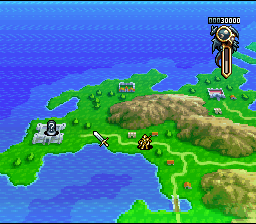
Each scenario is played on an overhead field where time passes and units move continuously. Players assemble squads of up to five fighters, though large creatures such as dragons and griffins occupy extra space, then deploy them from their base to claim settlements and confront enemy groups. Liberated towns can provide money, information, shops, or tarot cards; keeping them safe matters because opposing forces can recapture them. Defeating a stage’s boss completes its central objective, but optional discoveries and route choices make exploration an important part of the Super NES game.
When opposing squads meet, Ogre Battle switches to a close battle view. Rather than selecting every strike, the player assigns a general tactic such as targeting the strongest enemy, the weakest enemy, or the opposing leader. A round of attacks resolves according to the characters’ classes, positions, and abilities, and the side that inflicts more damage drives the other back. Stored tarot cards offer additional one-use effects in battle or on the field. The result is a game about planning formations, travel routes, and reinforcements as much as reacting to individual encounters.
Character development is built around experience, equipment, and extensive class-change paths. Human fighters and amazons can advance into different roles, while the roster also includes magical, flying, beast, undead, and other fantastical units. Class affects attacks, movement over terrain, and day-and-night performance. Some promotions require more than a level threshold, asking for particular alignment, charisma, or items, which makes the composition of each squad a long-term strategic decision rather than a simple matter of raising numbers.
A central feature of Ogre Battle: The March of the Black Queen is its morality and reputation system. Individual characters have alignment values, and the army’s reputation responds to actions such as who liberates towns, how long settlements remain protected, and decisions made during the campaign. High- and low-alignment troops each have practical strengths, so the system influences strategy as well as story. Recruitment opportunities and the finale can change with the player’s conduct, and the game offers multiple endings. Quest later followed it with Tactics Ogre on Super Famicom, while the original itself later received PlayStation, Sega Saturn, mobile, and Virtual Console releases; this description concerns the foundational Super NES version.
Gallery
Details
- Developer
- Quest
- Publisher
- Enix
- Genre
- Tactical RPG
- Players
- 1
- Release Date
- May 1, 1995
- System
- SNES