About
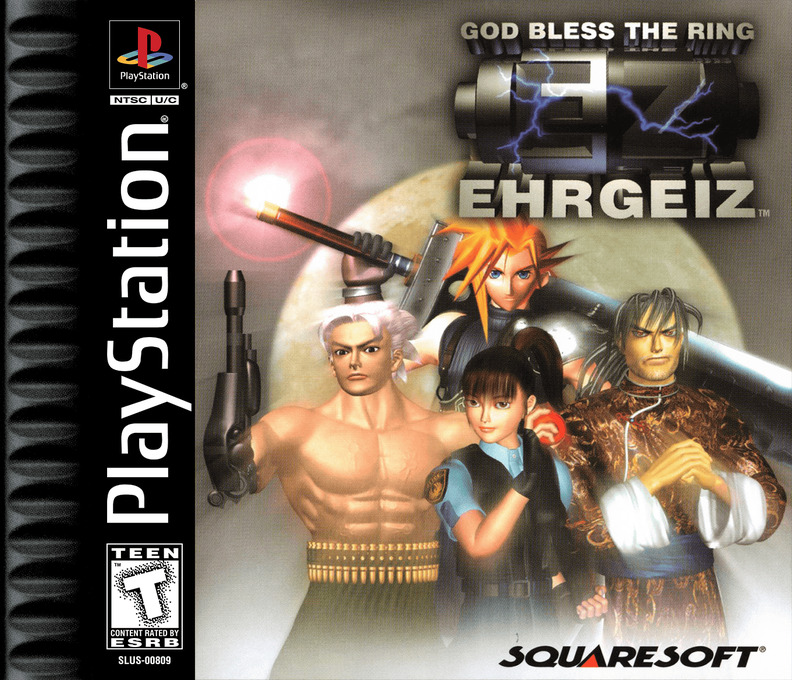
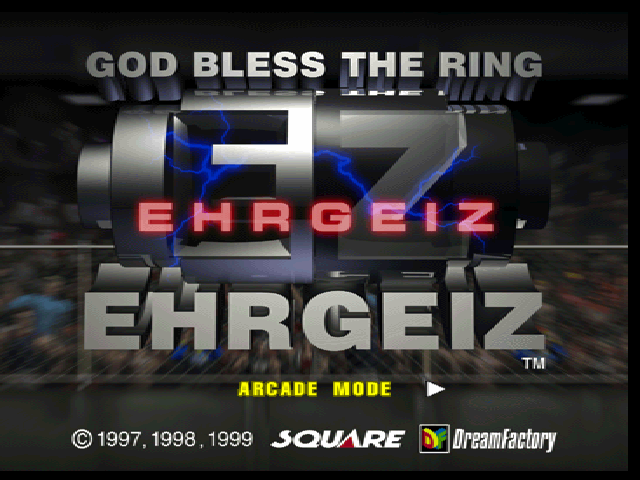
Ehrgeiz: God Bless the Ring for PlayStation is a 3D fighting game developed by DreamFactory and published internationally by Squaresoft. Released for Sony's console after the 1998 Namco arcade original, this version turns the contest for a mysterious ancient weapon into a home release with a significantly expanded character selection and a collection of modes beyond the one-on-one bouts. Director and designer Seiichi Ishii brought his experience in arena fighters to a game whose title comes from the German word for ambition.
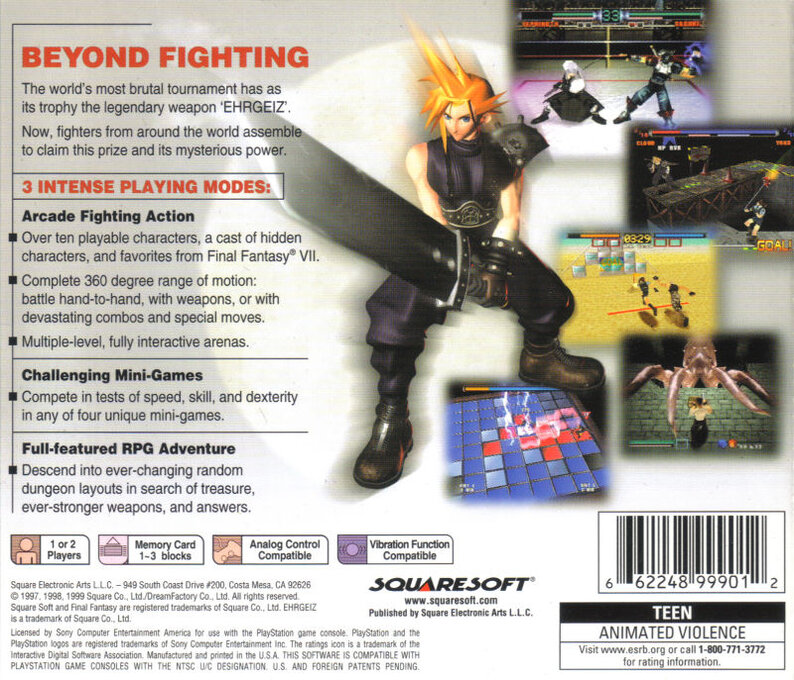
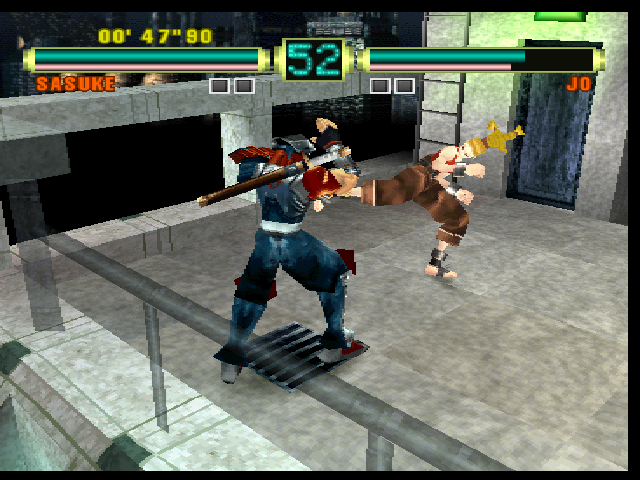
The central Ehrgeiz mode pits combatants against one another in fully three-dimensional arenas. Rather than being locked to a side-on plane, fighters can circle the stage, run around opponents, leap, guard, strike high or low, and use a character-specific special attack. Crates and other objects can be picked up or used in the action, while changes in height make positioning part of every match. The PlayStation manual also supports custom button layouts and the DualShock controller, and offers arcade-style and PlayStation-oriented control schemes.
Its fictional roster brings together martial artists, wrestlers, mercenaries, archaeologists and other fighters drawn to the tournament and the secret of the weapon called Ehrgeiz. Familiar faces include Ken Godhand Mishima, Yoko Yoyo Kishibojin, Sasuke, Clair Andrews, Koji Masuda, Dasher Inoba and the unlockable Django. The story connects the tournament prize to ancient ruins and a possible route to immortality, giving the cast individual reasons to pursue the artifact while keeping the fighting game’s focus on match play.
The PlayStation release is especially associated with its Final Fantasy VII guests. Cloud Strife, Tifa Lockhart and Sephiroth are available in this version, and Vincent Valentine, Yuffie Kisaragi and Zack Fair can be unlocked. Cloud and Tifa had appeared in the arcade game, while the console port enlarged the crossover component with the additional Final Fantasy VII fighters. Their inclusion reflects Square’s involvement in the project, and character supervisor Tetsuya Nomura is credited alongside the Square and DreamFactory teams.
PlayStation Ehrgeiz also adds Brand New Quest: The Forsaken Dungeon, an action role-playing mode separate from the tournament. Players guide Clair or Koji through dungeon floors, fighting monsters with equipped weapons, using items, guarding, jumping and casting magic with Materia. The dungeon expedition incorporates experience, equipment condition, money, a village with services, and food-based health management. Normal Quest permits the two characters to be used in turn, while Hard Mode removes the ability to return to the village, making preparation and survival more important.
Additional PlayStation options include minigames alongside the main fighter and Quest Mode, helping make Ehrgeiz: God Bless the Ring a broader package than the arcade release. The combination of free-roaming 3D combat, environmental interaction, Final Fantasy VII guests and a standalone dungeon adventure gives the PS1 game a distinctive place among late-1990s console fighters. It remains a notable collaboration between DreamFactory and Square, built around an arcade fighting foundation but reshaped for a home system with extra characters and modes.
Gallery
Details
- Developer
- Dreamfactory
- Publisher
- Squaresoft
- Genre
- Fighting
- Players
- 1-2
- Release Date
- January 5, 1999
- System
- PS1